

On this page
NCERT's Class 11 chapter on redox reactions has an exercise that catches students out once they reach electrochemistry. It gives the reaction XeO₆⁴⁻ + 2F⁻ + 6H⁺ → XeO₃ + F₂ + 3H₂O, asks why it occurs, and asks what it tells you about sodium perxenate, Na₄XeO₆. The expected answer is short. But check it against standard electrode potentials, including the fluorine value in NCERT's own Class 12 table, and the numbers point the other way. This post gives you both: the answer to write in your board exam, and the E° check that explains what is really going on.
What does the NCERT perxenate question ask?
The equation is XeO₆⁴⁻ + 2F⁻ + 6H⁺ → XeO₃ + F₂ + 3H₂O. First check that it balances:
Xe: 1 on each side.
O: 6 on the left; 3 + 3 = 6 on the right.
H: 6 on the left; 3 × 2 = 6 on the right.
F: 2 on each side.
Charge: −4 − 2 + 6 = 0 on the left; 0 on the right.
So the equation is balanced. The question then asks two things: why the reaction occurs, and what you can conclude about Na₄XeO₆, the salt that contains the perxenate ion.
What is the expected board answer?
Work out the oxidation numbers.
Xe in XeO₆⁴⁻: x + 6(−2) = −4, so x = +8.
Xe in XeO₃: x + 3(−2) = 0, so x = +6.
F goes from −1 in F⁻ to 0 in F₂.
Xenon gains two electrons and is reduced. Each fluoride loses one electron, two in all, and is oxidised. So perxenate is the oxidising agent. The answer NCERT expects is: the reaction occurs because XeO₆⁴⁻ oxidises F⁻ to F₂, so Na₄XeO₆ is a stronger oxidising agent than F₂.
Learn it as it stands. The oxidation-number reasoning in it is correct.
Do the standard electrode potentials agree?
Oxidation numbers tell you who is oxidised and who is reduced if the reaction goes. They do not tell you whether it goes. That is the job of E°, as our guide to using the electrochemical series to predict redox reactions explains.
First, get the species right. The XeO₆⁴⁻ ion exists only in strongly alkaline solution. In acid it picks up protons and is present as H₄XeO₆ and H₃XeO₆⁻. Adding 4H⁺ to XeO₆⁴⁻ gives H₄XeO₆, so the NCERT equation can be rewritten as H₄XeO₆ + 2F⁻ + 2H⁺ → XeO₃ + F₂ + 3H₂O. The atoms and charges still balance.
Now the two half-reactions, both written as reductions:
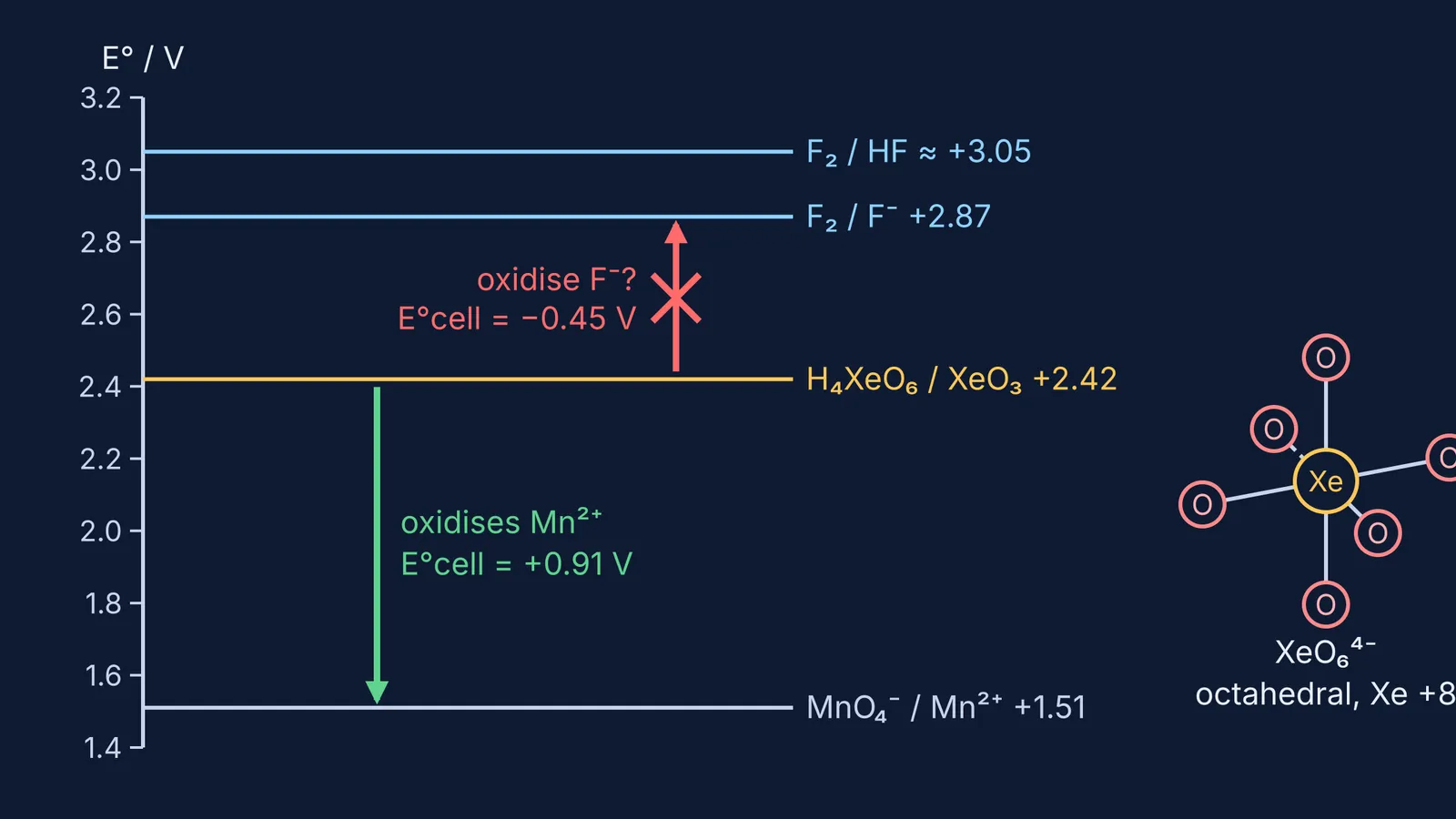
F₂ + 2e⁻ → 2F⁻, E° = +2.87 V. This is the value at the top of the electrochemical series table in NCERT's Class 12 Electrochemistry chapter.
H₄XeO₆ + 2H⁺ + 2e⁻ → XeO₃ + 3H₂O, E° ≈ +2.42 V. This value is from the standard electrode potential data page on Wikipedia), which compiles standard reference tables. Xenon couples are measured far less often than common ones, so treat it as approximate.
Fluorine sits about 0.45 V above perxenate. A couple higher in the series oxidises the reduced form of a couple below it, not the other way round. So on these numbers, F₂ should oxidise XeO₃, and perxenate should not oxidise F⁻.
Worked example: E°cell, ΔG° and K for perxenate and fluoride
Cathode (reduction): H₄XeO₆ is reduced to XeO₃, E°cathode = +2.42 V.
Anode (oxidation): 2F⁻ is oxidised to F₂, so E°anode = E°(F₂/F⁻) = +2.87 V.
Cell potential: E°cell = E°cathode − E°anode = 2.42 − 2.87 = −0.45 V.
Gibbs energy: two electrons move, so n = 2. ΔG° = −nFE°cell = −2 × 96485 × (−0.45) J mol⁻¹ = +86 800 J mol⁻¹, about +87 kJ mol⁻¹.
Equilibrium constant: log K = nE°cell / 0.059 = 2 × (−0.45) / 0.059 ≈ −15.3. So K ≈ 6 × 10⁻¹⁶, roughly 10⁻¹⁵.
A negative E°cell, a positive ΔG° and a K of about 10⁻¹⁵ all say the same thing. Under standard conditions, the reaction as written runs backwards. The link between them is worked through in from cell EMF to ΔG° and K.
Does the acid make it better or worse?
Worse. HF is a weak acid (pKa ≈ 3.2), so in acid almost all the fluoride is present as HF, not F⁻. The relevant couple is then F₂ + 2H⁺ + 2e⁻ → 2HF, with E° ≈ +3.05 V on the same data page. E°cell becomes 2.42 − 3.05 = −0.63 V, and log K ≈ −21. The gap grows.
Could concentrations rescue it?
Not in any ordinary solution. For the reaction to go forward, the reaction quotient Q would have to fall below K, which is around 10⁻¹⁵. No realistic choice of concentrations gets there. If you want practice turning E°cell into K and Q, the Fermi Problem Library has a step-by-step solver that explains the reasoning at each stage.
So is perxenate a weak oxidising agent?
No. At about +2.42 V, perxenate is among the strongest oxidising agents that work in water. It sits well above permanganate, MnO₄⁻/Mn²⁺ at +1.51 V. It oxidises Mn²⁺ to purple MnO₄⁻ quickly in acid. Using the same couple:
5H₄XeO₆ + 2Mn²⁺ → 5XeO₃ + 2MnO₄⁻ + 6H⁺ + 7H₂O
Check it: Xe 5 and 5; Mn 2 and 2; O 30 and 15 + 8 + 7 = 30; H 20 and 6 + 14 = 20; charge +4 and −2 + 6 = +4. Electrons gained by xenon are 5 × 2 = 10, and electrons lost by manganese are 2 × 5 = 10. Here E°cell = 2.42 − 1.51 = +0.91 V, so this reaction is strongly favoured.
The fair conclusion is that perxenate is a very strong oxidising agent, but fluorine is stronger still. That fits the rest of the syllabus, where F₂ is the strongest common oxidising agent. For more on the xenon side, see xenon fluorides: structures, shapes and reactions.
Why does oxidation-number reasoning mislead here?
Any balanced redox equation can be reversed, and the reverse is just as balanced. Try it:
XeO₃ + F₂ + 3H₂O → XeO₆⁴⁻ + 2F⁻ + 6H⁺
Now F₂ is the oxidising agent and xenon goes from +6 to +8. The bookkeeping looks just as tidy. Oxidation numbers cannot choose between the two directions. Only E°, or ΔG°, can. The NCERT question assumes the forward direction and asks you to explain it, so its conclusion rests on that assumption.
A useful habit for JEE: when a question says a reaction "occurs", check whether the E° data back that up. Sometimes a reaction with an unfavourable E° does go because a product precipitates or escapes, but nothing like that applies here.
Quick checklist
Xenon goes from +8 in XeO₆⁴⁻ to +6 in XeO₃; fluoride goes from −1 to 0.
Board answer: Na₄XeO₆ is a stronger oxidising agent than F₂, as NCERT expects.
E° check: +2.42 V for perxenate vs +2.87 V for F₂/F⁻, so E°cell ≈ −0.45 V, ΔG° ≈ +87 kJ mol⁻¹, K ≈ 10⁻¹⁵.
In acid the species are H₄XeO₆ and HF, and the gap grows to about −0.63 V.
Perxenate still oxidises Mn²⁺ to MnO₄⁻, with E°cell ≈ +0.91 V.
Oxidation numbers name the roles; E° decides the direction.


