

On this page
If you prepare for olympiad inequalities, you will meet problems where every term looks alike: x²y + x²z + y²x + ..., set against 6xyz. Muirhead's inequality settles a whole family of these in one line, once you can read the exponents. R. F. Muirhead set out the method in a 1902 paper in the Proceedings of the Edinburgh Mathematical Society, whose abstract describes taking a symmetric function as a sum over every permutation of the letters and writing the excess of the greater side over the lesser "in an explicitly positive form".
What is a symmetric sum?
Take an exponent vector, say (2, 1, 0), and three variables x, y, z. The symmetric sum writes x²y¹z⁰ under every permutation of the variables, so with three variables it has 3! = 6 terms, as the Wikipedia article on Muirhead's inequality describes. For (2, 1, 0) that gives x²y + x²z + y²x + y²z + z²x + z²y.
For (1, 1, 1) every permutation gives the same monomial, so the symmetric sum is 6xyz, not xyz.
The symmetric mean, written [a], is the symmetric sum divided by n!.
What does it mean for one vector to majorize another?
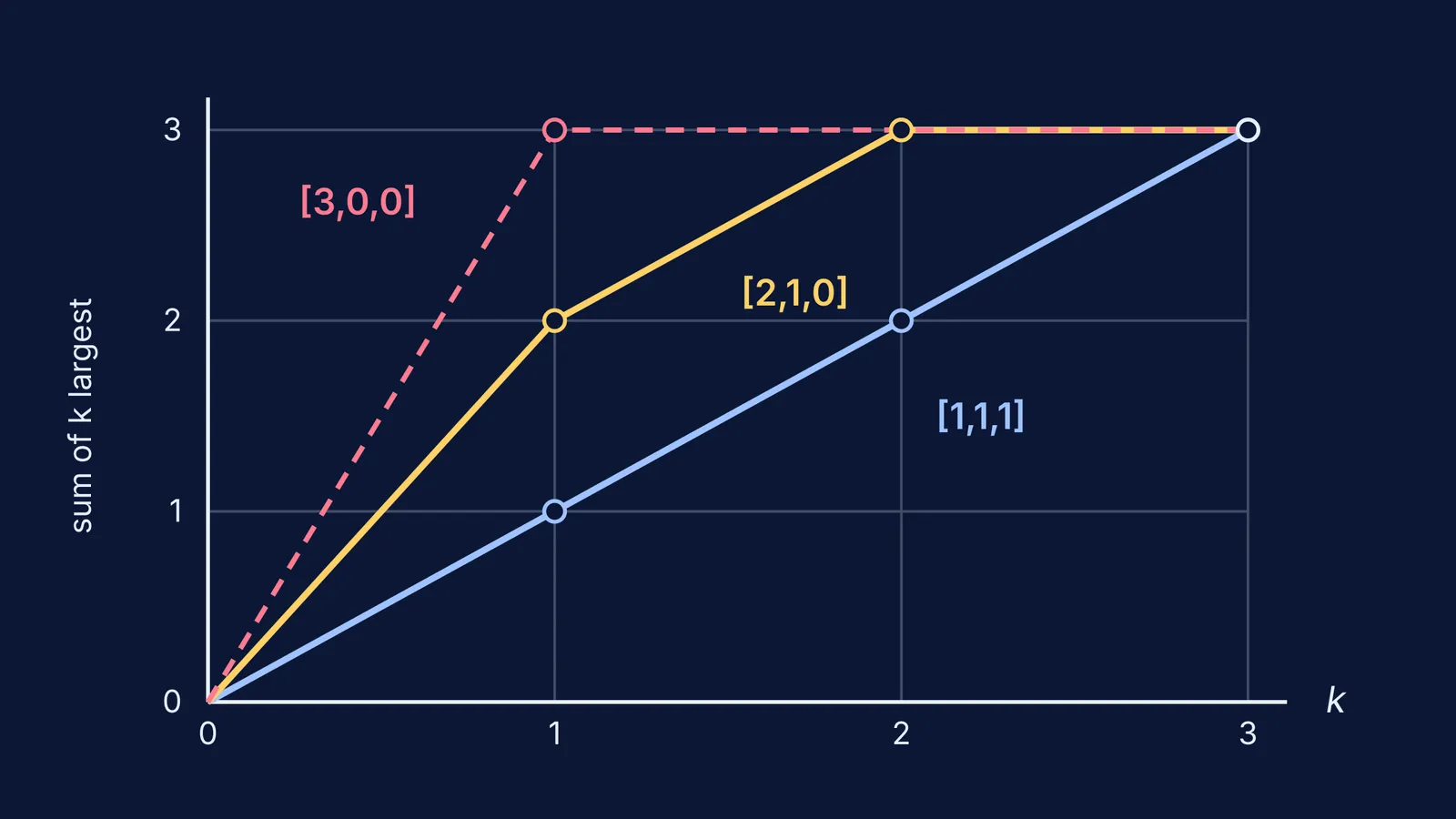
Sort both vectors in decreasing order. Vector a majorizes vector b when the sum of the largest k entries of a is at least that of b for every k, and the two full totals are equal (Wikipedia).
Check (2, 1, 0) against (1, 1, 1):
k = 1: 2 is at least 1.
k = 2: 2 + 1 = 3 is at least 1 + 1 = 2.
k = 3: both totals are 3.
So (2, 1, 0) majorizes (1, 1, 1).
Muirhead's inequality: for positive x₁, ..., xₙ, [a] ≥ [b] holds for every choice of the variables if and only if a majorizes b, with equality only when a = b or all the variables are equal (Wikipedia).
How does AM-GM follow from Muirhead?
Take a = (1, 0, ..., 0) and b = (1/n, 1/n, ..., 1/n). Every partial sum of a is 1, and the k-th partial sum of b is k/n, which never exceeds 1. Both totals are 1, so a majorizes b.
Now compute the means. In [a], each variable appears as the first letter in (n − 1)! of the n! permutations, so [a] = (x₁ + ... + xₙ)/n, the arithmetic mean. In [b], every term is the same product, so [b] is the n-th root of x₁x₂...xₙ, the geometric mean. Muirhead gives AM ≥ GM, the special case the Wikipedia article also uses.
Worked example: [2,1,0] against [1,1,1]
Problem: for positive x, y, z, prove (x + y + z)(xy + yz + zx) ≥ 9xyz.
Expand the left side. You get x²y + x²z + y²x + y²z + z²x + z²y + 3xyz.
Subtract 3xyz from both sides. The claim becomes: the symmetric sum of (2, 1, 0) is at least 6xyz.
The right side, 6xyz, is the symmetric sum of (1, 1, 1). Both sums have 6 terms, so comparing sums is the same as comparing means.
(2, 1, 0) majorizes (1, 1, 1), as checked above. Muirhead finishes the proof. Equality holds only at x = y = z.
Test a value before you trust it: x = 1, y = 2, z = 3 gives 6 × 11 = 66 on the left and 54 on the right.
For a written solution, add the elementary line: x(y − z)² + y(z − x)² + z(x − y)² ≥ 0 expands to exactly the symmetric sum of (2, 1, 0) minus 6xyz.
When does Muirhead's inequality not apply?
Muirhead is a statement about full symmetric sums of positive numbers. Outside that setting it can mislead you.
Cyclic sums. x²y + y²z + z²x and xy² + yz² + zx² both sort to (2, 1, 0), yet neither is always the larger. At x = 1, y = 2, z = 3 the first is 23 and the second is 25; swap x and y and the order reverses.
Negative values. x³ + y³ + z³ ≥ 3xyz is (3, 0, 0) against (1, 1, 1), but at x = −3, y = z = 1 the left side is −25 and the right side is −9.
Neither vector majorizes. (4, 1, 1) and (3, 3, 0) both total 6, but 4 beats 3 while 5 loses to 6. By the "only if" half, neither inequality holds for all positive values: at x = y = 1 and z near 0, (3, 3, 0) is larger; for large z, (4, 1, 1) wins.
How should you practise it?
Take five problems you have solved by AM-GM and rewrite each as a comparison of exponent vectors, then write the elementary line that proves it.
If symmetric functions still feel shaky, the Fermi Concept Library covers concepts across mathematics. When a step goes wrong, the Fermi Problem Library has a step-by-step solver that explains the reasoning, so you can see where your method slipped.


