

On this page
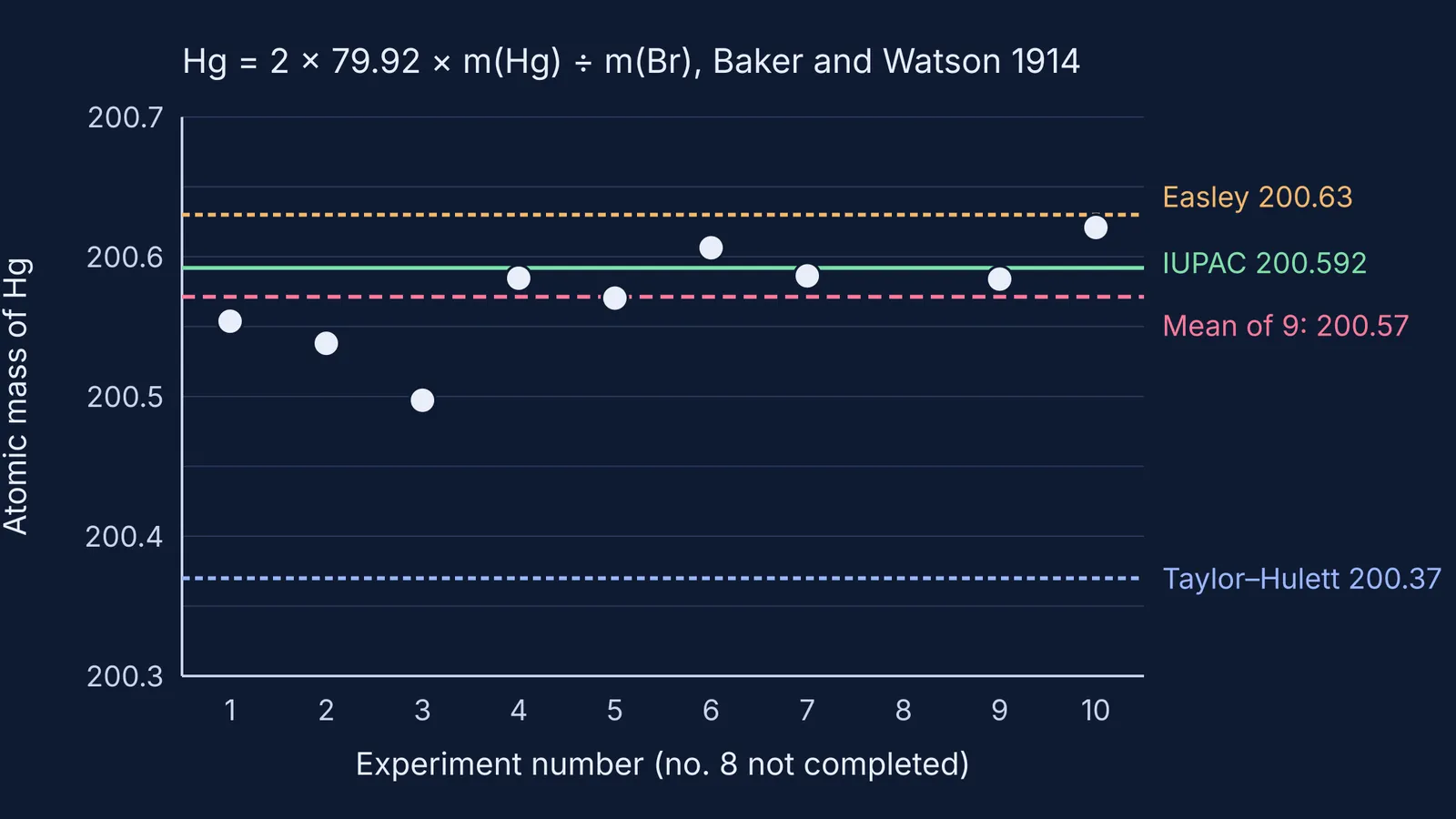
Class 11 asks you to find an atomic mass from combining masses: weigh an element, turn it into a compound, weigh again, and work out the ratio. In 1914 Herbert Brereton Baker and Walter Henry Watson did exactly that for mercury (H. B. Baker and W. H. Watson, J. Chem. Soc. Trans. 1914, 105, 2530). The addresses printed on the paper are the Imperial College of Science and Technology and the Northern Polytechnic Institute, London. They turned weighed mercury into mercuric bromide nine times and got a mean of Hg = 200.57. The value IUPAC lists today is 200.592. The arithmetic is a textbook problem. The useful part is which way each mistake pushes the answer.
Why did mercury's atomic mass need checking in 1914?
The paper opens with a disagreement. Analyses of mercuric chloride and bromide by Easley and by Easley and Brann had given Hg = 200.63, and "this figure, rounded off to 200.6, appeared in the International Table of Atomic Weights for 1912". The older accepted value had been 200, and earlier determinations ranged from 199.8 to 200.52. While Baker and Watson were working, Taylor and Hulett published a study of mercuric oxide that gave Hg = 200.37 ± 0.025.
So the question was open, and the authors wanted to check it "by a method as different as possible from those hitherto employed". A new method matters because two methods with different weak points rarely share the same hidden error.
How do you get an atomic mass from one mass ratio?
The chemistry is a single reaction:
Hg + Br₂ → HgBr₂
Mercury and bromine are both toxic, and this is not a school experiment. Only the principle matters here. Pure mercury was weighed, covered with liquid bromine and left until it had all reacted. The excess bromine was swept away with dry air, and the product was weighed. The gain in mass is the bromine that combined.
Each Hg atom takes two Br atoms, so:
moles of Br = m(Br) ÷ Ar(Br)
moles of Hg = ½ × moles of Br
Ar(Hg) = m(Hg) ÷ moles of Hg = 2 × Ar(Br) × m(Hg) ÷ m(Br)
The method needs one atomic mass to be known already. Baker and Watson took Br = 79.92. They also checked that the conversion was complete: the product melted to a clear liquid and was "completely soluble in alcohol or hot water", so no unreacted metal was left. Every weight was corrected to vacuum, −0.000054 g per gram of mercury and +0.000065 g per gram of mercuric bromide, because air buoyancy affects a dense metal and a lighter salt differently.
Worked example: experiment 3
The numbers are from the paper's table.
Mercury taken: 4.79430 g.
Product weighed: 8.61672 g.
Gain: 8.61672 − 4.79430 = 3.82242 g.
Subtract adsorbed bromine (measured separately, explained below): 0.00032 g. Combined bromine = 3.82210 g.
Moles of Br: 3.82210 ÷ 79.92 = 0.047824 mol.
Moles of Hg: 0.047824 ÷ 2 = 0.023912 mol.
Atomic mass: 4.79430 ÷ 0.023912 = 200.50. The paper prints 200.50.
You can also go through equivalent mass, as in finding the equivalent mass of a metal from oxide data. The mass of mercury that combines with 79.92 g of bromine is 4.79430 ÷ 3.82210 × 79.92 = 100.25 g. Mercury is bivalent in HgBr₂, so Ar = 2 × 100.25 = 200.50.
Which way does each error push the answer?
Look at the formula again. Ar(Hg) is proportional to m(Hg) ÷ m(Br). Anything that makes the bromine look heavier makes mercury come out lighter, and the reverse. Baker and Watson faced one error of each sign.
Bromine stuck to the product. They could not drive off every trace of bromine below the temperature at which mercuric bromide itself starts to vaporise. The product always had "a slight pink tint due to free bromine". So they melted the weighed product in a stream of air, passed the air into potassium iodide, and titrated the freed iodine with N/100 thiosulphate. The adsorbed bromine "never corresponded with more than 0.5 milligram". If they had not subtracted it, bromine would read high and mercury low. In experiment 3, ignoring the 0.32 mg gives 200.48 instead of 200.50.
Mercuric bromide lost as vapour. If any product escaped, the final weight would be too small, bromine would read low, and mercury would come out "too high", as the paper itself says. In experiment 3, losing just 1 mg of HgBr₂ gives 200.55 instead of 200.50.
Why is 1 mg worth 0.05? The bromine mass is found by difference, and 1 mg is 1 part in 3822 of it, or about 262 parts per million. Ar(Hg) moves by the same fraction: 262 ppm of 200.5 is 0.05. A small mass found by subtraction carries the whole error of the big weighings around it, the same lesson as in Theodore Richards and the impure silver behind Stas's chlorine.
How good were the nine results?
Experiment 8 was "not completed", so nine runs count. Recomputing every row with python gives values from 200.50 to 200.62, each within 0.01 of the printed figure, and a mean of 200.571. The paper writes Hg = 200.57 ± 0.008. The standard deviation of the nine values is 0.037. Dividing by √9 and multiplying by 0.6745 gives 0.008, so the ± matches what was then called the probable error of the mean.
Compared with today's 200.592, the 1914 mean is 0.021 lower, about one part in 10,000. That is close agreement, not a wrong answer. It sits much nearer Easley's 200.63 than Taylor and Hulett's 200.37.
What the experiment really measured was the ratio m(Hg) : m(Br). The atomic mass depends on the bromine value you multiply by. Use today's Br = 79.904 instead of 79.92 and the same nine ratios give a mean of 200.53. Any atomic mass found this way is only as good as the reference atomic mass behind it.
The authors also planned an improvement: remove the excess bromine "in a vacuum at the ordinary temperature", so that weighable amounts of mercuric bromide vapour could not be lost.
Where does this show up in JEE and NEET?
Class 11 Some Basic Concepts: laws of chemical combination, atomic mass from a mass ratio, and the effect of a systematic error on the answer.
Equivalent mass: E = m(metal) ÷ m(Br) × 79.92 here, then Ar = E × valency.
Average atomic mass: 200.592 is not a whole number because natural mercury is a mixture of isotopes, as explained in average atomic mass from isotope abundance.
For timed practice on mole-concept numericals like this one, Fermi Test Prep is built for JEE Main and Advanced preparation, with an AI tutor. If you keep losing the factor of 2 or the error sign, the Fermi Problem Library has a step-by-step solver that explains the reasoning.
Quick checklist
Baker and Watson, 1914: Hg weighed, converted to HgBr₂, weighed again; gain = bromine.
Ar(Hg) = 2 × 79.92 × m(Hg) ÷ m(Br).
Experiment 3: 4.79430 g Hg, 3.82210 g Br, Hg = 200.50.
Extra bromine left in the product: Hg too low. HgBr₂ lost as vapour: Hg too high.
Nine runs, mean 200.57 ± 0.008; IUPAC today 200.592.
The answer depends on the reference atomic mass you use for bromine.


