

On this page
How many times does 5 divide 6¹⁰⁰ − 1? The number has 78 digits, but the lifting the exponent lemma (LTE) answers in one line: 5³ divides it and 5⁴ does not.
What is the lifting the exponent lemma?
Write vₚ(x) for the exponent of the highest power of a prime p that divides x. For example, v₃(63) = 2, because 9 divides 63 but 27 does not (Parvardi, Lifting The Exponent Lemma).
The lifting the exponent lemma states that if p is an odd prime, p divides a − b, and p divides neither a nor b, then vₚ(aⁿ − bⁿ) = vₚ(a − b) + vₚ(n) for every positive integer n (Wikipedia, Lifting-the-exponent lemma).
For sums: if odd p divides a + b but neither a nor b, and n is odd, then vₚ(aⁿ + bⁿ) = vₚ(a + b) + vₚ(n) (same source).
Now try 6¹⁰⁰ − 1 with p = 5. 5 divides 6 − 1 once and 100 = 4 × 25 twice, so v₅(6¹⁰⁰ − 1) = 1 + 2 = 3. New to divisibility proofs? Warm up with why n³ − n is always divisible by 6.
Some ideas in the lemma appear in Édouard Lucas's work by 1878; Mihai Manea set it out systematically for olympiads in a 2006 Mathematics Magazine paper (Wikipedia).
What changes when p = 2?
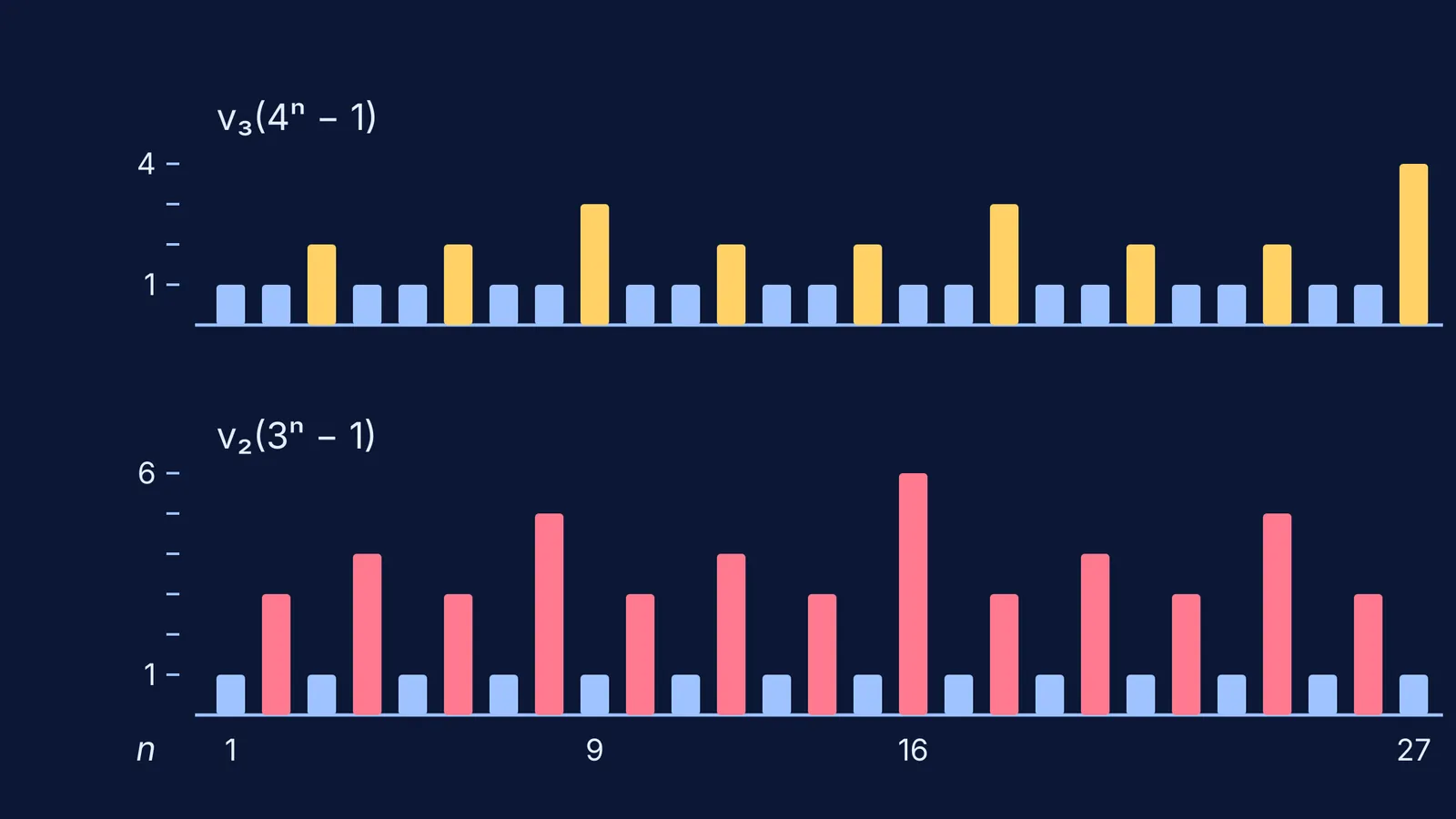
The odd-prime proof uses the fact that (p − 1)/2 is a whole number, and that is true only for p > 2 (Parvardi). For p = 2 the same notes give these rules, with a and b both odd:
If 4 divides a − b, then v₂(aⁿ − bⁿ) = v₂(a − b) + v₂(n).
If n is even, then v₂(aⁿ − bⁿ) = v₂(a − b) + v₂(a + b) + v₂(n) − 1.
If n is odd, then v₂(aⁿ − bⁿ) = v₂(a − b), as the Wikipedia statement also lists.
Take 3¹⁰⁰ − 1. Here 3 − 1 = 2 has one factor of 2, 3 + 1 = 4 has two, and 100 has two. So v₂(3¹⁰⁰ − 1) = 1 + 2 + 2 − 1 = 4. The odd-prime formula would wrongly give 3.
Why does LTE work?
The proof has three steps (Parvardi).
If p does not divide n, then vₚ(aⁿ − bⁿ) = vₚ(a − b). Factor aⁿ − bⁿ = (a − b)(aⁿ⁻¹ + aⁿ⁻²b + … + bⁿ⁻¹). Since a ≡ b (mod p), the long bracket is congruent to n·aⁿ⁻¹, which p does not divide.
For n = p, one extra factor appears: vₚ(aᵖ − bᵖ) = vₚ(a − b) + 1. Writing b = a + kp and expanding shows the bracket is p·aᵖ⁻¹ + k·aᵖ⁻²·p²·(p − 1)/2 modulo p². For odd p the second term is a multiple of p², so p² does not divide the bracket. This step fails for p = 2.
Write n = pᵏ·m with p not dividing m. Apply step 2 k times and step 1 once, and the exponent goes up by exactly k = vₚ(n).
Which olympiad problems does LTE shorten?
Like parity arguments in olympiad maths, LTE turns huge numbers into a short count.
AIME 2020 I, Problem 12. Find the least n for which 3³·5⁵·7⁷ divides 149ⁿ − 2ⁿ. Since 149 − 2 = 147 = 3·7², LTE gives v₃ = 1 + v₃(n) and v₇ = 2 + v₇(n), so 9 and 7⁵ must divide n. For 5, first note that 5 divides 149ⁿ − 2ⁿ only when n = 4k, then apply LTE to 149⁴ and 2⁴. The answer is n = 2²·3²·5⁴·7⁵, which has 270 divisors (worked solution on Wikipedia).
Worked example: when does 2ⁿ divide 3ⁿ − 1? (Problem 31 in Parvardi's notes.)
If n is odd, v₂(3ⁿ − 1) = v₂(3 − 1) = 1, so 2ⁿ divides it only when n = 1.
If n is even, v₂(3ⁿ − 1) = 1 + 2 + v₂(n) − 1 = 2 + v₂(n).
You need 2 + v₂(n) ≥ n. Since 2 to the power v₂(n) is at most n, this holds only for n = 2 and n = 4.
Check: 3² − 1 = 8 and 3⁴ − 1 = 80 = 16 × 5. The answer is n = 1, 2 or 4.
A checklist before you use LTE
Is p prime, dividing neither a nor b?
Does p divide a − b, or a + b with n odd? If not, find the smallest d with p dividing aᵈ − bᵈ, as the AIME solution did.
Is p = 2? Switch rules.
Test the smallest n by hand.
If you get stuck on step 2, the Fermi Problem Library has worked problems with a step-by-step solver that explains the reasoning rather than printing an answer. If modular arithmetic is shaky, the Fermi Concept Library gives each mathematics concept its own lesson.
Start with 7⁹ − 4⁹ and the prime 3, and predict the answer before you check it.


