

On this page
You are asked to show that n³ − n is a multiple of 6 for every positive integer n. The question appears as Question 4 of Exercise 1.4 in the NCERT Class 10 Exemplar Problems, Chapter 1: Real Numbers ("For any positive integer n, prove that n³ – n is divisible by 6"), right after a question on three consecutive integers. That order is your hint: the proof is one factorisation and two small facts.
What does n³ − n factorise to?
Take out the common factor n, then use the difference of squares, n² − 1 = (n − 1)(n + 1):
n³ − n = n(n² − 1) = (n − 1) × n × (n + 1).
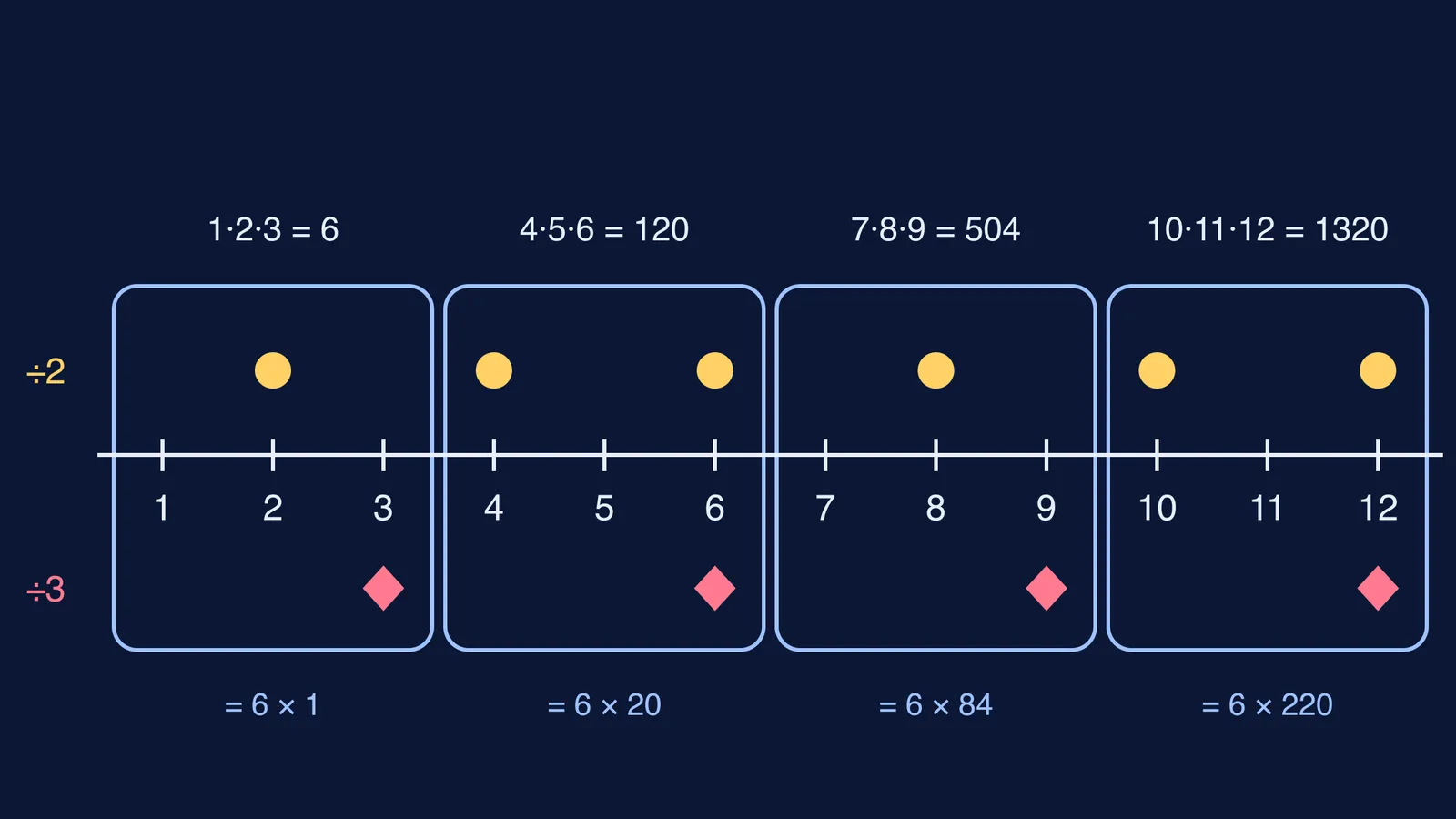
That is three integers in a row: the one before n, n itself, and the one after. For n = 5, 4 × 5 × 6 = 120 = 125 − 5.
Why is the product of three consecutive integers divisible by 6?
It is divisible by 2 and by 3, and 2 and 3 have no common factor other than 1.
Divisible by 2. Of any two consecutive integers one is even, so the product is even.
Divisible by 3. The same NCERT chapter states Euclid's division lemma: for positive integers a and b there are unique integers q and r with a = bq + r and 0 ≤ r < b. Taking b = 3, every n is 3q, 3q + 1 or 3q + 2. If n = 3q, n is a multiple of 3. If n = 3q + 1, then n − 1 = 3q is. If n = 3q + 2, then n + 1 = 3(q + 1) is.
A number divisible by both 2 and 3 is divisible by 2 × 3 = 6, because 2 and 3 are coprime. The same idea of combining coprime factors is behind the divisibility tests for 6, 12 and 15.
How do you write the proof in an exam?
Here is a model answer:
Let n be any positive integer. Then n³ − n = n(n² − 1) = (n − 1)n(n + 1).
So n³ − n is the product of three consecutive integers.
Of any two consecutive integers one is even, so 2 divides the product.
By Euclid's division lemma, n = 3q, 3q + 1 or 3q + 2 for some integer q. Then 3 divides n, n − 1 or n + 1 respectively, so 3 divides the product.
Since 2 and 3 are coprime and both divide n³ − n, their product 6 divides n³ − n. Hence proved.
For n = 1 the product is 0, which is a multiple of 6, so no case slips through.
Can you prove it another way?
Remainders. Write n = 6q + r, where r is 0, 1, 2, 3, 4 or 5. Exercise 1.4, Question 1 of the NCERT Exemplar chapter asks you to show that the cube of 6q + r has the form 6m + r. Check the six possible remainders: the cubes 0, 1, 8, 27, 64 and 125 leave remainders 0, 1, 2, 3, 4 and 5 on division by 6. So n³ and n always leave the same remainder, and their difference is a multiple of 6. Our explainer on modular arithmetic and remainders for JEE shows how to run these checks quickly.
Induction. Suppose k³ − k is a multiple of 6. Expanding gives (k + 1)³ − (k + 1) = (k³ − k) + 3k(k + 1). Here k(k + 1) is a product of two consecutive integers, so it is even, which makes 3k(k + 1) a multiple of 6. The base case n = 1 gives 0. For the full template, see how proof by mathematical induction works.
The factor of 3 is a special case of Fermat's little theorem: if p is prime, a^p − a is a multiple of p for every integer a. Fermat stated it in a letter dated 18 October 1640.
What mistakes cost marks?
Checking n = 1, 2, 3 and stopping. Examples are not a proof.
Claiming one of three consecutive numbers is divisible by 3 without the 3q, 3q + 1, 3q + 2 reason.
Jumping from divisible by 2 and 3 to divisible by 6 without saying that 2 and 3 are coprime.
Factorising n² − 1 as (n − 1)² or dropping the factor n.
If your own proof keeps losing marks at the same step, the Fermi Problem Library has worked problems with a step-by-step solver that explains the reasoning rather than printing an answer. For background ideas such as coprime numbers or Euclid's division lemma, each concept has its own lesson in the Fermi Concept Library.


