

On this page
Dissolve a neodymium salt in water and you get a pale lilac solution. A praseodymium salt gives green, a samarium salt yellow. Lanthanum and lutetium salts give colourless solutions. NCERT explains this in three short sentences: the colour comes from f electrons, La³⁺ and Lu³⁺ are colourless, and the absorption bands are narrow because the excitation happens within the f level. Below, each sentence is unpacked, with the places where real data are messier than NCERT's summary.
Why are most lanthanoid ions coloured?
Every Ln³⁺ ion has the configuration [Xe]4fⁿ, with n running from 0 for La³⁺ to 14 for Lu³⁺. When the 4f subshell is partly filled, the electrons can be arranged among the seven f orbitals in more than one way, and these arrangements have different energies. Absorbing a photon can move the ion from its lowest arrangement to a higher one. When that energy gap matches visible light, part of the spectrum is removed and you see the complementary colour. This is called an f–f transition.
The colours are usually pale. An f–f transition moves an electron from an f level to another f level, so Δl = 0, and that kind of transition is forbidden by the Laporte rule, just like a d–d transition in an octahedral complex. Forbidden transitions still happen, but weakly. So Ln³⁺ solutions are softly tinted, not intense like permanganate.
Why are La³⁺ and Lu³⁺ colourless?
La³⁺ is 4f⁰. There are no f electrons to excite. Lu³⁺ is 4f¹⁴. Every f orbital is full, so no electron can move to another f orbital. Neither ion has an f–f transition, so neither absorbs visible light. This is the same logic as Sc³⁺ (3d⁰) and Zn²⁺ (3d¹⁰) being colourless in the d block.
NCERT then says "the rest do so". The real data are less tidy, and it helps to know why:
Ce³⁺ (4f¹) has only one f electron, and its only f–f gap is tiny, in the infrared. Its strong absorption is a 4f → 5d jump in the ultraviolet. Ce³⁺ solutions look colourless.
Gd³⁺ (4f⁷) has a half-filled subshell with all seven spins parallel. Any excited f arrangement needs a spin flip, and the lowest one lies at about 32,000 cm⁻¹, around 310 nm, in the UV. Gd³⁺ is colourless. Compare the spin-forbidden pale pink of Mn²⁺, the d⁵ version of the same idea.
Yb³⁺ (4f¹³) has one hole, the mirror image of Ce³⁺. Its single f–f transition is at about 10,200 cm⁻¹, roughly 980 nm, in the near-infrared. Yb³⁺ is colourless.
Eu³⁺ (4f⁶) and Tb³⁺ (4f⁸) absorb only weakly in the visible and are often described as very pale pink or nearly colourless.
So in an exam that quotes NCERT, answer that La³⁺ and Lu³⁺ are colourless. But if you are asked which ions do not absorb visible light, remember that Ce³⁺, Gd³⁺ and Yb³⁺ also look colourless, even though they have unpaired f electrons. An unpaired electron makes an ion paramagnetic. It does not guarantee colour.
Why are lanthanoid absorption bands so narrow?
The 4f orbitals are not on the outside of the ion. They sit inside the filled 5s² and 5p⁶ shells, which shield them from the surrounding ligands. In a d-block ion, the d electrons point straight at the ligands, and the crystal field splitting is typically 10,000 to 30,000 cm⁻¹. In an Ln³⁺ ion, the ligand field splits the f levels by only about 100 cm⁻¹, a few hundred at most.
Two things follow from that.
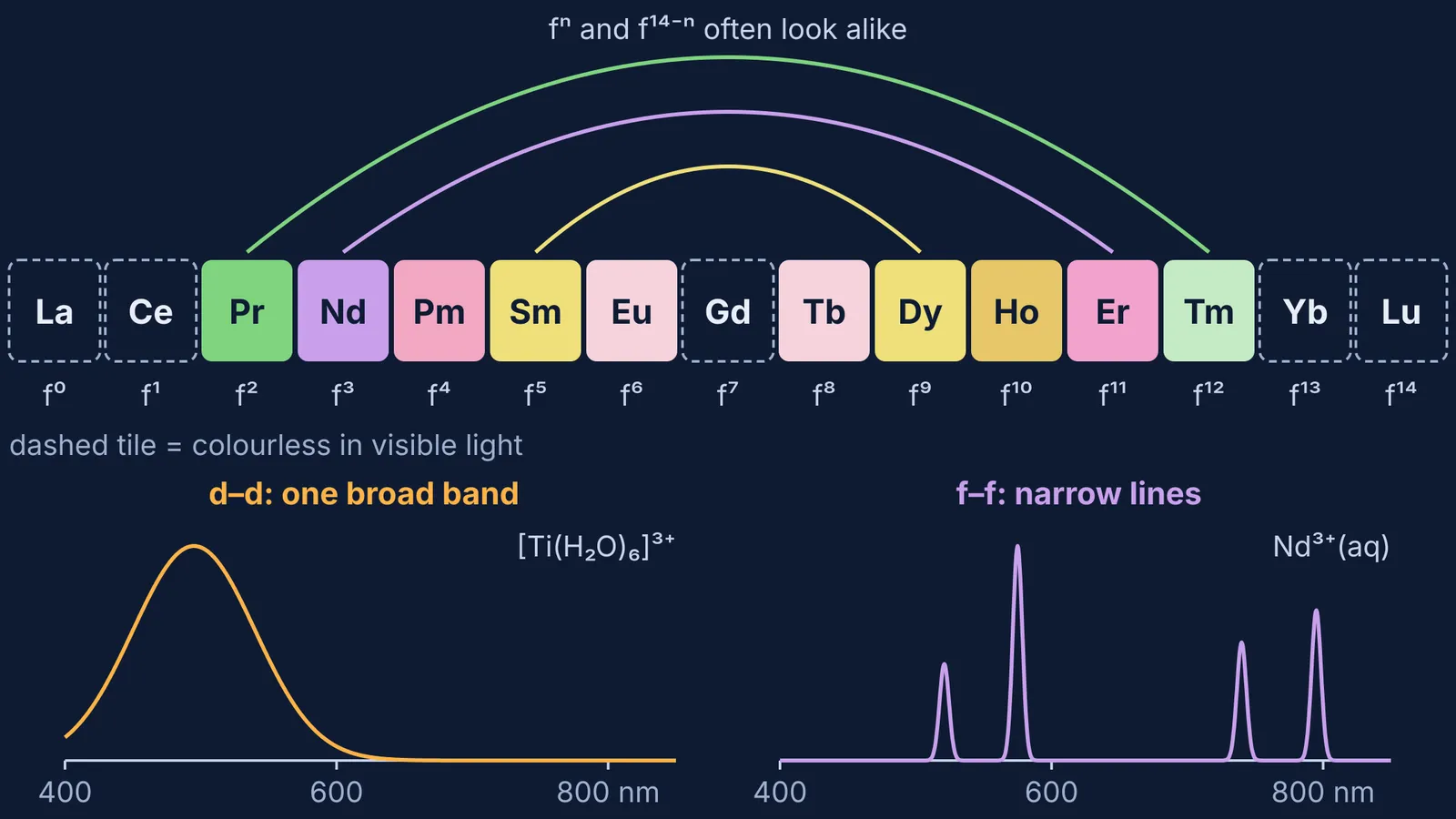
The bands are sharp. In a d–d transition, the vibrating ligands keep changing the splitting, so the absorption is smeared over 100 nm or more. The shielded 4f electrons barely feel those vibrations, so f–f absorptions are narrow lines, often only a few nanometres wide. This is why glass containing holmium oxide is used to check the wavelength scale of spectrophotometers, and why didymium glass (a neodymium and praseodymium mixture) can cut out the narrow yellow sodium glare in glassblowers' goggles.
The colour hardly depends on the ligand. Change the ligands around Cu²⁺ from water to ammonia and pale blue becomes deep blue. Change the ligands around Nd³⁺ and the lines shift only slightly, so the colour barely changes. The general d-block treatment is in d- and f-block elements: configurations, colour and magnetism.
Do fⁿ and f¹⁴⁻ⁿ ions have similar colours?
Often, yes. An f¹⁴⁻ⁿ ion can be treated as a full subshell with n "holes". Electrons and holes give the same set of possible energy levels, so the gaps are broadly similar, although the order and spacing are not identical. The usual textbook colours line up like this:
f⁰ La³⁺ and f¹⁴ Lu³⁺: both colourless.
f¹ Ce³⁺ and f¹³ Yb³⁺: both colourless.
f² Pr³⁺ green and f¹² Tm³⁺ pale green.
f³ Nd³⁺ lilac (some books say reddish violet) and f¹¹ Er³⁺ pink.
f⁵ Sm³⁺ yellow and f⁹ Dy³⁺ yellow.
f⁶ Eu³⁺ and f⁸ Tb³⁺: both very pale pink.
The pattern is rough, not a law. The f⁴/f¹⁰ pair breaks it: Pm³⁺ is usually listed as pink and Ho³⁺ as yellow. Colour names also vary from book to book. Use the pattern to remember the colours, not to predict them.
Worked example: find Nd³⁺'s partner and compare the two ions
Question: Give the 4f configuration of Nd³⁺ (Z = 60). Which Ln³⁺ ion has the complementary configuration, and how do the two compare in colour and magnetism?
Neutral atom. Nd is [Xe]4f⁴6s².
Form the ion. Remove the two 6s electrons, then one 4f electron. Nd³⁺ is [Xe]4f³.
Shortcut. For every Ln³⁺, the 4f count is Z − 57. For Nd, 60 − 57 = 3.
Partner configuration. 14 − 3 = 11, so you want 4f¹¹.
Which element? Z − 57 = 11 gives Z = 68, which is erbium. Er is [Xe]4f¹²6s², and Er³⁺ is [Xe]4f¹¹.
Colour. Both have partly filled 4f subshells with visible f–f transitions. Nd³⁺ is lilac and Er³⁺ pink: similar, not identical.
Unpaired electrons. f³: three electrons in seven orbitals, all unpaired, so 3. f¹¹: seven orbitals hold 11 electrons, so 4 orbitals are doubly filled and 3 are singly filled, giving 3 unpaired. Both ions are paramagnetic.
Do not stop at step 7 and use the spin-only formula. For 3 unpaired electrons it gives √15 ≈ 3.87 BM for both ions. The measured moments are about 3.6 BM for Nd³⁺ and about 9.6 BM for Er³⁺. The 4f electrons keep their orbital motion because ligands barely touch them, so orbital angular momentum adds to the moment. Spin-only works reasonably for 3d ions, not for lanthanoids.
For more questions like this, the Fermi Problem Library has a step-by-step solver that explains the reasoning, so you can check where a configuration or electron count went wrong.
Quick checklist
Ln³⁺ colour comes from f–f transitions within the 4f subshell.
La³⁺ (f⁰) and Lu³⁺ (f¹⁴) are colourless. Ce³⁺, Gd³⁺ and Yb³⁺ also look colourless because they absorb outside the visible range.
f–f transitions are Laporte forbidden, so colours are pale.
4f orbitals are shielded by 5s² 5p⁶, so bands are narrow and colour barely depends on the ligand.
fⁿ and f¹⁴⁻ⁿ ions often look alike (Pr/Tm, Nd/Er, Sm/Dy), but the rule is rough.
4f count of Ln³⁺ = Z − 57. Count unpaired electrons, but do not use spin-only moments for lanthanoids.


