

On this page
Statement-based and match-the-list questions appear in recent NEET papers. Kinematics is Unit 2 of the physics syllabus in the NMC syllabus for NEET (UG)-2026. These 8 original questions run easy to hard, checked against NCERT Class 11 Physics Chapter 2 and Chapter 3 (Reprint 2026-27). Take g = 10 m/s², no air resistance.
Can you judge these kinematics statements?
Statement I/II options: (1) Both correct. (2) Both incorrect. (3) I correct, II incorrect. (4) I incorrect, II correct.
Q1 (easy, statements). For motion along a straight line, which statements are correct? A. Instantaneous speed equals the magnitude of instantaneous velocity. B. For uniform velocity, the average velocity over any interval equals the instantaneous velocity. C. A body with negative velocity must have negative acceleration. D. If a body is speeding up, its acceleration is in the direction of its velocity. E. v = v₀ + at holds even when acceleration changes with time.
(1) A and B only (2) A, B and D only (3) B, C and D only (4) A, B, D and E only
Answer: (2). A true: speed is the magnitude of velocity. B true: the x-t graph is a straight line. C false: a body braking while moving in −x has positive acceleration. D true: speed grows only then. E false: it needs constant acceleration.
Trap: (4), because E looks like a formula you know.
Q2 (easy, Statement I/II). Statement I: In uniform circular motion, velocity is along the tangent at each point. Statement II: Its acceleration vectors at two diametrically opposite points are equal.
Answer: (3). I is correct. II is not: both have magnitude v²/R, but each points to the centre, so they are opposite.
Trap: (1), confusing equal magnitudes with equal vectors.
Q3 (medium, statements). A ball leaves level ground at 50 m/s, 37° above horizontal (sin 37° = 0.6). A. Flight time is 6 s. B. Maximum height is 45 m. C. Range is 120 m. D. At t = 2 s, the ball is 50 m above the ground. E. At t = 3 s, velocity is horizontal.
(1) A, B and C only (2) A and B only (3) A, D and E only (4) A, B and E only
Answer: (4). Components: 40 m/s across, 30 m/s up. A: 2 × 30/10 = 6 s, true. B: 30²/20 = 45 m, true. C: 40 × 6 = 240 m, false. D: 30 × 2 − 5 × 2² = 40 m, false. E: 30 − 10 × 3 = 0, true.
Trap: (1), using half the flight time.
Q4 (hard, Statement I/II). Ball P is thrown up from the ground at 15 m/s as ball Q is dropped from rest 30 m directly above. Statement I: They meet 2 s later, 10 m above the ground. Statement II: When they meet, both are moving downward.
Answer: (1). Both share g, so the 30 m gap closes at a steady 15 m/s: 2 s, both at 10 m. P peaked at 1.5 s, so it moves down at 5 m/s; Q at 20 m/s.
Trap: (3), assuming P rises.
Can you match these kinematics lists?
Q5 (easy, match). Match each motion along x with its x-t graph.
List-I: A. At rest at x = 5 m. B. Uniform velocity in +x. C. From rest, constant positive acceleration. D. Moving in +x, slowing uniformly.
List-II: I. Line with positive slope. II. Line parallel to the time axis. III. Curve with increasing slope. IV. Curve with decreasing slope.
(1) A-I, B-II, C-III, D-IV (2) A-II, B-I, C-IV, D-III (3) A-II, B-I, C-III, D-IV (4) A-II, B-III, C-I, D-IV
Answer: (3). Slope is velocity: fixed x, constant slope, growing slope, falling slope.
Trap: (2), swapping the two curves.
Q6 (medium, match). A car at 10 m/s accelerates uniformly at 2 m/s² along a line. Match the SI values.
List-I: A. Velocity at t = 5 s. B. Displacement in the first 5 s. C. Distance in the 5th second. D. Speed after covering 24 m.
List-II: I. 14 II. 19 III. 20 IV. 75
(1) A-III, B-IV, C-II, D-I (2) A-III, B-II, C-IV, D-I (3) A-I, B-IV, C-II, D-III (4) A-III, B-IV, C-I, D-II
Answer: (1). A: 10 + 2 × 5 = 20 m/s. B: 50 + 25 = 75 m. C: 10 + 1 × (2 × 5 − 1) = 19 m. D: v² = 100 + 96 = 196, so 14 m/s.
Trap: (2), reading "5th second" as "5 seconds".
Q7 (medium, match). Car A drives north at 12 m/s. Match car B's motion with its speed relative to A.
List-I: A. North at 12 m/s. B. South at 12 m/s. C. East at 5 m/s. D. North at 7 m/s.
List-II: I. 0 II. 5 m/s III. 13 m/s IV. 24 m/s
(1) A-I, B-III, C-IV, D-II (2) A-IV, B-I, C-III, D-II (3) A-I, B-IV, C-II, D-III (4) A-I, B-IV, C-III, D-II
Answer: (4). A: 0. B: 24 m/s. C: perpendicular, √(12² + 5²) = 13 m/s. D: 12 − 7 = 5 m/s.
Trap: (2), adding speeds for same-direction cars.
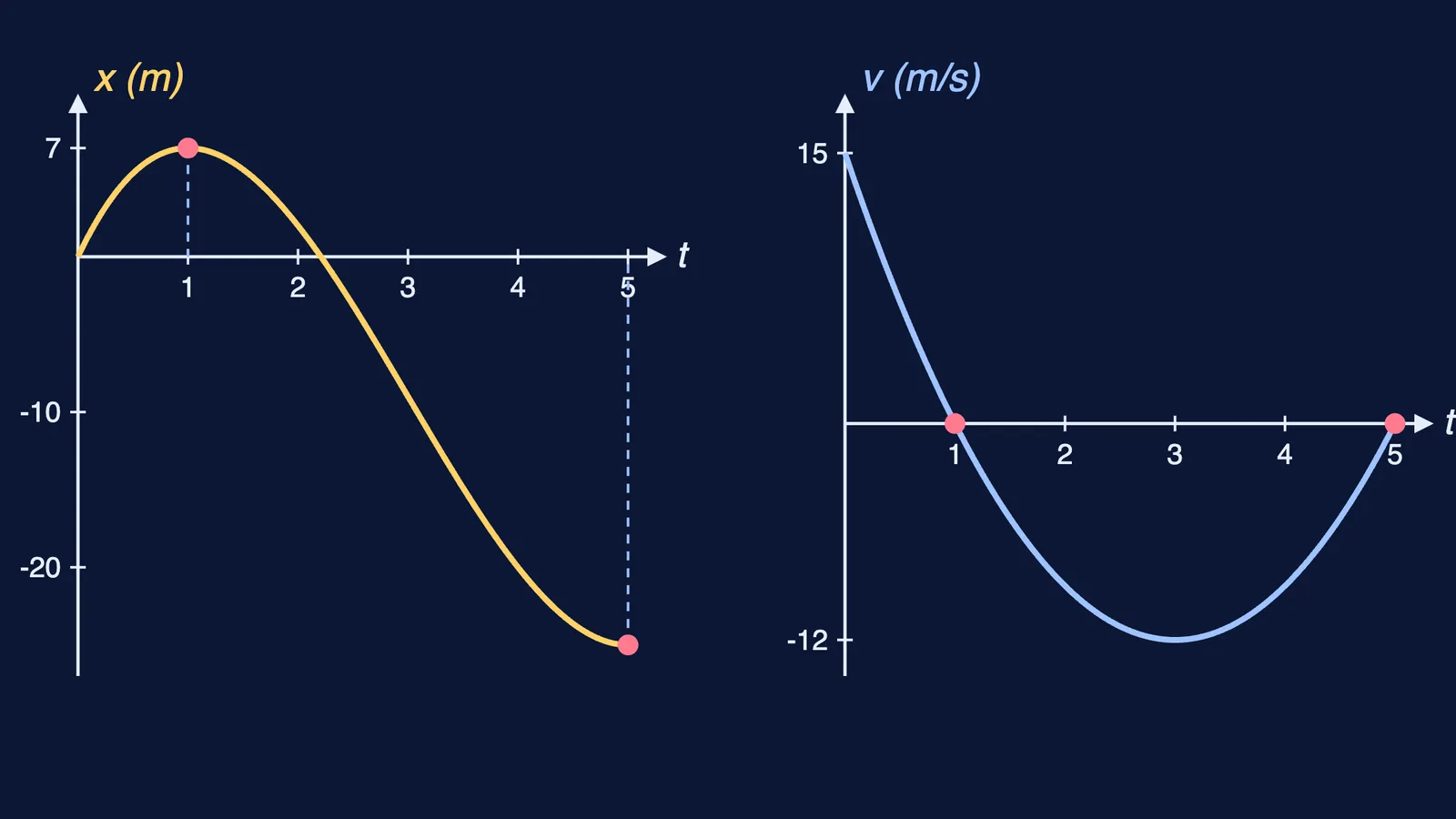
Q8 (hard, match). A particle moves as x = t³ − 9t² + 15t (SI units). Match the values.
List-I: A. Velocity at t = 0. B. Instant when acceleration is zero. C. Distance in the first 5 s. D. Magnitude of displacement in the first 5 s.
List-II: I. 3 II. 15 III. 25 IV. 39
(1) A-II, B-I, C-III, D-IV (2) A-II, B-I, C-IV, D-III (3) A-I, B-II, C-IV, D-III (4) A-II, B-III, C-I, D-IV
Answer: (2). v = 3(t − 1)(t − 5), so v(0) = 15 m/s. a = 6t − 18 = 0 at t = 3 s. It turns at t = 1 s (x = 7 m) and ends at x = −25 m: distance 7 + 32 = 39 m, displacement 25 m.
Trap: (1), skipping the turning point and taking 25 m as the distance.
How do you work these faster?
In an A-E list, judge first the statement in the fewest options.
In a match grid, fix the most distinctive pair first.
For any x(t), find where v = 0 before computing a distance.
Hard to picture projectile components? The Fermi Simulation Lab has interactive simulations for the ideas that are easier to see than to read.
New to the chapter? See how to prepare kinematics for NEET. For method, see NEET match-the-list questions.


