On this page
You have used the implicit function theorem every time you differentiated x² + y² = 1 to get dy/dx = −x/y. Implicit differentiation quietly assumes that y really is a function of x. The theorem tells you when that assumption is safe, and the circle shows what goes wrong when it is not.
What does the implicit function theorem say?
Take a function F(x, y) with continuous partial derivatives and a point (a, b) where F(a, b) = 0. The two-variable statement on Wikipedia's implicit function theorem page is this: if ∂F/∂y is not zero at (a, b), then there is a unique differentiable function y = φ(x) near x = a with φ(a) = b and F(x, φ(x)) = 0.
Three words in that sentence do the work:
Near: the theorem is local. It promises a function on a small interval around a, not on the whole curve.
Unique: close to (a, b), each x has exactly one y.
Differentiable: dy/dx exists and you can compute it.
The same page gives the derivative: dy/dx = −F_x / F_y, where F_x and F_y are the partial derivatives. To see why, differentiate F(x, y(x)) = 0 with the chain rule to get F_x + F_y · dy/dx = 0, then divide by F_y. That division is legal only when F_y ≠ 0, and that is exactly the theorem's condition.
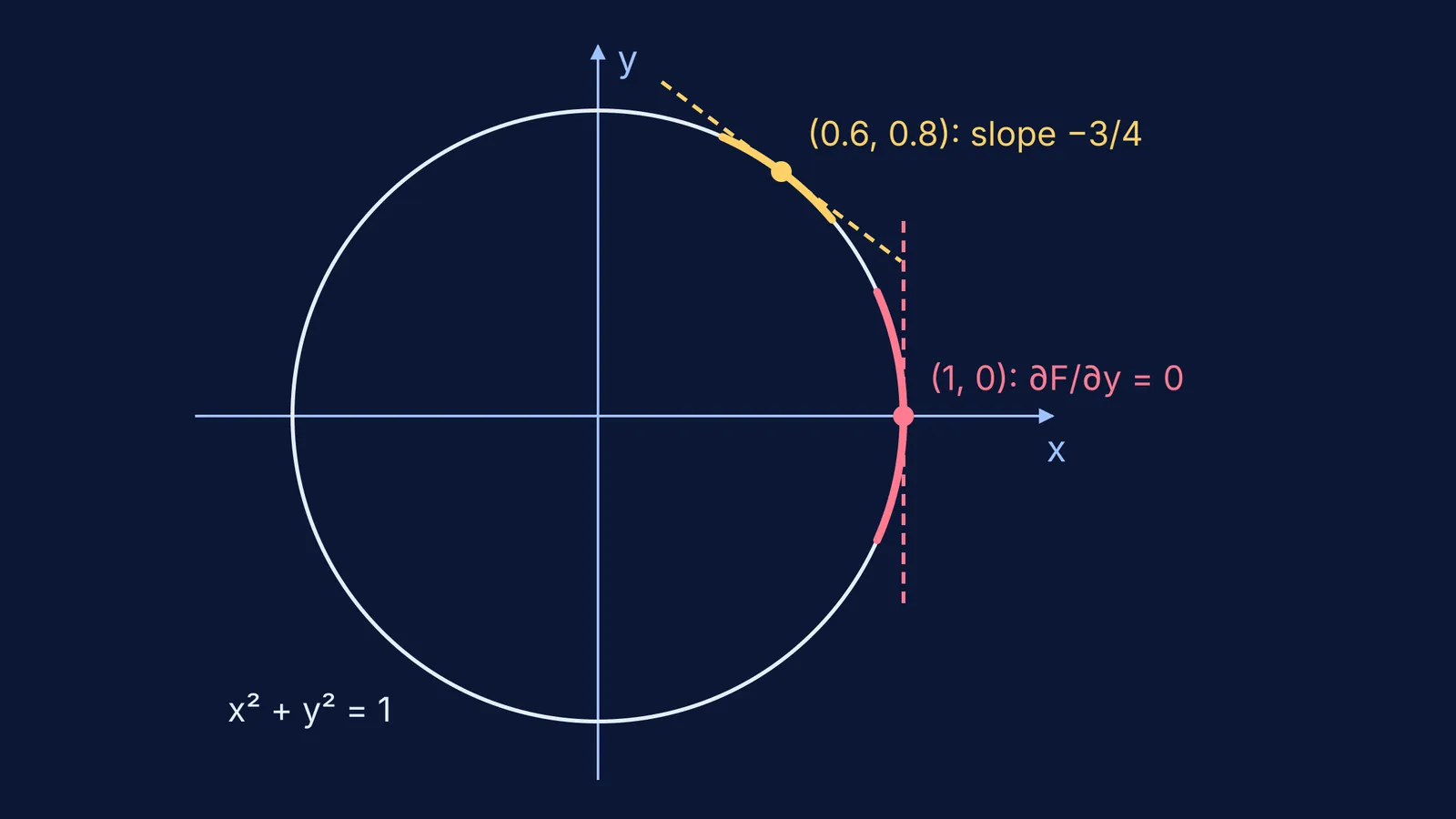
Why does it fail at (1, 0) on the circle x² + y² = 1?
Write the circle as F(x, y) = x² + y² − 1 = 0. Then F_x = 2x and F_y = 2y, so dy/dx = −x/y.
At (0.6, 0.8), check first: F = 0.36 + 0.64 − 1 = 0, and F_y = 1.6, which is not zero. The theorem applies. Near this point the circle is the graph of y = √(1 − x²), and the slope is −0.6/0.8 = −3/4.
At (1, 0), F_y = 2 × 0 = 0, so the test fails. Here is why no function can work there:
For x a little less than 1, there are two points on the circle, y = +√(1 − x²) and y = −√(1 − x²).
For x a little more than 1, there are no points at all.
The tangent at (1, 0) is vertical, so −x/y would mean dividing by zero.
Wikipedia's circle example reaches the same verdict: y is locally a function of x wherever y ≠ 0, and (±1, 0) is where it runs into trouble. The fix is to swap roles. At (1, 0), F_x = 2 is not zero, so x is locally a function of y, namely x = √(1 − y²), with dx/dy = −y/x = 0.
A zero F_y does not always mean failure. It means the theorem gives no guarantee, so you have to check by hand.
What is the multivariable (Jacobian) version?
Now suppose you have m equations F(x, y) = 0, where x has n variables and y has m unknowns. MathWorld's statement asks that the determinant of the m × m matrix of partial derivatives of F with respect to y be nonzero at the point. If it is, then near that point the equations hold if and only if y = g(x) for a unique continuously differentiable function g.
The derivative formula looks the same, with matrices in place of numbers: Dg = −(∂F/∂y)⁻¹ (∂F/∂x) (Wikipedia). For the matrix itself, see what the Jacobian measures.
A worked example: x + y + z = 0 and x² + y² + z² = 2 near the point (0, 1, −1). Both equations hold there. The Jacobian with respect to (y, z) has rows (1, 1) and (2y, 2z) = (2, −2). Its determinant is −4, so y and z are locally functions of x. Differentiating both equations in x gives 1 + y′ + z′ = 0 and 2x + 2y y′ + 2z z′ = 0. At the point that becomes y′ + z′ = −1 and 2y′ − 2z′ = 0, so y′ = z′ = −1/2.
How do you use it in a problem?
Write the equation as F = 0 and check that your point satisfies it.
Compute F_y (or the Jacobian determinant) at the point.
If it is nonzero, use dy/dx = −F_x/F_y. If it is zero, try solving for x instead, or look at the curve directly.
If partial derivatives still feel shaky, start with partial derivatives: meaning and rules. The same −F_x/F_y idea turns up in Lagrange multipliers, where a constraint g = 0 defines one variable in terms of the others.
To go over the chain rule step or the Jacobian again, look the ideas up in the Fermi Concept Library. To practise implicit derivatives, try the Fermi Problem Library, whose step-by-step solver explains the reasoning rather than printing an answer.