On this page
If a polynomial with integer coefficients splits into factors with fractions, must it also split into factors with integers? Gauss's lemma says yes, and its proof is short.
What are the content and primitive part of a polynomial?
The content of an integer polynomial is the greatest common divisor of its coefficients, and the polynomial is primitive when that gcd is 1, so no prime divides every coefficient (Gauss's lemma, Wikipedia)).
Primitive does not mean the coefficients are pairwise coprime: 6T² + 10T + 15 is primitive although every pair of coefficients shares a factor, because 6, 10 and 15 have no common factor taken together (Keith Conrad, The Gauss norm and Gauss's lemma).
Every integer polynomial is its content times a primitive polynomial, its primitive part. For example, 12x² + 54x + 54 = 6(2x² + 9x + 9).
What does Gauss's lemma say?
In modern form, Gauss's lemma states that the product of two primitive polynomials is primitive (Wikipedia)). More generally, c(fg) = c(f)c(g).
Check it: (4x + 6)(3x + 9) = 12x² + 54x + 54. The contents are 2 and 3, and the product has content 6.
Gauss's own version, Article 42 of the Disquisitiones Arithmeticae (1801), was about monic polynomials: if P and Q are monic with rational coefficients, not all integers, then PQ cannot have all-integer coefficients either (Wikipedia)).
How do you prove Gauss's lemma mod p?
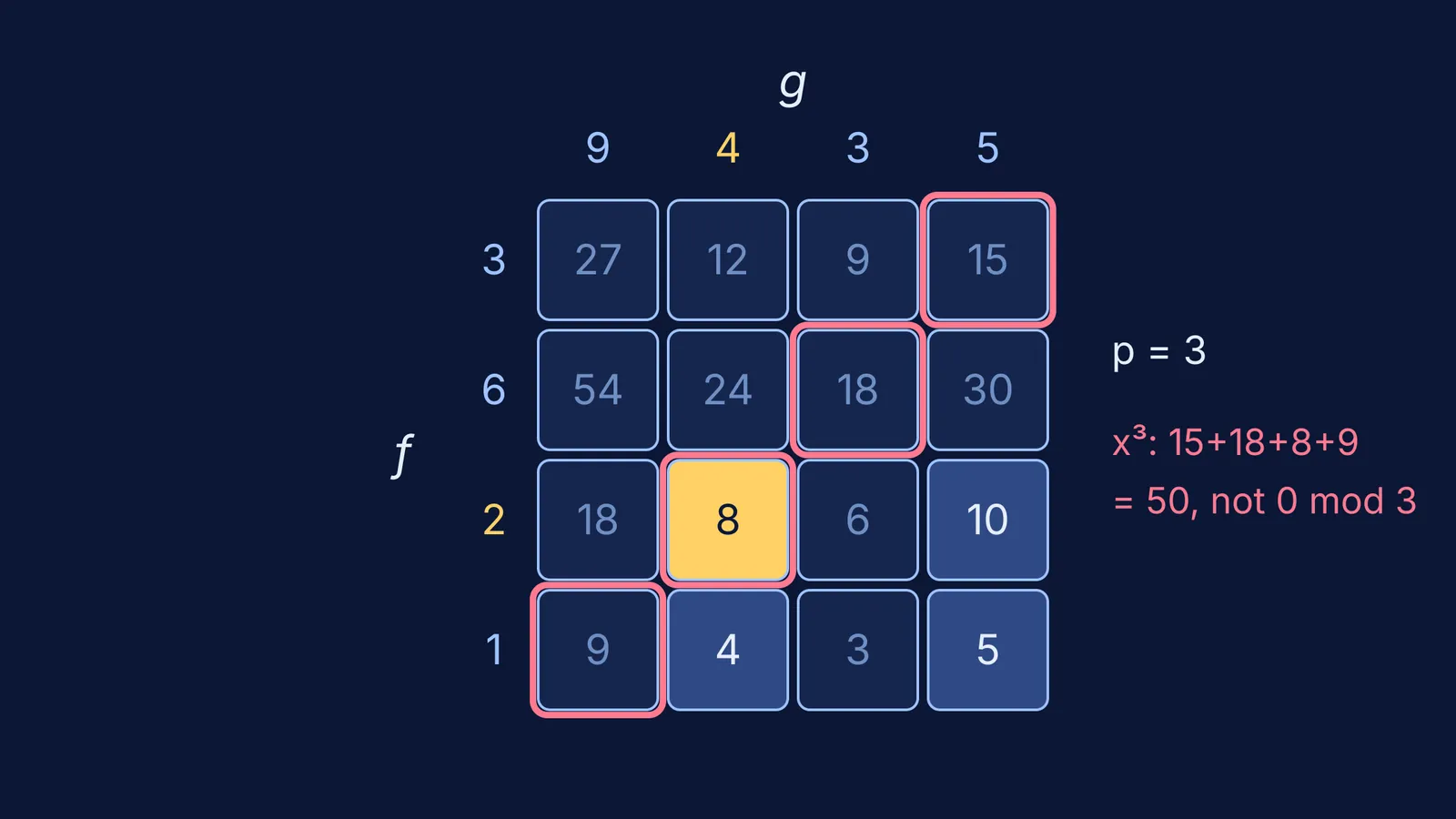
Suppose f and g are primitive but a prime p divides every coefficient of fg. Reduce mod p: then f̄ · ḡ = 0. But neither f̄ nor ḡ is zero, since p does not divide all coefficients of either. The integers mod p form a field, and over a field two nonzero polynomials have a nonzero product, because their leading coefficients multiply to something nonzero. Contradiction.
In coefficients: let aᵣ and bₛ be the first coefficients of f and g not divisible by p. In the coefficient of x^(r+s), every term except aᵣbₛ is divisible by p, so the sum is not (Wikipedia)). The diagram above shows p = 3 with f = 3, 6, 2, 1 and g = 9, 4, 3, 5 (constant term first): here r = 2 and s = 1, the x³ coefficient is 15 + 18 + 8 + 9 = 50, and only the 8 breaks divisibility.
Why is a polynomial irreducible over Z also irreducible over Q?
Suppose a primitive f factors over Q as g times h. Write g = (a/b)g₀ and h = (c/d)h₀ with g₀, h₀ primitive integer polynomials. Then bd · f = ac · g₀h₀. The left side has content bd; by the lemma the right side has content ac. So bd = ±ac, and f = ±g₀h₀ is a factorisation over the integers.
How do you factorise 6x³ − x² + 3x − 2 with Gauss's lemma?
The rational root test gives candidates ±1, ±2, ±1/2, ±1/3, ±2/3, ±1/6.
Try x = 1/2: 6/8 − 1/4 + 3/2 − 2 = 0, so it is a root.
Over Q: 6x³ − x² + 3x − 2 = (x − 1/2)(6x² + 2x + 4).
The quadratic has content 2. Move that 2 onto the first factor: (2x − 1)(3x² + x + 2), both primitive, as the lemma promised.
The quadratic's discriminant is 1 − 24 = −23, which is negative, so it does not factor further over Q.
How does Gauss's lemma underpin the rational root theorem and Eisenstein's criterion?
The rational root theorem is a special case of Gauss's lemma for a single linear factor (Rational root theorem, Wikipedia). If p/q in lowest terms is a root, then qx − p is a primitive factor over Q, so f = (qx − p)g with g having integer coefficients. Comparing leading coefficients gives q | aₙ; comparing constants gives p | a₀.
Eisenstein's criterion says that if a prime p divides every coefficient except the leading one, does not divide the leading one, and p² does not divide the constant term, then the polynomial is irreducible over Q (Eisenstein's criterion, Wikipedia). Gauss's lemma lets the proof work over Z, with two non-constant integer factors. Mod p the polynomial becomes āₙxⁿ, so each factor reduces to a constant times a power of x, both constant terms are divisible by p, and a₀ is divisible by p². Contradiction. Wikipedia's example, 3x⁴ + 15x² + 10 with p = 5, is irreducible over Q.
A routine for any integer polynomial:
Pull out the content.
Test rational roots.
Try Eisenstein, directly or after substituting x + 1.
Rescale any fractional factorisation by contents.
More mod p reasoning: Hensel's lemma, lifting roots from mod 7 to mod 343. More on roots: Sturm's theorem for counting real roots and Newton's identities for power sums of roots.
If content or irreducibility still feels shaky, the Fermi Concept Library has a lesson for every concept in mathematics; to practise factorisations, the Fermi Problem Library has worked problems with a step-by-step solver that explains the reasoning.