

On this page
Polythene from a bag and polythene from a bottle are both made of CH₂CH₂ units, yet they are made in completely different ways. The bag is low density polythene (LDPE), and its chains grow by a free-radical chain reaction. NCERT gives this mechanism in three stages, initiation, propagation and termination, and JEE Advanced can ask you to write it out or to use it in a calculation. This post walks through each stage with fish-hook arrows, explains why LDPE chains branch, and then uses the mechanism to estimate a molar mass from the amount of initiator.
One syllabus note first. Polymers are on the JEE Advanced syllabus, but they have been dropped from the current JEE Main and NEET-UG syllabi, so this topic matters mainly if you are writing Advanced.
What is free-radical addition polymerisation?
It is a chain reaction in which a radical adds across the C=C double bond of a monomer, and the product is a new, longer radical that can add the next monomer. The polymer forms without losing any small molecule, which is why it counts as addition polymerisation. If you need the difference between addition and condensation polymers, see addition and condensation polymers with monomers and examples.
Every arrow in this mechanism is a fish-hook arrow: a curved arrow with a half head that moves one electron, not a pair. A bond that breaks evenly needs two fish-hooks, one to each atom. A new bond made from two radicals needs two fish-hooks meeting in the middle.
How does initiation work with benzoyl peroxide?
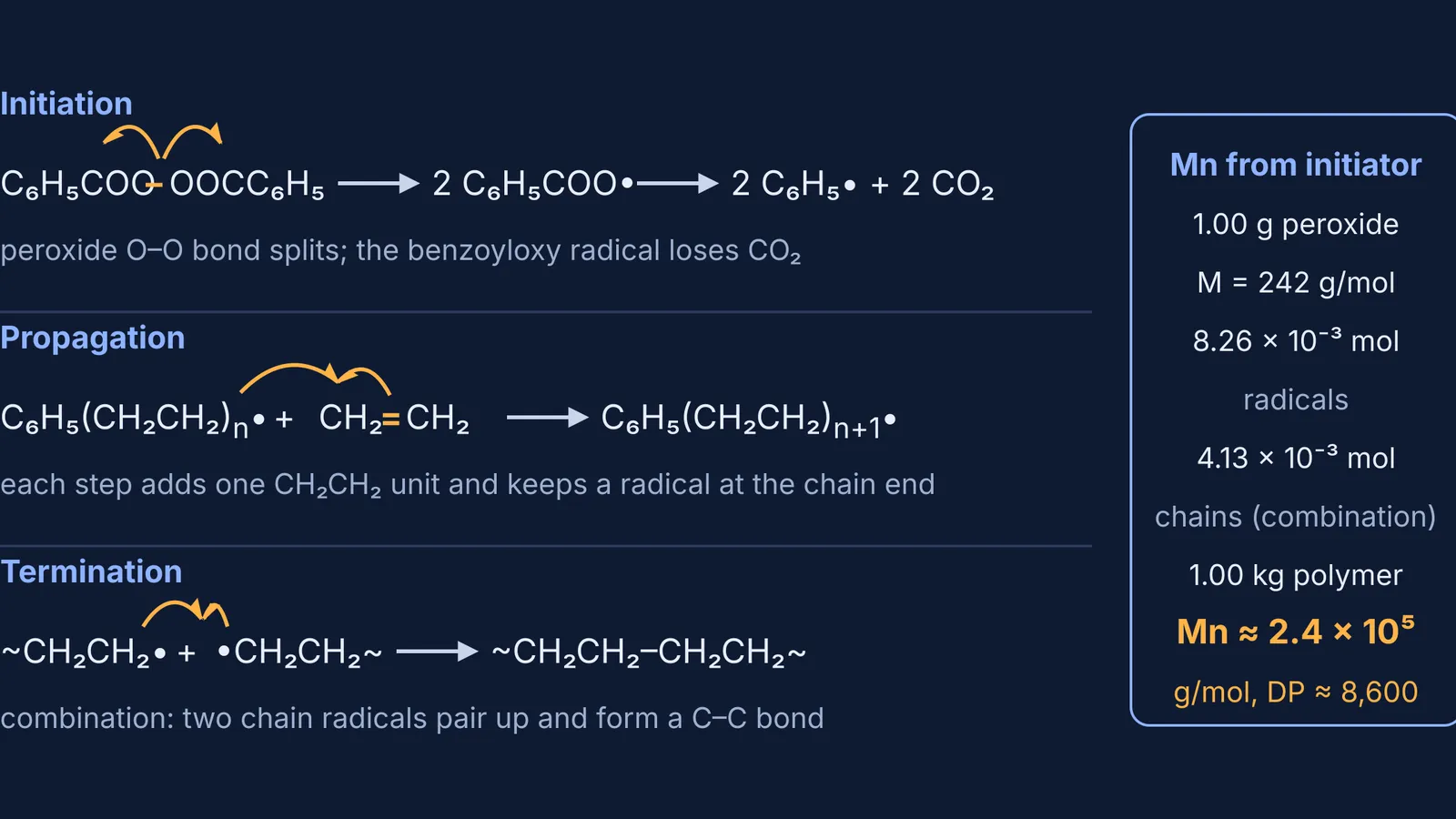
NCERT's initiator is benzoyl peroxide, (C₆H₅COO)₂. Its O–O bond is weak, so on warming it breaks homolytically. Each oxygen keeps one electron:
(C₆H₅COO)₂ → 2 C₆H₅COO•
The benzoyloxy radical then loses carbon dioxide (decarboxylation), giving the phenyl radical that NCERT writes as the starting radical:
C₆H₅COO• → C₆H₅• + CO₂
Check the balance: 14 C, 10 H and 4 O on the left of the overall change (C₆H₅COO)₂ → 2 C₆H₅• + 2 CO₂, and 12 + 2 = 14 C, 10 H and 4 O on the right. No charges appear anywhere, because radicals are neutral.
The phenyl radical now attacks ethene. One fish-hook goes from the radical's electron towards a carbon of the double bond, and one electron of the π bond moves to join it. The other π electron stays on the far carbon, which becomes the new radical centre:
C₆H₅• + CH₂=CH₂ → C₆H₅–CH₂–CH₂•
What happens in the propagation step?
The radical made in initiation adds another ethene in exactly the same way, and so does the next one:
C₆H₅–CH₂–CH₂• + CH₂=CH₂ → C₆H₅–CH₂–CH₂–CH₂–CH₂•
In general, C₆H₅(CH₂CH₂)n• + CH₂=CH₂ → C₆H₅(CH₂CH₂)n+1•, where n is the number of units already added. Each step uses up one π bond and makes one σ bond, so each step is exothermic, and the radical is never destroyed. That is why one initiating radical can add thousands of monomer units before anything stops it. For an unsymmetrical monomer such as propene or styrene, the radical adds so that the more stable radical forms, which places the units head-to-tail. For ethene both ends are the same, so this question does not arise.
How does the chain stop: combination or disproportionation?
Radicals are present in tiny concentrations, but sooner or later two growing chains meet. Two things can happen.
Combination (coupling). The two unpaired electrons pair up into a new C–C bond. Two chains become one dead chain: ~CH₂CH₂• + •CH₂CH₂~ → ~CH₂CH₂–CH₂CH₂~. This is the termination NCERT shows.
Disproportionation. One radical takes a hydrogen atom from the carbon next to the other radical's centre. One chain ends saturated (~CH₂–CH₃) and the other ends with a double bond (~CH=CH₂). Two chains go in and two dead chains come out.
Which route wins depends on the monomer and the temperature. The difference matters when you count chains, as the worked example shows.
Why is LDPE branched, and why does HDPE need a different catalyst?
NCERT's conditions for LDPE are ethene at 1000 to 2000 atm and 350 to 570 K, with traces of dioxygen or a peroxide initiator. Under these conditions a growing chain end can curl back and pull a hydrogen atom off a CH₂ group four or five carbons along its own chain. This is called back-biting, a form of chain transfer. The radical centre moves into the middle of the chain, new ethene units add there, and a short branch is left behind. Chain transfer to another polymer molecule gives long branches in the same way.
Branches stop the chains from packing closely. That is why LDPE has a lower density, is soft and flexible, and is used for squeeze bottles and films. HDPE is made at much lower pressure, about 6 to 7 atm and 333 to 343 K, with a Ziegler–Natta catalyst (triethylaluminium and titanium tetrachloride). That route is not a radical reaction, and it gives nearly linear chains that pack well. The story of those catalysts is told in Karl Ziegler, Giulio Natta and the catalysts behind plastics.
How do you find the molar mass of polythene from the initiator?
Problem. 1.00 g of benzoyl peroxide (M = 242 g mol⁻¹) is used to polymerise ethene, and 1.00 kg of polythene is obtained. Assume every radical starts one chain and every chain ends by combination. Find the number-average molar mass, Mn, and the degree of polymerisation. Then repeat for termination by disproportionation.
Moles of initiator. n = 1.00 / 242 = 4.13 × 10⁻³ mol.
Moles of radicals. Each peroxide gives two radicals, so 2 × 4.13 × 10⁻³ = 8.26 × 10⁻³ mol radicals, and 8.26 × 10⁻³ mol growing chains.
Moles of dead chains by combination. Two growing chains join to make one, so dead chains = 8.26 × 10⁻³ / 2 = 4.13 × 10⁻³ mol.
Mn. Mn = total mass / moles of chains = 1000 g / 4.13 × 10⁻³ mol ≈ 2.42 × 10⁵ g mol⁻¹.
Degree of polymerisation. The repeat unit CH₂CH₂ has M = 28 g mol⁻¹, so DP ≈ 2.42 × 10⁵ / 28 ≈ 8,600. The two C₆H₅ end groups add only 154 g mol⁻¹, which is negligible here.
Disproportionation. Now each growing chain becomes one dead chain, so there are 8.26 × 10⁻³ mol chains. Mn = 1000 / 8.26 × 10⁻³ ≈ 1.21 × 10⁵ g mol⁻¹, and DP ≈ 4,300. The molar mass halves.
For the reverse calculation, getting DP from a known molar mass, see degree of polymerisation from molar mass for polythene and nylon-6,6.
If you want to practise more initiator and chain-counting problems, the Fermi Problem Library has a step-by-step solver that explains the reasoning at each stage.
Quick checklist
Use fish-hook arrows for every step: one electron per arrow.
Initiation: (C₆H₅COO)₂ → 2 C₆H₅COO•, then C₆H₅COO• → C₆H₅• + CO₂, then C₆H₅• adds to CH₂=CH₂.
Propagation keeps one radical at the chain end and adds one monomer per step.
Termination by combination joins two chains; disproportionation gives two chains, one saturated and one with C=C.
LDPE: 1000 to 2000 atm, 350 to 570 K, O₂ or peroxide traces, branched by back-biting.
HDPE: Ziegler–Natta catalyst, low pressure, linear chains, not a radical route.
Moles of chains = radicals ÷ 2 for combination, = radicals for disproportionation.


