

On this page
Statement and match-the-list questions appear in recent JEE Main papers. Here are eight original ones.
Which experiments does JEE Main list?
NTA's Syllabus for JEE (Main) - 2027 lists 18 experiments in Physics Unit 20, Experimental Skills. Theory follows NCERT Waves, Ray Optics and Semiconductor Electronics. For least count, read how to prepare Units and Measurements for JEE Main.
Statement I/II options: (1) both correct (2) both incorrect (3) I correct, II incorrect (4) I incorrect, II correct.
Statement questions
Q1 (easy, Statement I/II). For Ohm's law with real meters, an ammeter is in series with a wire and a voltmeter is across the wire alone. Statement I: V/I is slightly below the true resistance. Statement II: A voltmeter across the ammeter and wire together would also give a smaller value.
Answer: (3). I true: the ammeter also carries the voltmeter's current, so V/I = R ∥ R_V. II false: V now includes the ammeter's drop, giving R + R_A.
Trap: (1), assuming all meter errors lower R.
Q2 (easy, statements). Zener diode experiment: which are correct?
A. The Zener is reverse-biased to find its breakdown voltage.
B. Beyond breakdown, a small voltage rise gives a large current rise.
C. No series resistor is needed.
D. A 12.0 V supply, a 6.2 V Zener and 290 Ω in series (no load) give 20 mA.
E. Doubling the series resistor raises the breakdown voltage.
(1) A, B and D only (2) A, B, C and D only (3) A, D and E only (4) B, C and E only
Answer: (1). A, B: breakdown is reverse-bias, with a sharp current rise. C false: unlimited current overheats the junction. D: (12.0 − 6.2)/290 = 0.020 A. E false: breakdown voltage belongs to the diode.
Trap: (2), forgetting the resistor.
Q3 (medium, Statement I/II). A forward-biased silicon diode carries 5.0 mA at 0.72 V and 13.0 mA at 0.76 V. Statement I: Its dynamic resistance here is about 58 Ω. Statement II: Below breakdown, its reverse current is microamperes and almost independent of voltage.
Answer: (4). I false: ΔV/ΔI = 0.04/0.008 = 5.0 Ω; 58 Ω is the static V/I. II true: reverse saturation current.
Trap: (1), using V/I.
Q4 (hard, statements). Concave mirror, parallax: object 24.0 cm, real image 40.0 cm. Using magnitudes, which are true?
A. 1/|v| against 1/|u| is a straight line of slope −1.
B. That line cuts both axes at 1/f.
C. The focal length is 15.0 cm.
D. Moving the object to 20.0 cm brings the image closer to the mirror.
E. On the u–v graph, u = v at 30.0 cm.
(1) A, B and C only (2) A, B, C and E only (3) A, C, D and E only (4) B, C, D and E only
Answer: (2). A, B: 1/|v| = 1/f − 1/|u|. C: 1/24 + 1/40 = 8/120. D false: 1/15 − 1/20 = 1/60: 60.0 cm, farther. E: u = v = 2f.
Trap: (3), guessing the image's direction.
Match-the-list questions
Q5 (easy, match). Least counts. List-I: (A) Vernier: 20 VSD = 19 MSD of 0.5 mm (B) Screw gauge: pitch 0.5 mm, 100 divisions (C) Vernier: 10 VSD = 9 MSD of 1 mm (D) Travelling microscope: 50 VSD = 49 MSD of 0.5 mm. List-II: (I) 0.005 mm (II) 0.01 mm (III) 0.025 mm (IV) 0.1 mm
(1) A-III, B-II, C-IV, D-I (2) A-IV, B-I, C-III, D-II (3) A-III, B-I, C-IV, D-II (4) A-II, B-I, C-IV, D-III
Answer: (3). Least count = MSD/n or pitch/divisions. A: 0.025 mm. B: 0.005 mm. C: 0.1 mm. D: 0.01 mm.
Trap: (1), swapping screw gauge and microscope.
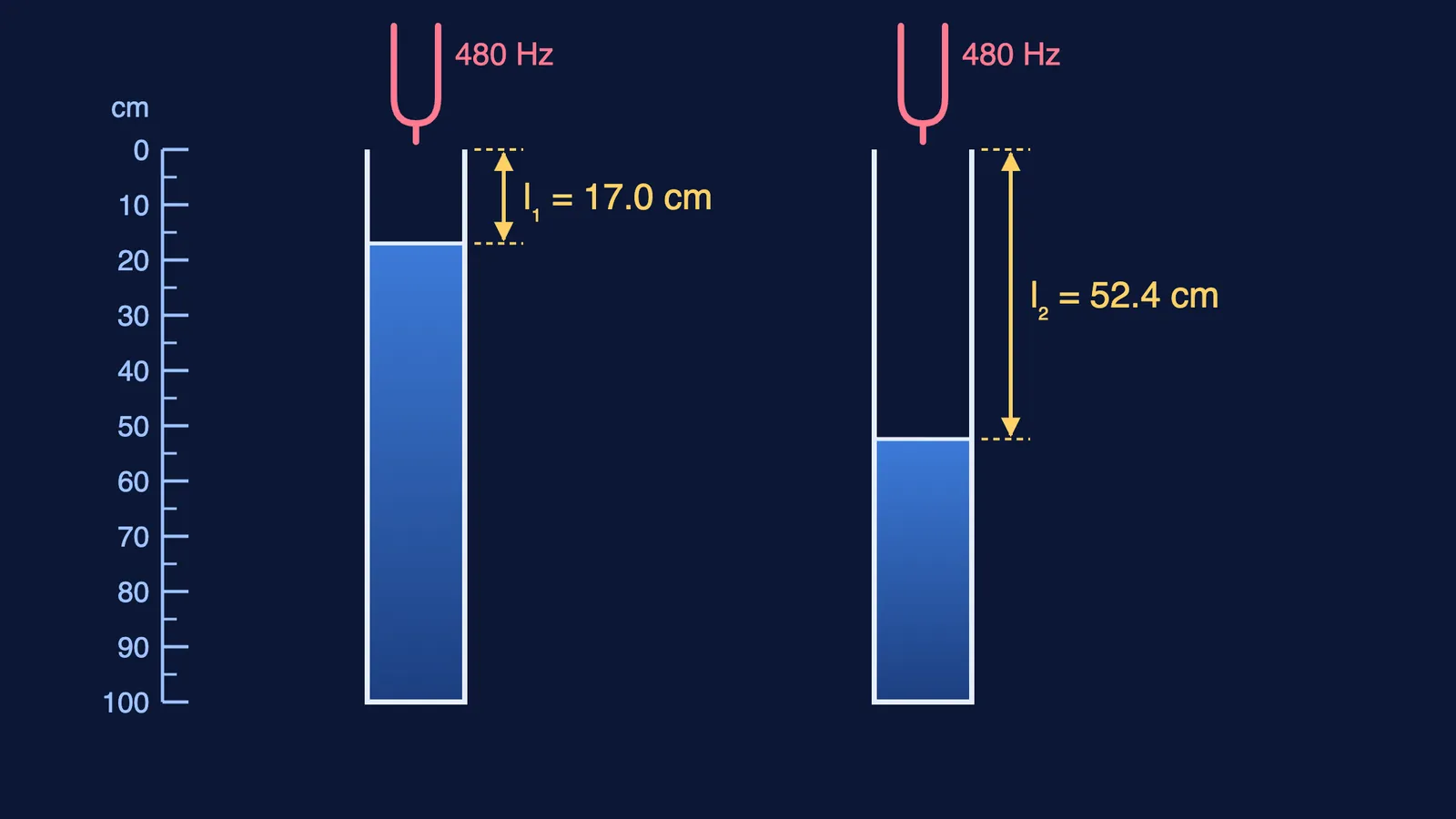
Q6 (medium, match). A 480 Hz fork resonates a tube at 17.0 cm and 52.4 cm; end correction fixed. List-I: (A) λ/4 at 480 Hz (B) Third resonance, 480 Hz (C) Second resonance, 720 Hz (D) Third resonance, 720 Hz. List-II: (I) 17.7 cm (II) 34.7 cm (III) 58.3 cm (IV) 87.8 cm
(1) A-I, B-IV, C-III, D-II (2) A-II, B-IV, C-I, D-III (3) A-I, B-III, C-II, D-IV (4) A-I, B-IV, C-II, D-III
Answer: (4). λ/2 = 52.4 − 17.0 = 35.4 cm, so A: 17.7 cm, and e = 0.7 cm. B: 52.4 + 35.4 = 87.8 cm. At 720 Hz, λ = 47.2 cm. C: 3λ/4 − e = 34.7 cm. D: 5λ/4 − e = 58.3 cm.
Trap: (1), taking the third resonance as the third harmonic.
Q7 (medium, match). Resistance from each setup. List-I: (A) Metre bridge: 30.0 Ω in left gap, X in right, null at 40.0 cm from left; X (B) V (y) against I (x) through the origin and (25.0 mA, 1.50 V) (C) Half deflection: 1980 Ω in series, a 19.8 Ω shunt halves it; G (D) V (y) against I (x), offset by a voltmeter zero error, through (20.0 mA, 1.20 V) and (50.0 mA, 2.10 V). List-II: (I) 20.0 Ω (II) 30.0 Ω (III) 45.0 Ω (IV) 60.0 Ω
(1) A-I, B-IV, C-III, D-II (2) A-III, B-IV, C-I, D-II (3) A-III, B-II, C-I, D-IV (4) A-IV, B-III, C-I, D-II
Answer: (2). A: 30.0/X = 40.0/60.0, X = 45.0 Ω. B: slope R = 1.50/0.025 = 60.0 Ω. C: G = RS/(R − S) = 20.0 Ω. D: slope R = 0.90/0.030 = 30.0 Ω, not V/I.
Trap: (1), giving X the 40.0 cm length: 20.0 Ω.
Q8 (hard, match). A 60° prism: minimum deviation 40°; at i = 40°, e = 62°. List-I: (A) i at minimum deviation (B) r₁ at minimum deviation (C) δ at i = 40° (D) The other i giving the δ in (C). List-II: (I) 30° (II) 42° (III) 50° (IV) 62°
(1) A-III, B-I, C-II, D-IV (2) A-IV, B-I, C-II, D-III (3) A-III, B-II, C-I, D-IV (4) A-III, B-I, C-IV, D-II
Answer: (1). A: (60° + 40°)/2 = 50°. B: 60°/2 = 30°. C: δ = i + e − 60° = 42°. D: swapping i and e keeps δ: 62°.
Trap: (4), taking e as the deviation.
How do you work these faster?
In a resonance tube, l₂ − l₁ = λ/2 cancels the end correction.
For an offset straight line, use the slope, not V/I at one point.
In a match, fix your surest pair first.
Right formula, wrong answer? The Fermi Problem Library has worked problems with a step-by-step solver that explains the reasoning rather than printing an answer.


