

On this page
Statement and match-the-list questions appear in recent NEET papers and are slow: every statement or pair needs its own check. Here are eight original Electrostatics questions, four per format, easy to hard.
What do these Electrostatics questions cover?
Every item fits Unit 11 of the NMC's NEET (UG)-2026 syllabus. The NEET (UG)-2026 information bulletin sets single-correct questions, +4 or −1. Facts follow NCERT Physics Chapter 1 and Chapter 2. New to the chapter? Read our guide on how to prepare Electrostatics for NEET.
Take k = 9 × 10⁹ N m² C⁻².
Statement questions
Q1 (easy, statements). Which are correct? A. Equipotential surfaces are normal to field lines. B. Field lines of a lone positive charge start on it and go to infinity. C. Electrostatic field lines can form closed loops. D. Where equal-step equipotentials crowd, the field is weaker. E. Moving a test charge along an equipotential takes no work.
(1) A, C and E only (2) A, B and E only (3) B, D and E only (4) A, B, D and E only
Answer: (2). A true, otherwise E would have a component along the surface. B true: a lone charge's lines end at infinity. C false: the field is conservative. D false: crowding means V changes fast, so E is strong. E true: ΔV = 0.
Trap: (4) reads crowding as a weak field.
Q2 (easy, Statement I/II). Statement I: In electrostatics, excess charge on a solid conductor spreads through its volume. Statement II: Just outside a charged conductor, the field is normal to its surface.
(1) Both correct (2) Both incorrect (3) I correct, II incorrect (4) I incorrect, II correct
Answer: (4). I is incorrect: E = 0 inside, so by Gauss's law excess charge sits only on the surface. II is correct: a tangential component would move surface charges.
Trap: (1) treats metal like an insulator.
Q3 (medium, Statement I/II). A dipole p sits in a uniform field E. Statement I: Its potential energy is lowest when p is along E. Statement II: Its torque is greatest when p is opposite to E.
(1) Both correct (2) Both incorrect (3) I correct, II incorrect (4) I incorrect, II correct
Answer: (3). I is correct: U = −pE cos θ is −pE, its minimum, at θ = 0. II is incorrect: τ = pE sin θ is zero at 180° and greatest at 90°.
Trap: (1) confuses unstable with maximum torque.
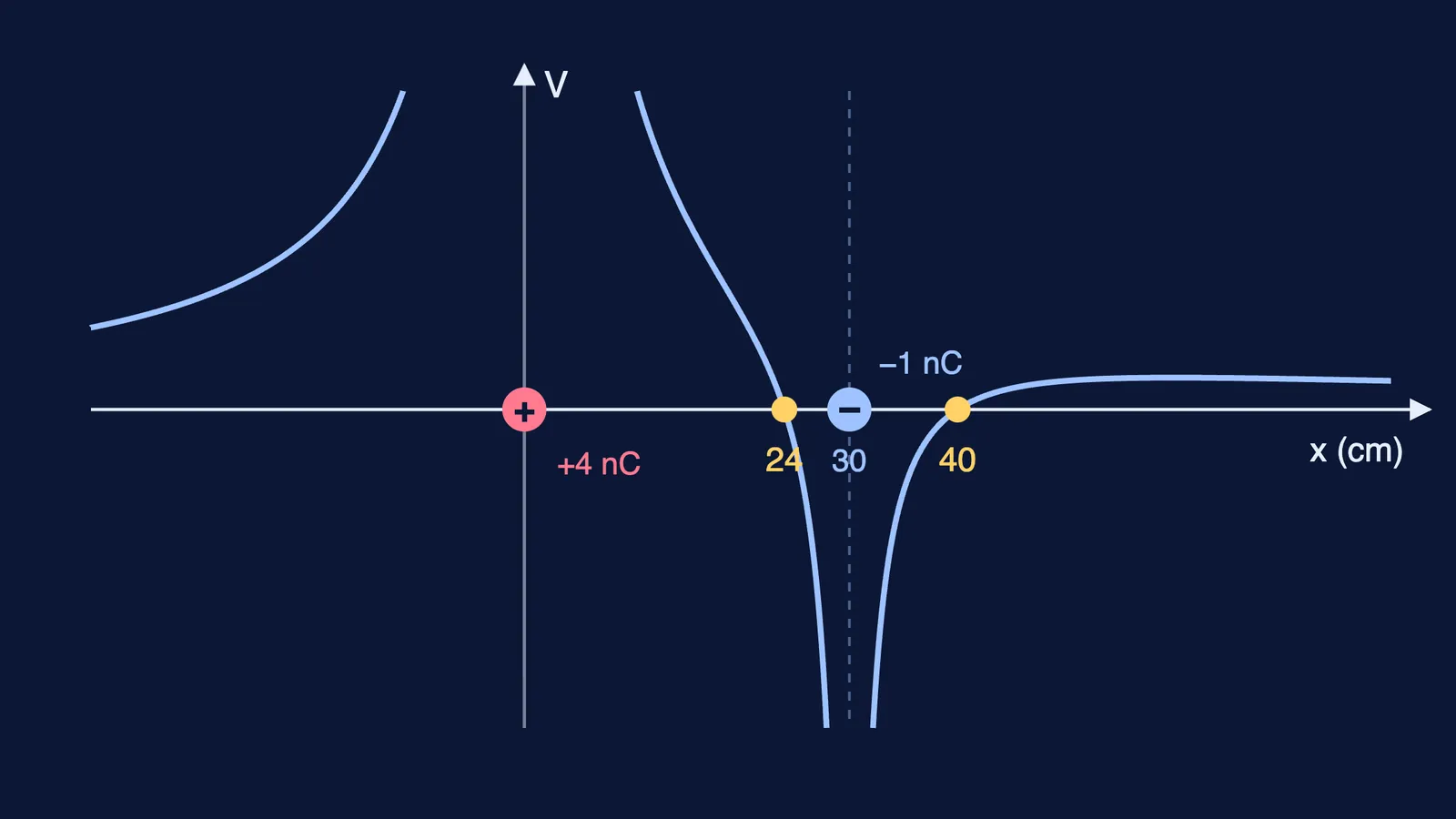
Q4 (hard, statements). Charges +4 nC at x = 0 and −1 nC at x = 30 cm lie on the x-axis. Which are correct? A. V = 0 at x = 24 cm. B. V = 0 at x = 40 cm. C. E = 0 somewhere between the charges. D. The pair's potential energy is +0.12 µJ. E. Bringing +1 nC slowly from infinity to x = 40 cm takes zero work.
(1) A, B and E only (2) A, C and E only (3) A, B and D only (4) B, D and E only
Answer: (1). A true: 4/0.24 = 1/0.06. B true: 4/0.40 = 1/0.10. C false: between unlike charges both fields point towards −1 nC and add. D false: U = kq₁q₂/r = −0.12 µJ. E true: W = qV, and V = 0 there.
Trap: (3) drops the minus sign in U.
Match-the-list questions
Q5 (easy, match). SI units. List-I: (A) electric flux (B) permittivity of free space ε₀ (C) electric dipole moment (D) linear charge density. List-II: (I) C m (II) N m² C⁻¹ (III) C² N⁻¹ m⁻² (IV) C m⁻¹.
(1) A-II, B-III, C-IV, D-I (2) A-III, B-II, C-I, D-IV (3) A-III, B-II, C-IV, D-I (4) A-II, B-III, C-I, D-IV
Answer: (4). A-II: field × area. B-III: from F = q₁q₂/4πε₀r². C-I: charge × separation. D-IV: charge per length.
Trap: (1) swaps C m and C m⁻¹.
Q6 (medium, match). List-I: (A) field magnitude on a short dipole's equatorial plane at distance r (B) field of an infinite charged sheet (C) field just outside a charged conductor (D) energy of a dipole at θ to a uniform field. List-II: (I) σ/ε₀ (II) −pE cos θ (III) σ/2ε₀ (IV) p/(4πε₀r³).
(1) A-IV, B-III, C-I, D-II (2) A-IV, B-I, C-III, D-II (3) A-II, B-III, C-I, D-IV (4) A-II, B-I, C-III, D-IV
Answer: (1). A-IV: falls as 1/r³. B-III: flux leaves both faces. C-I: E = 0 inside, so flux leaves one face. D-II: NCERT's result.
Trap: (2) swaps sheet and conductor.
Q7 (medium, match). Potential energy. List-I: (A) +2 nC and +2 nC, 10 cm apart (B) +2 nC and −2 nC, 20 cm apart (C) three +2 nC charges on an equilateral triangle of side 10 cm (D) +2 nC and +2 nC, 20 cm apart. List-II: (I) −0.18 µJ (II) +0.18 µJ (III) +0.36 µJ (IV) +1.08 µJ.
(1) A-III, B-II, C-IV, D-I (2) A-IV, B-I, C-III, D-II (3) A-III, B-I, C-IV, D-II (4) A-II, B-I, C-IV, D-III
Answer: (3). A-III: kq²/r = 0.36 µJ. B-I: twice the distance, unlike charges. C-IV: three pairs. D-II: half of A.
Trap: (1) loses the sign in B.
Q8 (hard, match). A 6 pF air capacitor is charged by a 100 V battery (30 nJ). Match the change with the stored energy. List-I: (A) battery on, gap tripled (B) battery disconnected, gap tripled (C) battery on, gap filled with a dielectric of K = 2 (D) battery disconnected, gap halved. List-II: (I) 10 nJ (II) 15 nJ (III) 60 nJ (IV) 90 nJ.
(1) A-IV, B-I, C-III, D-II (2) A-I, B-IV, C-III, D-II (3) A-I, B-IV, C-II, D-III (4) A-IV, B-I, C-II, D-III
Answer: (2). A-I: V fixed, C = 2 pF, ½CV² = 10 nJ. B-IV: Q = 600 pC fixed, Q²/2C = 90 nJ. C-III: C = KC₀ = 12 pF at 100 V. D-II: Q fixed, C = 12 pF.
Trap: (1) swaps the battery-on and battery-disconnected cases.
How do you work these faster?
Mark each statement T or F before reading the options.
For capacitors, first write "V fixed" or "Q fixed", then choose ½CV² or Q²/2C.
Keep signs in potentials and energies.
In match questions, check units first.
Unsure why σ gives σ/ε₀ in one place and σ/2ε₀ in another? The Fermi Concept Library has every concept in physics, chemistry, biology, mathematics and computing.
For a method that works in any chapter, read our strategy for NEET match-the-list questions.


