On this page
Suppose you must show that x⁵ − 6x + 3 cannot be split into two smaller polynomials with rational coefficients. Guessing factorisations goes nowhere; Eisenstein's criterion settles it by checking the coefficients against one prime.
What does Eisenstein's criterion say?
Take f(x) = aₙxⁿ + … + a₁x + a₀ with integer coefficients. As stated on Wikipedia's page on Eisenstein's criterion, f is irreducible over the rational numbers if there is a prime p such that:
p divides every coefficient a₀, a₁, …, aₙ₋₁;
p does not divide the leading coefficient aₙ;
p² does not divide the constant term a₀.
Irreducible over Q means f cannot be written as a product of two non-constant polynomials with rational coefficients. By Gauss's lemma), a primitive polynomial (one whose coefficients share no common factor) is irreducible over the integers exactly when it is irreducible over the rationals, so one test answers both questions.
The name hides a second discoverer. Theodor Schönemann published a version of the test in 1846 and Gotthold Eisenstein published a somewhat different version in 1850, both in Crelle's Journal. Because Schönemann was first, the result was also known in the early 20th century as the Schönemann–Eisenstein theorem; David Cox tells the story in a 2011 article in The American Mathematical Monthly.
How do you apply Eisenstein's criterion?
Example 1 is x⁵ − 6x + 3. Write out all six coefficients, zeros included: 1, 0, 0, 0, −6, 3. Try p = 3.
3 divides 0, 0, 0, −6 and 3, so condition 1 holds.
3 does not divide the leading 1, so condition 2 holds.
9 does not divide 3, so condition 3 holds.
So x⁵ − 6x + 3 is irreducible over Q. The prime p = 2 fails at once, because 2 does not divide 3, but you only need one prime that works.
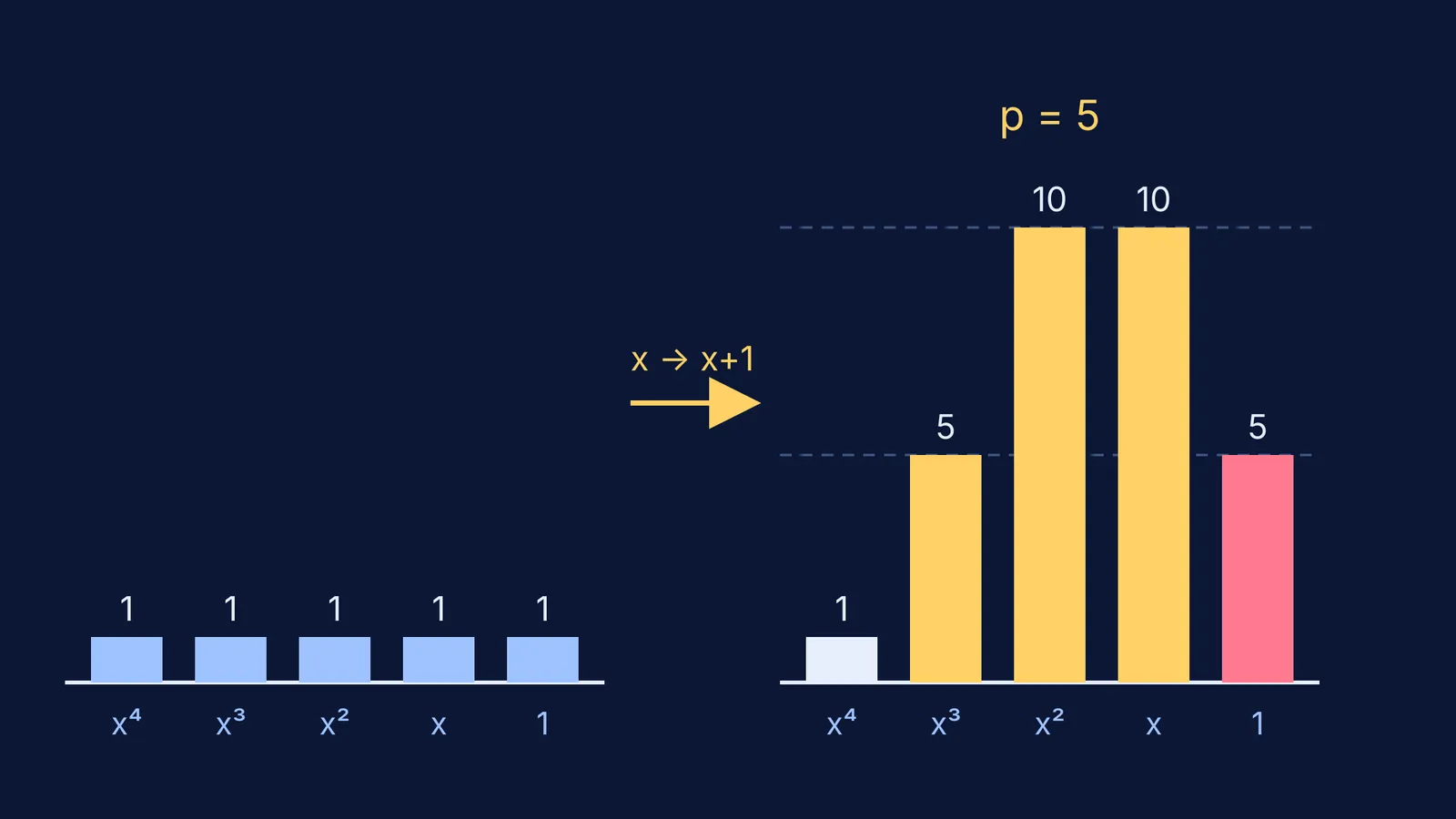
Example 2 is x⁴ + x³ + x² + x + 1, the fifth cyclotomic polynomial, (x⁵ − 1)/(x − 1). Every coefficient is 1, so no prime divides them. The trick is to substitute x + 1 for x: a polynomial f(x) is irreducible exactly when f(x + 1) is, because a factorisation of one becomes a factorisation of the other by shifting back.
Apply x → x + 1 to (x⁵ − 1)/(x − 1):
((x + 1)⁵ − 1)/x = x⁴ + 5x³ + 10x² + 10x + 5.
Now p = 5 works: 5 divides 5, 10, 10 and 5; 5 does not divide the leading 1; 25 does not divide 5. So x⁴ + x³ + x² + x + 1 is irreducible over Q.
The same shift proves that xᵖ⁻¹ + … + x + 1 is irreducible for every prime p: the binomial coefficients C(p, k) with 0 < k < p are all divisible by p and the constant term is p itself, as the Eisenstein's criterion page explains. To see why those coefficients carry the prime, our piece on Kummer's theorem and prime powers in binomial coefficients works through it.
What if Eisenstein's criterion does not apply directly?
Failing the test proves nothing: the criterion is a sufficient condition, not a necessary one. The same Wikipedia page gives x² + x + 2, where no prime divides the middle coefficient 1, until the shift x → x + 3 turns it into x² + 7x + 14, which passes with p = 7. Here is the order we suggest:
Make it primitive. Divide out any common factor of the coefficients first.
Try each prime that divides the constant term. Only those can satisfy condition 1.
Shift. Try x → x + 1, then x → x − 1, then x → x + 2. For x⁴ + 1, the shift x → x + 1 gives x⁴ + 4x³ + 6x² + 4x + 2, which passes with p = 2.
Reverse the coefficients (constant term not zero). The page's example is 2x⁵ − 4x² − 3, whose reverse passes with p = 2.
Reduce modulo a prime. If f is irreducible mod a prime p that does not divide its leading coefficient, then f is not a product of two non-constant integer polynomials, as the irreducible polynomial page states.
For degree 2 or 3, look for rational roots. The same page notes that a reducible quadratic or cubic must have a linear factor, so no rational root means irreducible over Q.
Steps 5 and 6 together handle x³ + x + 1, where no prime divides the constant term 1. Modulo 2, f(0) = 1 and f(1) = 1, so it has no root mod 2, and a cubic with no linear factor cannot factor at all. It is therefore irreducible mod 2, and 2 does not divide the leading 1, so it is irreducible over Q.
Where can you practise it?
After any shift, recompute every coefficient and check condition 3 on the new constant term, not the old one. If words like primitive or cyclotomic are new to you, the Fermi Concept Library gives each concept in mathematics its own lesson and its place in the map. To practise, the Fermi Problem Library has worked problems with a step-by-step solver that explains the reasoning rather than printing an answer.
Once you can prove a polynomial does not factor, the next question is how many real roots it has; Sturm's theorem for counting real roots answers that.