On this page
Take two small sets of remainders, add every element of one to every element of the other, and count how many different answers you get. When the modulus is a prime, the theorem says those answers cannot crowd together: there are always at least as many as the two sizes added, minus one, unless they already fill every remainder.
What is a sumset mod p?
Work in Z/pZ, the remainders 0, 1, ..., p−1 with addition taken mod p. For sets A and B of remainders, the sumset A+B is the set of all a+b (mod p) with a in A and b in B. Repeats count once, so A+B often has fewer elements than the |A| × |B| pairs you add.
What does the Cauchy–Davenport theorem say?
For a prime p and nonempty subsets A and B of Z/pZ, |A+B| ≥ min(p, |A|+|B|−1), stated as Theorem 1.1 in Boothby, DeVos and Montejano's paper on Kemperman's theorem. The same paper notes that Cauchy proved this in 1813 and that Davenport rediscovered it in 1935; Davenport's paper is On the addition of residue classes in the Journal of the London Mathematical Society.
The "min(p, ...)" part is there because a sumset can never have more than p elements: once |A|+|B| > p, the theorem says A+B is all of Z/pZ.
When is the bound exactly reached?
Arithmetic progressions with the same common difference are the extreme case. If A = {0, 1, 2} and B = {0, 1}, then A+B = {0, 1, 2, 3}, exactly 3 + 2 − 1 = 4 elements. Sums of two progressions with step d form a progression with step d, so the lengths simply add, minus one for the overlap.
Vosper proved in 1956 that, apart from a few edge cases, these are the only sets that reach the bound. Theorem 1.3 in the Boothby, DeVos and Montejano paper states the edge cases: one set has a single element, |A|+|B| > p (so A+B is all of Z/pZ), or |A|+|B| = p and the sumset has exactly p−1 elements. Outside those cases, |A+B| = |A|+|B|−1 forces A and B to be arithmetic progressions with a common difference.
A worked example mod 7
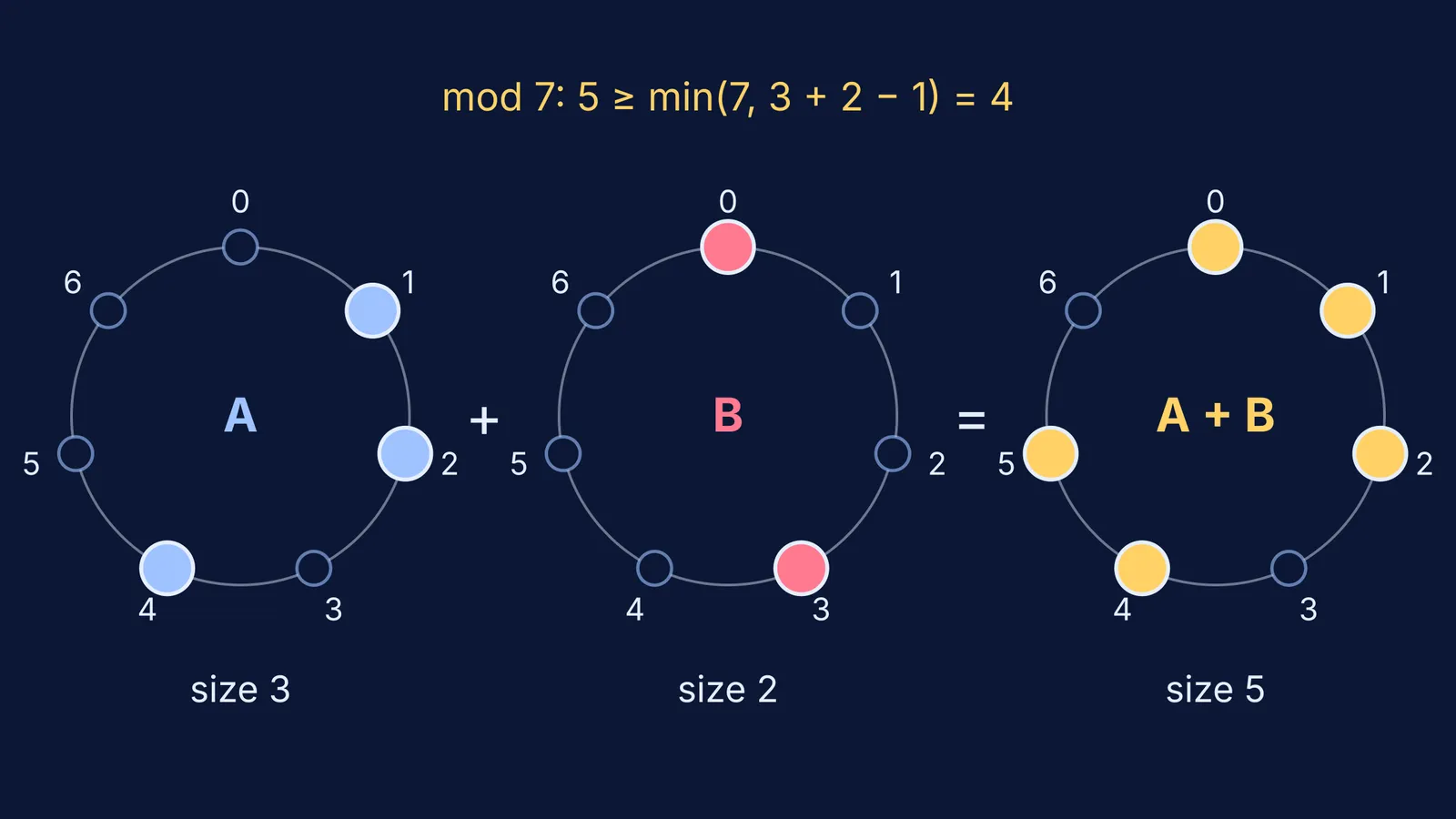
Let p = 7, A = {1, 2, 4} and B = {0, 3}. The theorem promises |A+B| ≥ min(7, 3 + 2 − 1) = 4.
Add 0 to each element of A: 1, 2, 4.
Add 3 to each element of A: 4, 5, 7 ≡ 0.
Collect the distinct remainders: A+B = {0, 1, 2, 4, 5}.
Count: 5 elements, which is at least 4. The bound holds, with room to spare, because A is not a progression.
Now try a progression that wraps around: A = {0, 3, 6} and B = {1, 4}, both with step 3. The sums are 1, 4, 4, 7 ≡ 0, 7 ≡ 0 and 10 ≡ 3, so A+B = {0, 1, 3, 4}. That is exactly 4 elements: the equality case.
Why does it fail mod 8?
The theorem needs a prime modulus because composite moduli have subgroups. As the Boothby, DeVos and Montejano paper puts it, if H is a proper nontrivial subgroup and A = B = H, then A+B = H, so the sumset does not grow at all.
Mod 8, take A = B = {0, 2, 4, 6}. Every sum of two even numbers is even, so A+B = {0, 2, 4, 6}: 4 elements, while the bound would demand min(8, 4 + 4 − 1) = 7. Smaller still, A = B = {0, 4} gives A+B = {0, 4}, 2 elements against a promised 3.
Mod a prime, this trap cannot happen. By Lagrange's theorem on group order, a subgroup's size divides p, so the only subgroups are {0} and the whole of Z/pZ.
How do you use it in an olympiad problem?
A short checklist:
Is the modulus prime? If not, look for a subgroup that could trap the sums.
Write down |A| and |B| and compute min(p, |A|+|B|−1).
For a sum of k sets, apply the theorem repeatedly: |A1 + ... + Ak| ≥ min(p, |A1| + ... + |Ak| − (k−1)).
If the problem says the bound is tight, test for a common difference.
It sits in the same family as Schur's theorem on sum-free colourings: both ask what structure is forced when you add elements of a set.
To revise modular arithmetic, groups and cosets before you try harder problems, the Fermi Concept Library gives every concept in mathematics its own lesson and its place in the map. When you get stuck on a counting step, the Fermi Problem Library has worked problems with a step-by-step solver that explains the reasoning rather than printing an answer.