

On this page
The extreme value theorem and compactness in first-year analysis both lean on this one result. Here are both standard proofs, one sequence worked by hand, and where it stops working.
What does the Bolzano–Weierstrass theorem say?
The Bolzano–Weierstrass theorem states that every bounded sequence in ℝⁿ has a convergent subsequence. The same page records that Bolzano first proved it in 1817 as a lemma in his proof of the intermediate value theorem, and that Weierstrass proved it again some fifty years later, once the result was seen as important in its own right.
Two words do the work. Bounded means there is a number M with −M ≤ x_n ≤ M for every n. A subsequence keeps infinitely many terms in their original order: x_{n_1}, x_{n_2}, x_{n_3}, … with n_1 < n_2 < n_3 < …. The theorem does not say the sequence converges; sin n does not. It says you can always pick out a part of it that does.
How does the bisection proof work?
This is the nested-intervals argument, and it is the one to draw.
All terms lie in [−M, M]. Cut it in half. At least one half contains x_n for infinitely many n. Keep that half.
Halve again, keeping a half that still holds infinitely many terms. Repeat forever. The k-th interval has length 2M/2^(k−1), which shrinks to zero.
Pick n_1 with x_{n_1} in the first interval, then n_2 > n_1 with x_{n_2} in the second, and so on. A later index always exists because each interval holds infinitely many terms.
Nested intervals with lengths going to zero close in on one point L (completeness of the real numbers). x_{n_k} and L share the k-th interval, so x_{n_k} → L.
Completeness is used once, in step 4. Over the rationals the proof fails.
What is the peak-point proof?
The second proof, also given on the Wikipedia page, shows something stronger: every real sequence has a monotone subsequence. Call an index N a peak if x_N ≥ x_m for every m > N.
Infinitely many peaks: list them in order. Each peak is at least as large as every later term, so the peaks form a non-increasing subsequence.
Finitely many peaks: start after the last one. Every index there is not a peak, so some later term is strictly larger. Jump to it, and repeat. You get a strictly increasing subsequence.
Either way the subsequence is monotone. If the sequence is bounded, the monotone convergence theorem says a bounded monotone sequence of real numbers converges (to its supremum if increasing, its infimum if decreasing). That finishes the proof.
Worked example: what subsequence of sin n converges?
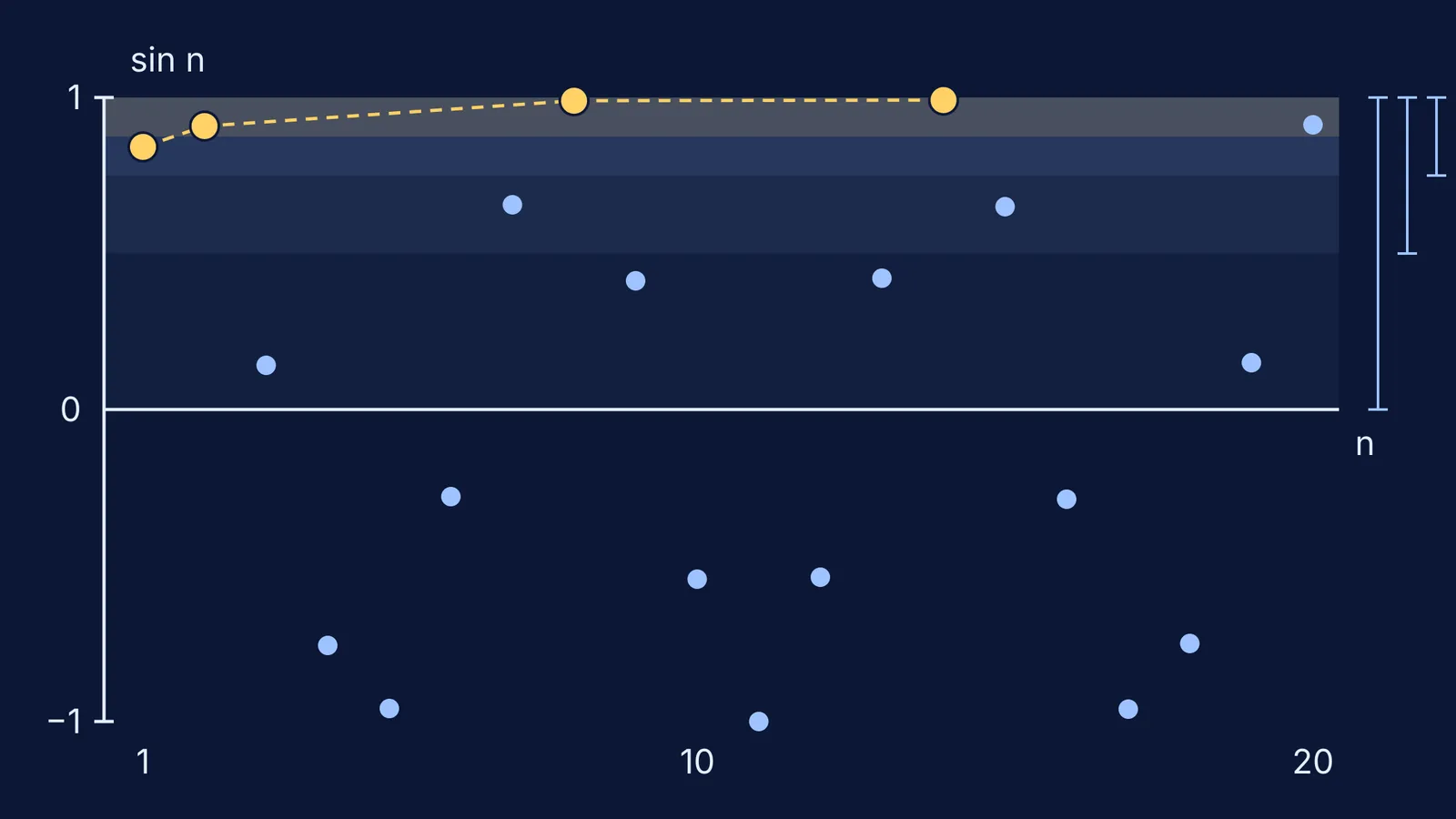
Take x_n = sin n, with n in radians. It is bounded by 1, so the theorem applies. Here are the first twenty terms to three places: 0.841, 0.909, 0.141, −0.757, −0.959, −0.279, 0.657, 0.989, 0.412, −0.544, −1.000, −0.537, 0.420, 0.991, 0.650, −0.288, −0.961, −0.751, 0.150, 0.913.
Bisection, by hand. Eleven of the twenty are in [0, 1], so keep it. Of those, seven are in [0.5, 1]; keep it. Five are in [0.75, 1], then four in [0.875, 1]. Picking one new index from each interval gives n = 1, 2, 8, 14, with values 0.841, 0.909, 0.989, 0.991. Twenty terms only illustrate the idea; the proof needs infinitely many in each half.
Peak points. Because π is irrational, so is 1/(2π), and the equidistribution theorem says that the multiples of an irrational number, taken mod 1, are spread evenly around the circle. So n/(2π) mod 1 comes arbitrarily close to 1/4 for infinitely many n, which makes sin n come arbitrarily close to 1. Yet sin n never equals 1. So every term is beaten by a later one: sin n has no peaks. The second branch applies, and jumping to the next larger term gives 1, 2, 8, 14, 33, … (sin 33 ≈ 0.99991). This increasing subsequence converges to 1.
Why does it fail in infinite dimensions?
Let ℓ² be the space of sequences whose squares add up to a finite number, and let e_k be the sequence with a 1 in place k and 0 elsewhere. Every e_k has length 1, so the sequence e_1, e_2, … is bounded. But any two different terms are √2 apart, so no subsequence can settle down. No subsequence converges.
Bisection breaks because there are infinitely many coordinates to halve. Riesz's lemma makes this general: a normed vector space is finite-dimensional exactly when its closed unit ball is compact.
How to practise it this week
Write the bisection proof from memory and mark the line that uses completeness.
Repeat the sin n bisection with cos n.
Prove that (−1)^n + 1/n has a convergent subsequence both ways.
If supremum or compactness still feels loose, the Fermi Concept Library gives each concept its own lesson. When a proof stalls, the Fermi Problem Library has worked problems with a step-by-step solver that explains the reasoning rather than printing an answer.


