

On this page
Bolzano–Weierstrass says every bounded sequence of real numbers has a convergent subsequence. The Arzelà–Ascoli theorem makes the same promise for functions, with one extra condition: equicontinuity.
What does equicontinuity mean?
A single continuous function f has a δ for every ε. Usually that δ depends on f: a steeper function needs a smaller δ. A family of functions is equicontinuous when one δ works for all of them at once. Wikipedia's statement of the theorem puts it this way: for every ε > 0 there is a δ > 0 such that |fₙ(x) − fₙ(y)| < ε whenever |x − y| < δ, for every function fₙ in the sequence. The same page adds that δ "may depend on ε, but not x, y or n."
The second condition is easier. The sequence is uniformly bounded if one number M satisfies |fₙ(x)| ≤ M for every n and every x in [a,b] (same page).
A worked contrast:
gₙ(x) = sin(nx)/n is equicontinuous. Its slope is cos(nx), which never exceeds 1 in size. By the mean value theorem, |gₙ(x) − gₙ(y)| ≤ |x − y| for every n. So δ = ε works for the whole family.
hₙ(x) = sin(nx) on [0, π] is not equicontinuous. Take x = 0 and y = π/(2n). The two points are π/(2n) apart, which shrinks to 0, yet hₙ(y) − hₙ(x) = 1 every time. With ε = 1/2, no single δ can work.
Both families are bounded by 1. Steepness is what separates them.
What does the Arzelà–Ascoli theorem say?
In its classroom form, the theorem says that if a sequence of continuous real functions on a closed, bounded interval [a,b] is uniformly bounded and equicontinuous, then some subsequence converges uniformly (statement on Wikipedia). The converse also holds. If every subsequence has a uniformly convergent subsequence, the sequence must be uniformly bounded and equicontinuous.
The same article records that Giulio Ascoli proved a weaker form, the sufficient condition, in 1883–84. Cesare Arzelà proved the necessary condition in 1895 and gave the first clear presentation of the result. The MacTutor biography of Arzelà names that 1895 paper, Sulle funzioni di linee.
Why does fₙ(x) = xⁿ have no uniformly convergent subsequence?
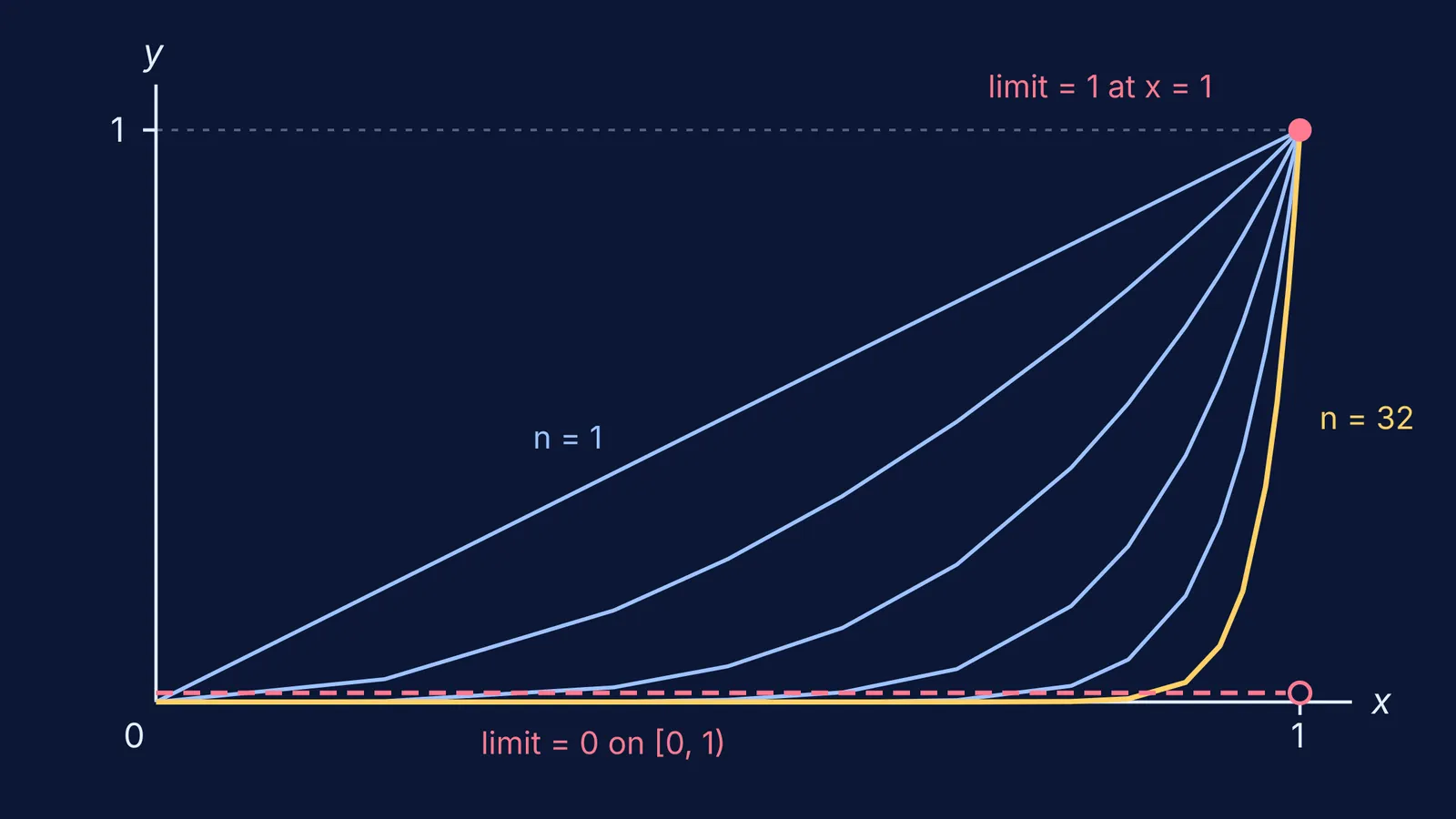
On [0,1], every xⁿ lies between 0 and 1, so the sequence is uniformly bounded. Now look at its pointwise limit. For x < 1, xⁿ → 0. At x = 1, xⁿ = 1 for every n. The limit function is 0 everywhere except a jump to 1 at the right end.
Every subsequence has this same pointwise limit. A uniform limit of continuous functions must be continuous, and this limit is not. So no subsequence converges uniformly.
So equicontinuity must fail, and you can see where. Take ε = 1/2 at x = 1. For any δ, pick x = 1 − δ/2. Since (1 − δ/2)ⁿ → 0, for large n the gap fₙ(1) − fₙ(x) exceeds 1/2. The slope at 1 is n, so the curves steepen without limit.
How does the proof work?
The Wikipedia proof is a diagonal argument over the rationals:
List the rationals in [a,b] as q₁, q₂, q₃, … (they are countable).
The numbers fₙ(q₁) are bounded, so Bolzano–Weierstrass gives a subsequence converging at q₁.
From it, pick a further subsequence converging at q₂, then q₃, and so on. Each list sits inside the one before.
Take the diagonal: the 1st function of list 1, the 2nd of list 2, and so on. From position k onward it lies inside list k, so it converges at every rational.
Use equicontinuity to reach every x. Given ε, take the common δ. Finitely many rationals put every x of [a,b] within δ of one of them. For large k and m, the kth and mth diagonal functions agree to within ε at those rationals. The triangle inequality makes them agree to within 3ε at every x. The sequence is uniformly Cauchy, so it converges uniformly.
If uniform convergence or Bolzano–Weierstrass feels shaky, look it up in the Fermi Concept Library before going back to the proof.
How do you check a family in an exam question?
Is there one bound M for every function at every point? If not, the theorem does not apply.
Is there a common slope bound, |fₙ′(x)| ≤ L for all n and x? Then δ = ε/L works and the family is equicontinuous.
If the slopes blow up, look for points xₙ and yₙ that get closer together while |fₙ(xₙ) − fₙ(yₙ)| stays above a fixed ε. That proves equicontinuity fails, as with sin(nx).
If the pointwise limit exists and is discontinuous, as with xⁿ, no subsequence can converge uniformly.
Check the domain. The theorem as stated needs a closed, bounded interval.
To practise, try this checklist on xⁿ/n or on n·x·e^(−nx) on [0,1]. If a step goes wrong, the Fermi Problem Library has a step-by-step solver that explains the reasoning rather than printing an answer.


