

On this page
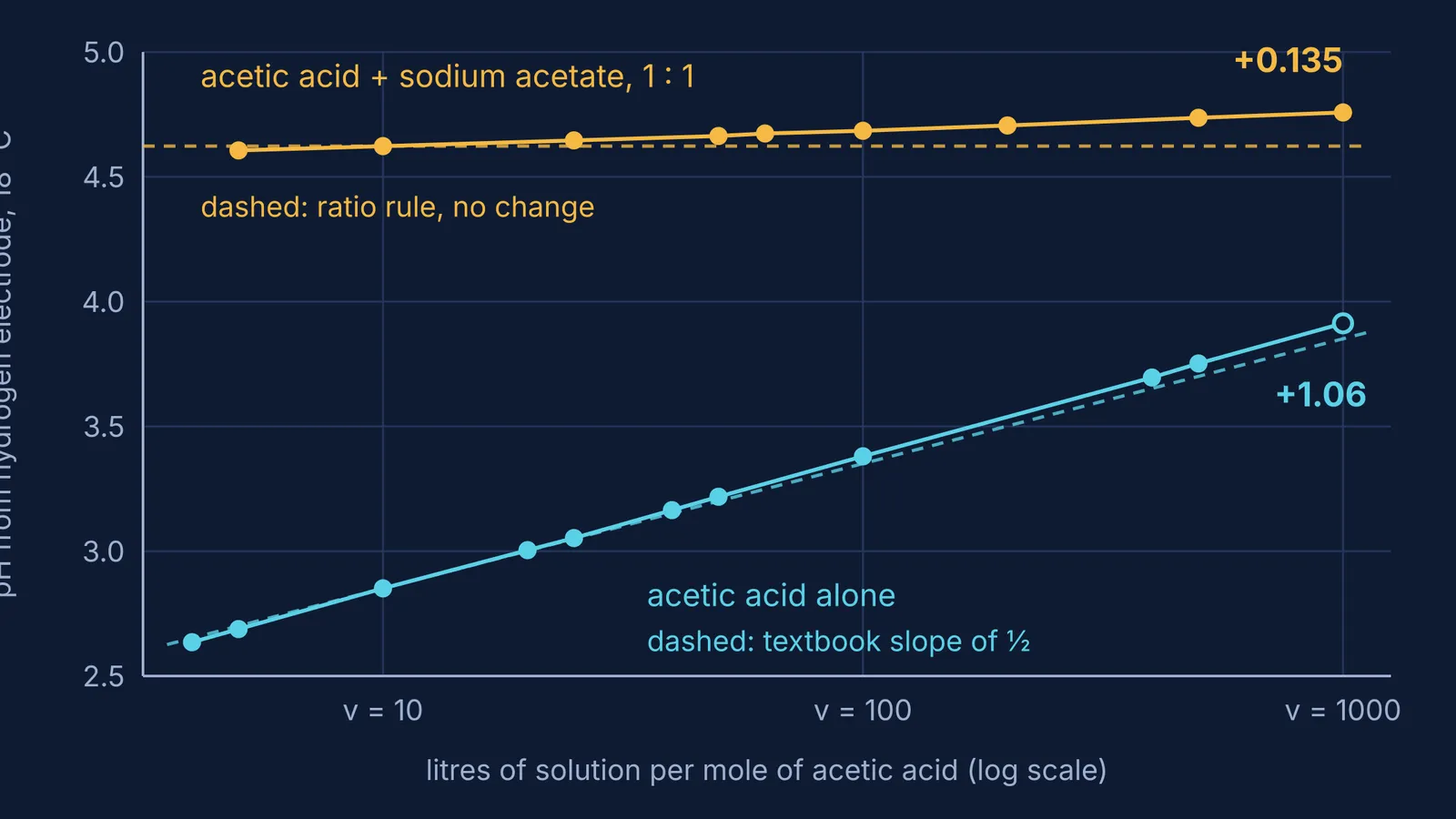
Every buffer chapter says that diluting a buffer leaves its pH almost where it was, while diluting a weak acid raises its pH. In 1914 George Stanley Walpole put numbers on both. He diluted acetic acid, and an acetic acid–sodium acetate buffer, a hundred-fold and more, and read the pH of each with a hydrogen electrode. The acid's pH rose by about 1.06. The buffer's rose by about 0.135.
Who was George Stanley Walpole?
He wrote two papers in the same issue: "Hydrogen potentials of mixtures of acetic acid and sodium acetate", J. Chem. Soc. Trans. 105 (1914) 2501–2521, and "The effect of dilution on the hydrogen potentials of acetic acid and 'standard acetate' solutions", pages 2521–2529. We read both in the scanned 1914 volume and checked every number below against the page images. The first paper is signed from the Wellcome Physiological Research Laboratories, Herne Hill, London. We have not checked anything else about his life.
Acetate mixtures were used as "regulator mixtures", what we now call buffers, in work on protein solutions, so he needed their exact pH.
How did a hydrogen electrode measure pH in 1914?
A platinum-black electrode bathed in hydrogen gives a potential that depends on the H⁺ in solution. Walpole measured it against a 0.1 N calomel electrode at 18 °C. His conversion was:
E = 0.3377 + 0.0577 × pH (volts)
The 0.0577 is 2.303RT/F at 18 °C. Python gives 0.05777 V at 291.15 K, against the familiar 0.0592 V at 25 °C. The 0.3377 V is the cell constant he took from Sørensen.
His check solution was "standard acetate", 0.1 N acetic acid plus 0.1 N sodium acetate. He measured it as 0.6046 V, in "good accord" with Sørensen and Koefoed and with Michaelis (0.6045 V). The pH it gives is (0.6046 − 0.3377) ÷ 0.0577 = 4.626.
What happened when he diluted acetic acid alone?
He wrote concentrations as v, the litres of solution holding one mole of acetic acid. So v = 10 means 0.1 M and v = 1000 means 0.001 M. From his Table I (EMF corrected for the small liquid-junction potential):
v = 10: 0.50220 V, pH 2.851
v = 100: 0.53273 V, pH 3.380
v = 1000: 0.56347 V, pH 3.913 (he put this value in brackets: it was extrapolated, not measured)
From 0.1 M to 0.001 M the pH rises by 1.06. Using only measured points, v = 5 to v = 500, it rises by 1.064. His EMF was a straight line in log v: 0.53 pH units per tenfold dilution.
What happened when he diluted the buffer?
Table II of the second paper did the same for standard acetate, keeping the 1 : 1 ratio:
v = 5 (0.2 M of each): 0.60345 V, pH 4.606
v = 10 (0.1 M): 0.60445 V, pH 4.623
v = 100 (0.01 M): 0.60798 V, pH 4.684
v = 1000 (0.001 M): 0.61223 V, pH 4.758
Over the same hundred-fold dilution, v = 10 to v = 1000, the pH rises by 0.135, about one-eighth of the acid's change. It is not noise: his electrodes agreed within 0.1 millivolt, and 0.135 pH units is 7.8 millivolts. In his first paper, after a twenty-fold dilution test, he wrote that the statement that the pH of these mixtures "is independent of dilution holds rigidly for only one particular acetic acid–acetate mixture".
Worked example 1: from voltage to pH and Ka
Take his acetic acid at v = 10 (0.100 M), E = 0.50220 V.
pH. pH = (0.50220 − 0.3377) ÷ 0.0577 = 0.16450 ÷ 0.0577 = 2.851.
[H⁺]. 10⁻²·⁸⁵¹ = 1.41 × 10⁻³ M.
Ka. Ka = [H⁺]² ÷ (c − [H⁺]) = (1.41 × 10⁻³)² ÷ (0.100 − 0.0014) = 2.0 × 10⁻⁵. He printed 20.2 × 10⁻⁶.
Textbook prediction for dilution. For a weak acid, [H⁺] ≈ √(Ka·c), so pH = ½(pKa − log c). Dilute 100-fold and log c falls by 2, so pH rises by 1.00. Solving the quadratic without the approximation gives 1.03 for Ka = 1.8 × 10⁻⁵.
Compare. He measured 1.06. His Ka fell slowly with dilution (18.1 × 10⁻⁶ at v = 100), which he reported without claiming to explain it.
Worked example 2: why the buffer drifts (modern view)
The ratio rule uses concentrations. A modern treatment uses activities, a = γ × concentration, where γ is the activity coefficient. In dilute solution γ for an ion is below 1 and rises towards 1 as ionic strength falls. The steps below use today's ideas and 25 °C constants, not Walpole's, so they are approximate.
Henderson with activities. pH = pKa + log(γ[A⁻] ÷ [HA]), taking γ = 1 for the neutral acid.
At 0.1 M of each. Ionic strength I ≈ 0.1 (from Na⁺ and CH₃COO⁻). The Davies equation, log γ = −0.51(√I ÷ (1 + √I) − 0.3I), gives log γ = −0.107, γ ≈ 0.78. With pKa 4.76, pH ≈ 4.65.
At 0.001 M of each. I ≈ 0.001, log γ = −0.015. Now the acid's own dissociation matters too: about 2% of it ionises, nudging the ratio up. Solving both together gives pH ≈ 4.76.
Predicted drift. About 0.11, against his measured 0.135: most of the drift is the ionic-strength effect.
Walpole had his own version of step 1. He wrote [H⁺] = Ka·C ÷ (αC′), where C′ is the sodium acetate concentration and α its degree of dissociation from conductivity. For standard acetate α = 61.1 ÷ 76.8 = 0.796, and log 0.796 = −0.099. That is close to the modern log γ of −0.107.
His first paper's Table I shows the ratio rule working when the total concentration stays at 0.2 N. Subtract log(acetate ÷ acid) from each printed pH: 1 : 1 gives 4.626, 0.08 : 0.12 gives 4.626, 0.05 : 0.15 gives 4.616, 0.02 : 0.18 gives 4.620. The ratio term holds; only the constant differs from the textbook pKa. He took Ka as 18.83 × 10⁻⁶, which his footnote calls "a purely arbitrary value chosen so that the calculated E.M.F. for 'standard acetate' will agree with the observed value."
To practise EMF-to-pH and Henderson questions with every step shown, try the Fermi Problem Library, a step-by-step solver that explains the reasoning. For timed JEE practice, Fermi Test Prep covers JEE Main and Advanced with an AI tutor.
How does this fit with the textbook buffer story?
The ratio argument in why a buffer's pH stays the same on dilution is what exams test, and Walpole's tables support it to a first approximation. They add the size of the effect: 0.135 for the buffer against 1.06 for the acid. For buffer capacity, which does fall on dilution, see Henderson–Hasselbalch buffer problems.
Quick checklist
Hydrogen electrode at 18 °C: E = 0.3377 + 0.0577 pH in Walpole's cell; 0.0577 = 2.303RT/F.
Weak acid, 100-fold dilution: textbook +1.00, quadratic +1.03, Walpole +1.06.
1 : 1 acetate buffer, same dilution: ratio rule 0, Walpole +0.135.
In exams, use pH = pKa + log([A⁻]/[HA]) and say the pH is unchanged on dilution unless activities are asked for.


