

On this page
In 1912 a chemist at Presidency College, Calcutta, looked at a famous chemist's poor yield and found a stoichiometry mistake inside it. F. D. Chattaway could turn only about a quarter of his urea into dichlorourea, and he blamed hydrolysis. Rasik Lal Datta showed that the reaction makes its own obstacle: the HCl it releases ties up two of every three urea molecules, so one-third is the most you could ever get. It is a limiting-reagent problem in disguise, and you can check every step with Class 11 mole arithmetic.
Who was Rasik Lal Datta, and what did he publish?
The paper is Rasik Lal Datta, "The Formation of Dichlorocarbamide and its Behaviour Towards Amines", Journal of the Chemical Society, Transactions, volume 101 (1912), pages 166–169 (DOI 10.1039/CT9120100166; scan on the Internet Archive). "Carbamide" is the old name for urea, and dichlorocarbamide is CO(NHCl)₂. The paper is signed from the Chemical Laboratory, Presidency College, Calcutta. Datta closes by thanking "Professor P. C. Ray for his encouragement". Beyond that address and that line, we have not checked his biography, so this post sticks to what the paper says. Numbers and quotes below were checked against the page images.
This post is history and arithmetic only. N-chloro compounds and nitrogen trichloride, which turns up below, are hazardous, and nothing here is a procedure.
What did Chattaway say went wrong?
Datta was making dichlorourea by Chattaway's method, and the yield was poor. He quotes Chattaway's equation, a swap of two N–H hydrogens for chlorine:
CO(NH₂)₂ + 2Cl₂ → CO(NHCl)₂ + 2HCl
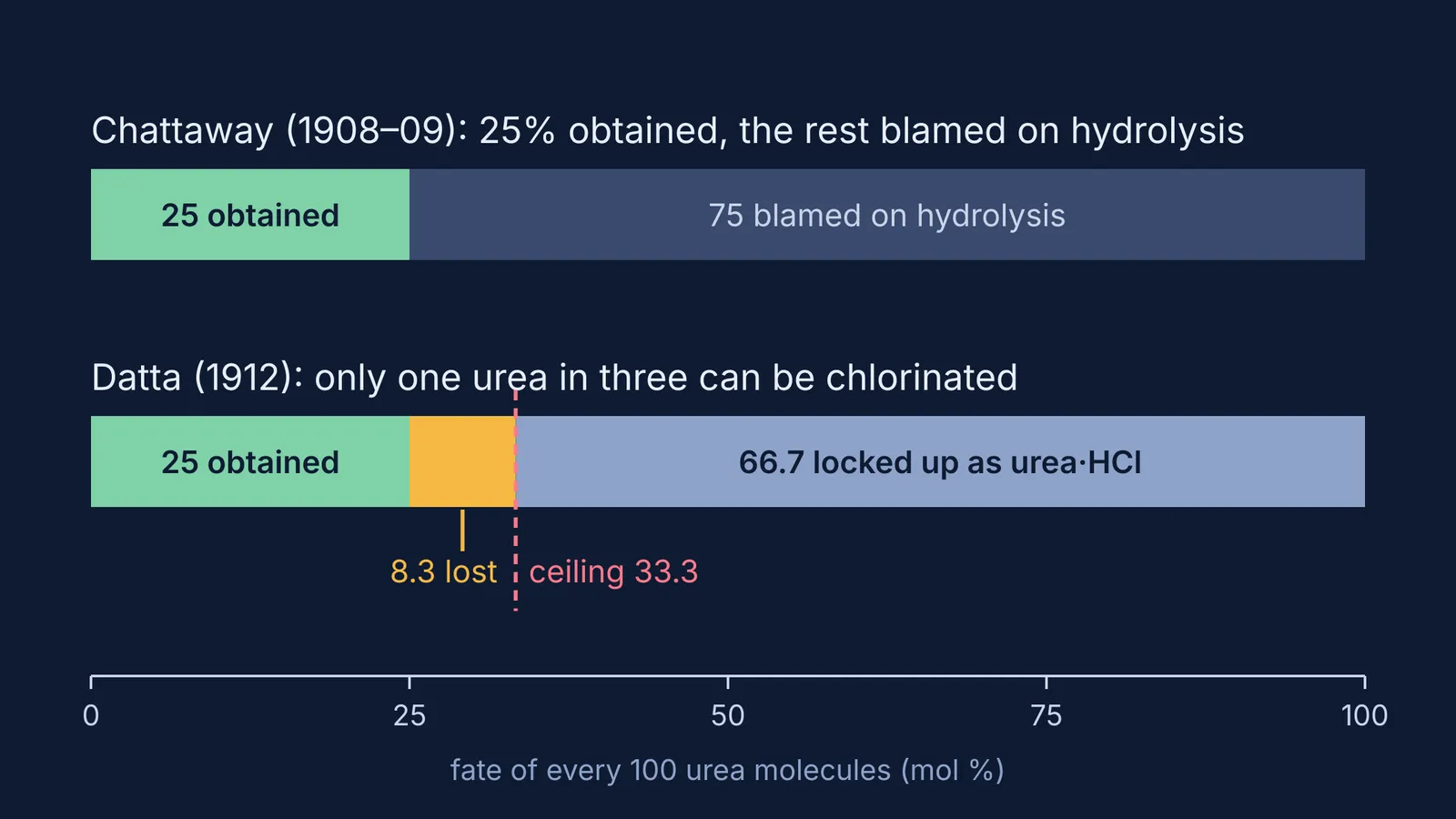
Chattaway's explanation, as Datta reports it, was that all this HCl made the product hydrolyse, CO(NHCl)₂ + H₂O → 2NH₂Cl + CO₂, with the chloroamine breaking down further to ammonia and nitrogen trichloride. On this view the yield "amounts only to about 25 per cent. of the theoretical", and the other 75% was lost to hydrolysis. Chattaway said the filtrate held nothing but nitrogen chloride and ammonium chloride. In a later paper he found that adding zinc oxide raised the yield to about 75%, and he credited the oxide with stopping the hydrolysis.
Why can only one urea in three be chlorinated?
Datta's key sentence: "for each molecule of carbamide chlorinated there are formed two molecules of hydrogen chloride. This combines with carbamide to form the monohydrochloride". Urea is a weak base, and urea that has become a hydrochloride "cannot be converted into dichlorocarbamide". He noted that urea hydrochloride dissociates readily in water, but argued the dissociation "becomes negligibly small in the presence of a large excess of chlorine".
He wrote two equations:
CO(NH₂)₂ + 2Cl₂ → CO(NHCl)₂ + 2HCl
2CO(NH₂)₂ + 2HCl → 2CO(NH₂)₂·HCl
Add them and the HCl cancels:
3CO(NH₂)₂ + 2Cl₂ → CO(NHCl)₂ + 2CO(NH₂)₂·HCl
Check it: 3 C, 12 H, 6 N, 3 O and 4 Cl on each side. Every urea that reacts sends two more into salt form, so the reacting urea can never exceed one-third of the total. In his words, "The yield theoretically possible is thus only 33·3 per cent. of the total carbamide". The other two-thirds "can be obtained as carbamide hydrochloride".
The zinc oxide result now has a different meaning. ZnO + 2HCl → ZnCl₂ + H₂O removes the acid, so urea is not locked up, and the overall equation becomes CO(NH₂)₂ + 2Cl₂ + ZnO → CO(NHCl)₂ + ZnCl₂ + H₂O, which also balances. Datta's verdict: "the increase in the yield is due to the liberation of carbamide from its hydrochloride, thus rendering it available for chlorination", not to stopping hydrolysis.
What evidence did Datta give?
The filtrate. It was "almost pure carbamide hydrochloride", with only a little ammonium chloride from partial hydrolysis.
The residue. Chattaway had reported pure ammonium chloride after evaporating and heating the filtrate. Datta found that moderate ignition left cyanuric acid mixed with ammonium chloride, because heating urea hydrochloride gives cyanuric acid. He suggested that stronger heating drives the cyanuric acid off, which could have misled Chattaway. His analysis: "Found, N=32·73. Calc., N=32·56 per cent." Cyanuric acid, C₃H₃N₃O₃ (M = 129.07), is 32.56% nitrogen. Ammonium chloride is only 26.19% nitrogen, so the residue was clearly not NH₄Cl.
Bromine. A urea solution took up "only one-third of the weight of bromine that is actually required to brominate it completely", the same one-in-three pattern with HBr in place of HCl.
He also reinterpreted older equations by Wurtz (chlorine over molten urea) and Smolka (bromine over hot urea). We checked that Wurtz's equation as printed, 6CH₄ON₂ + 3Cl₂ = N₂ + 2HCl + 4NH₄Cl + 2C₃H₃O₃N₃, balances.
How big was the hydrolysis loss really?
Here the printed page has a small puzzle. Datta writes: "The yield actually obtained by Chattaway was 25 per cent.; hence, the loss due to hydrolysis is only 7·6 per cent., and not 75 per cent." The scan clearly reads 7·6. But 33.3 − 25 = 8.3 percentage points. Measured against what could actually form, 25 is 75% of 33.3, so a quarter of the attainable product was lost. We cannot tell how 7.6 was reached. The arithmetic gives 8.3, and either way the loss is small, not 75%.
Worked example: what is the real theoretical yield?
Take 1 mol of urea, 60.06 g. Molar masses: CO(NHCl)₂ = 128.94, CO(NH₂)₂·HCl = 96.51, Cl₂ = 70.90 g/mol.
Chattaway's "theoretical" yield assumes every urea reacts: 1 mol × 128.94 = 128.94 g.
His 25%: 0.25 × 128.94 = 32.23 g.
Datta's ceiling: only 1/3 mol can react, so the maximum is 128.94/3 = 42.98 g.
Real percentage yield: 32.23/42.98 × 100 = 75% of what was attainable.
Chlorine used: 2/3 mol Cl₂ = 47.27 g. Urea hydrochloride formed: 2/3 mol = 64.34 g.
The lesson: a "theoretical yield" is only as good as the equation behind it. If a by-product consumes a reactant, the true limit is lower.
Where does this show up in JEE and NEET?
Class 11, Some basic concepts: limiting reagent, theoretical and percentage yield. The trap is a side reaction that eats a reactant. Revise the basics in limiting reagent and percentage yield problems, step by step.
Class 12, Amines and amides: urea is a weak base that forms a salt with HCl. Swapping an amide N–H for a halogen is also the first step of the Hofmann bromamide degradation.
Chlorine on nitrogen: Chattaway's own earlier work on N-chloro compounds is told in Chattaway and Orton, 1899: chlorine lands on nitrogen first.
For more yield and stoichiometry problems with each step explained, try the Fermi Problem Library, a step-by-step solver that explains the reasoning.
Quick checklist
Chattaway's equation: CO(NH₂)₂ + 2Cl₂ → CO(NHCl)₂ + 2HCl.
Each urea chlorinated frees 2HCl, which ties up two more ureas as hydrochloride.
Net: 3CO(NH₂)₂ + 2Cl₂ → CO(NHCl)₂ + 2CO(NH₂)₂·HCl, so the ceiling is 33.3%.
Chattaway's 25% is 75% of the true maximum.
ZnO helps by freeing urea from its hydrochloride.
The paper prints a 7·6% hydrolysis loss; subtraction gives 8.3 percentage points.


