On this page
Schwarz's lemma is short and widely used in complex analysis. It is named after the German mathematician Hermann Amandus Schwarz (1843–1921), per Wikipedia's biography of Schwarz. Here is the statement, an exam-ready proof, two worked examples, and why every automorphism of the disc is a Möbius map.
What does Schwarz's lemma say?
Let D be the open unit disc, the set of complex numbers z with |z| < 1. Wikipedia's article on the Schwarz lemma and Wolfram MathWorld state it in the same form.
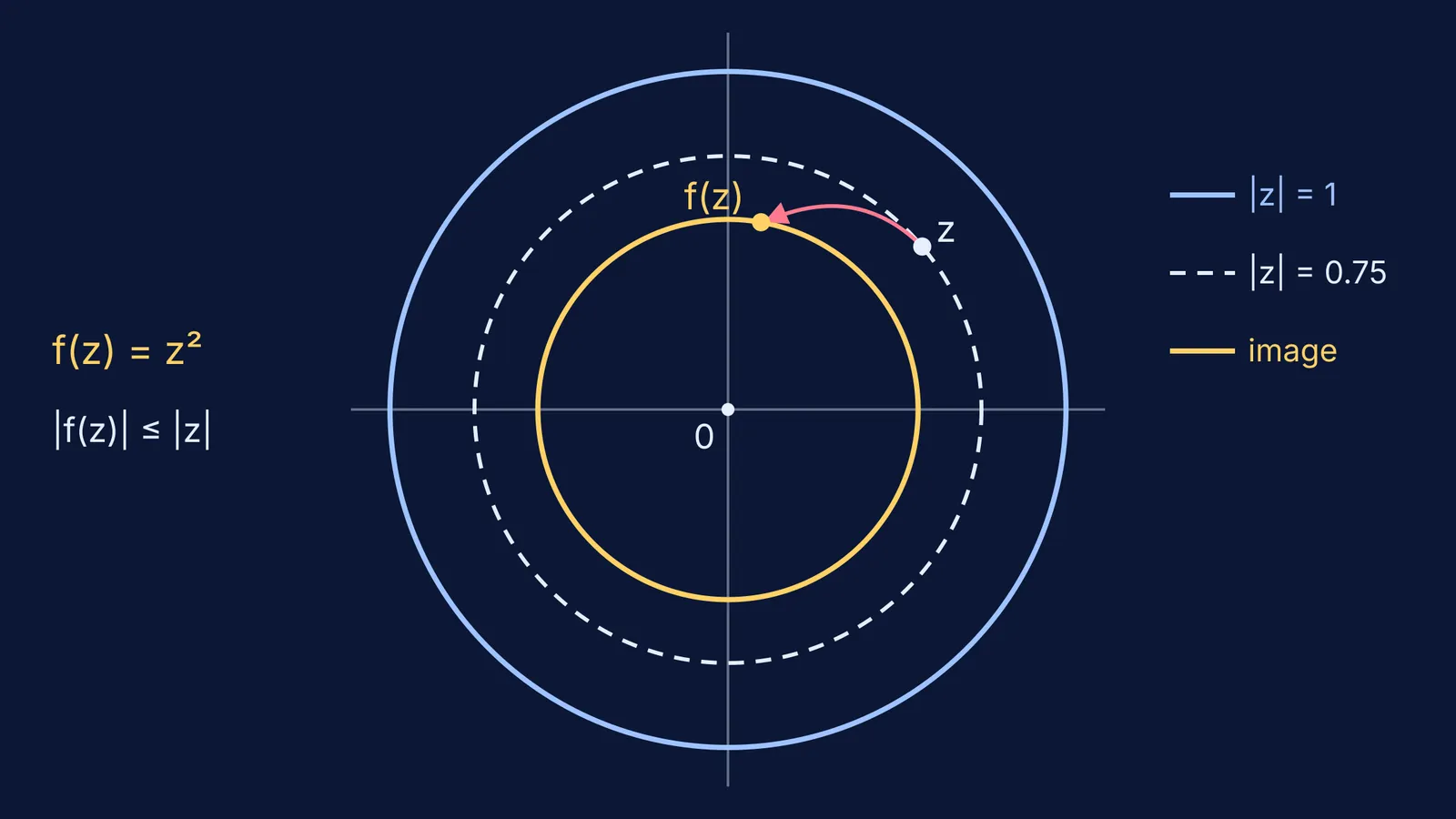
Schwarz's lemma: if f is holomorphic on D, |f(z)| ≤ 1 for all z in D, and f(0) = 0, then |f(z)| ≤ |z| for every z in D and |f′(0)| ≤ 1.
Equality case: if |f(z)| = |z| for some nonzero z, or if |f′(0)| = 1, then f(z) = az for a constant a with |a| = 1, which is a rotation of the disc.
In words: a map that keeps the disc inside itself and fixes the centre never pushes a point further out, and only rotations pull nothing inward.
How do you prove Schwarz's lemma?
The proof uses the maximum modulus principle: the modulus of a non-constant holomorphic function has no local maximum inside a connected open set, so on a closed disc it peaks on the boundary circle. The steps follow the Schwarz lemma article above.
Define g(z) = f(z)/z for z ≠ 0 and g(0) = f′(0). Because f(0) = 0, the power series of f starts at the z term, so g is holomorphic on all of D.
Fix r with 0 < r < 1. On the circle |z| = r, |g(z)| = |f(z)|/r ≤ 1/r.
By the maximum modulus principle, |g(z)| ≤ 1/r on the whole closed disc |z| ≤ r.
Let r tend to 1. For each fixed z this gives |g(z)| ≤ 1, which is |f(z)| ≤ |z|; at z = 0 it reads |f′(0)| ≤ 1.
If |g| equals 1 at any interior point, |g| has an interior maximum, so g is a constant a with |a| = 1, and f(z) = az.
A worked example: checking the bound
Take f(z) = z(z + 1/2)/(1 + z/2). The factor (z + 1/2)/(1 + z/2) is a disc automorphism (see below), so f maps D into D, and f(0) = 0.
f′(0) is the value of (z + 1/2)/(1 + z/2) at 0, which is 1/2, so |f′(0)| ≤ 1 holds strictly.
At z = 1/2: f(1/2) = (1/2)(1)/(5/4) = 2/5, which is less than |z| = 1/2.
Because |f′(0)| < 1, the lemma tells you f is not a rotation, so |f(z)| < |z| at every nonzero z.
How does Schwarz's lemma pin down the automorphisms of the disc?
An automorphism of D is a holomorphic bijection from D onto D. For each a in D, the Möbius map φ_a(z) = (z − a)/(1 − āz), where ā is the complex conjugate of a, is one of them: it maps the disc onto itself and sends a to 0.
Wikipedia's article on the Riemann mapping theorem states that, by the Schwarz lemma, the holomorphic bijections of the unit disc onto itself are the Möbius transformations e^(iθ)(z − α)/(1 − ᾱz) with |α| < 1. Here is the argument.
Suppose F is an automorphism with F(0) = 0. The lemma gives |F(z)| ≤ |z|. Its inverse is also an automorphism fixing 0, so |z| = |F⁻¹(F(z))| ≤ |F(z)|. Both hold, so |F(z)| = |z|, and the equality case makes F a rotation.
Now take any automorphism F and let b = F(0). Then φ_b ∘ F is an automorphism fixing 0, so it is a rotation z ↦ e^(iθ)z.
Undo φ_b with its inverse, z ↦ (z + b)/(1 + b̄z); F comes out in the form above.
How do you use Schwarz's lemma on a problem?
The same composition trick answers other questions. Suppose f maps D into D holomorphically and f(1/2) = 0. How large can |f(0)| be?
Let ψ(w) = (w + 1/2)/(1 + w/2). It is a disc automorphism with ψ(0) = 1/2 and ψ(−1/2) = 0.
Then g = f ∘ ψ maps D into D with g(0) = f(1/2) = 0, so the lemma gives |g(w)| ≤ |w|.
Since f(0) = g(−1/2), you get |f(0)| ≤ 1/2. The map f(z) = (z − 1/2)/(1 − z/2) has f(0) = −1/2, so the bound cannot be improved.
A checklist for any Schwarz-type question:
Is the map holomorphic on the open disc and bounded by 1 there?
Which point is sent to 0? If it is not the centre, move it there with a Möbius map φ_a.
Apply |g(w)| ≤ |w| or |g′(0)| ≤ 1 to the composed map.
Undo the composition; equality happens only for automorphisms.
If the maximum modulus principle or Möbius maps feel shaky, the Fermi Concept Library gives each concept in mathematics its own lesson, and the Fermi Problem Library has a step-by-step solver that explains the reasoning.