

On this page
In 1913 four Oxford chemists, Harold Hartley, Julien Drugman, Charles Archibald Vlieland and Robert Bourdillon, mapped which potassium oxalates crystallise from water at 25 °C. They analysed every solution "by titration against permanganate and baryta". Then comes the line that matters for your exam: "both permanganate and baryta were standardised against solutions of Kahlbaum's purest potassium quadroxalate" (Hartley et al., J. Chem. Soc. Trans. 1913, 103, 1747). One weighed salt fixed the strength of an alkali and of an oxidising agent. That works only because the salt has two different n-factors. The paper states the method; the n-factor reasoning below is ours.
What is potassium quadroxalate?
Its formula is usually written KHC₂O₄·H₂C₂O₄·2H₂O: one potassium hydrogen oxalate and one oxalic acid crystallised together with two waters. Hartley and his co-workers wrote it as KH₃(C₂O₄)₂,2H₂O, which makes the count easier to see. Per formula unit there are:
3 acidic hydrogens (one from KHC₂O₄, two from H₂C₂O₄);
2 oxalate units, C₂O₄, each of which can be oxidised to 2CO₂;
1 K⁺ and 2 H₂O, which do nothing in either titration.
Molar mass (K 39.098, H 1.008, C 12.011, O 15.999): 254.19 g mol⁻¹. Older books also call it potassium tetroxalate.
What is the n-factor of KHC₂O₄·H₂C₂O₄·2H₂O?
It depends on what it reacts with. That is the whole point.
As an acid, with NaOH or baryta, Ba(OH)₂: each of the 3 acidic H is neutralised.
H₃(C₂O₄)₂⁻ + 3OH⁻ → 2C₂O₄²⁻ + 3H₂O
So n(acid) = 3, and the equivalent mass is 254.19 ÷ 3 = 84.73 g. With baryta the full equation is 2KH₃(C₂O₄)₂ + 3Ba(OH)₂ → K₂C₂O₄ + 3BaC₂O₄ + 6H₂O, which balances for every atom.
As a reductant, with KMnO₄ in dilute H₂SO₄: carbon goes from +3 in oxalate to +4 in CO₂. Each C₂O₄ unit loses 2 electrons, and there are 2 units.
5H₃(C₂O₄)₂⁻ + 4MnO₄⁻ + 17H⁺ → 4Mn²⁺ + 20CO₂ + 16H₂O
Check it: 20 C, 56 O and 32 H on each side, and charge +8 on each side (−5 − 4 + 17 = +8; 4 × +2 = +8). Electrons: 5 × 4 = 20 lost, 4 × 5 = 20 gained.
So n(redox) = 4, and the equivalent mass is 254.19 ÷ 4 = 63.55 g.
The K⁺ does not count in either case, and the acidic H is not oxidised. You count H⁺ for the acid titration and electrons for the redox one, and the two counts differ.
How can one salt standardise both NaOH and KMnO₄?
A primary standard has to be weighable, pure and stable. The quadroxalate is a crystalline solid, so you weigh it once and make one solution. Its normality is then fixed twice over:
as an acid, N = 3 × molarity;
as a reductant, N = 4 × molarity.
Titrate one aliquot with the alkali (phenolphthalein end point) and another with acidified KMnO₄ (self-indicating, done warm). Both burettes are now calibrated against the same weighed solid. Hartley's group titrated every sample both ways, so one standard for both titrants put the alkali and the permanganate on the same footing.
Worked example: one standard, two titrants
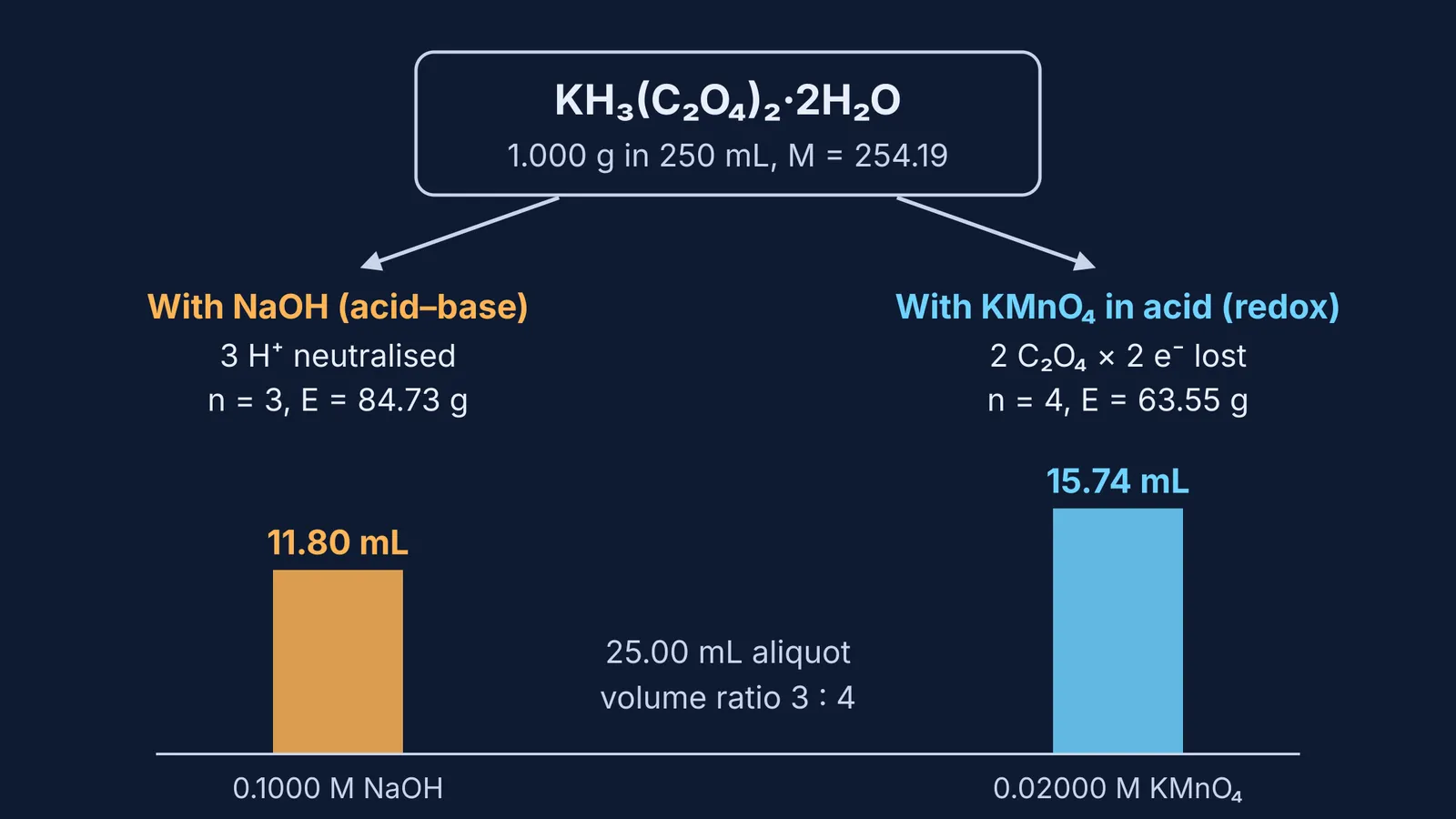
Dissolve 1.000 g of KHC₂O₄·H₂C₂O₄·2H₂O in water and make up to 250.0 mL. Take 25.00 mL aliquots.
Moles of salt in one aliquot. 1.000 ÷ 254.19 = 3.934 mmol in 250 mL, so 0.3934 mmol in 25.00 mL.
NaOH needed. Each mole uses 3 mol OH⁻: 3 × 0.3934 = 1.180 mmol. With 0.1000 M NaOH, V = 1.180 ÷ 0.1000 = 11.80 mL.
KMnO₄ needed. Each mole gives 4 electrons and each MnO₄⁻ takes 5, so mol KMnO₄ = 4/5 × 0.3934 = 0.3147 mmol. With 0.02000 M KMnO₄, V = 0.3147 ÷ 0.02000 = 15.74 mL.
Check by equivalents. 0.1000 M NaOH is 0.1000 N; 0.02000 M KMnO₄ is 5 × 0.02000 = 0.1000 N. Same normality, so the volumes should be in the ratio 3 : 4. Indeed 11.80 : 15.74 = 0.750.
In practice you run it backwards: you know the mass of the salt and read the burette, and you solve for the unknown molarity of the NaOH or the KMnO₄.
What does JEE ask about the quadroxalate?
The classic question: "What is the ratio of the volumes of NaOH and KMnO₄ (in acid) of equal normality needed to react with the same mass of KHC₂O₄·H₂C₂O₄·2H₂O?" The answer is the ratio of n-factors, 3 : 4.
Variants you should be ready for:
In moles, not normality: 1 mol of the salt needs 3 mol NaOH but only 4/5 = 0.8 mol KMnO₄. Ratio of moles 3 : 0.8, which is 15 : 4.
Equal molarity: 0.1 M NaOH and 0.1 M KMnO₄. Volumes are proportional to 3 and 0.8, so 15 : 4 again.
Equivalent mass: 84.73 as an acid, 63.55 as a reductant. If the question just says "equivalent weight", ask yourself which reaction.
For the general rules behind this, see n-factors and the equivalent concept in redox titrations. A related problem, two different compounds in one sample titrated two ways, is worked in analysing oxalic acid and sodium oxalate with NaOH and KMnO₄. If you are preparing for JEE Main and Advanced, Fermi Test Prep has an AI tutor you can work through n-factor questions like these with.
What are the other potassium oxalates?
Hartley's group found five solid phases in equilibrium with solution at 25 °C as the mixture went from pure oxalic acid to neutral potassium oxalate. The same counting gives each its two n-factors (acid, redox):
H₂C₂O₄·2H₂O, oxalic acid: M 126.06; n = 2 and 2. Equal, which is why the two equivalent masses coincide at 63.03.
KH₃(C₂O₄)₂·2H₂O, quadroxalate: M 254.19; n = 3 and 4.
KHC₂O₄, binoxalate: M 128.12; n = 1 and 2.
2K₂C₂O₄·H₂C₂O₄·2H₂O, which they called tetrapotassium dihydrogen oxalate: M 458.49; n = 2 and 6.
K₂C₂O₄·H₂O, neutral oxalate: M 184.23; no acidic H, n = 2 as a reductant.
They also settled two smaller questions:
Binoxalate hydrate. Below about 6.4 °C the binoxalate crystallises as a hydrate. Their analyses B and C gave 34.17% and 34.16% K₂O. The formula 2KHC₂O₄·H₂O needs 34.36%; KHC₂O₄·H₂O needs 32.24%. So it is the hemihydrate, as Rammelsberg and Marignac had said, not the monohydrate Wyrouboff reported. (They give composition as % K₂O and % C₂O₃, the old way of writing a salt as base oxide plus acid anhydride.)
Neutral oxalate solubility. At 25.15 °C a saturated solution held 27.37 g K₂C₂O₄ per 100 g of solution. Per 100 g of water that is 100 × 27.37 ÷ (100 − 27.37) = 37.7 g. Converting "per 100 g solution" to "per 100 g water" is a standard Class 12 Solutions step.
For the titration itself (warm, dilute H₂SO₄, why the pink end point appears), see titrating oxalic acid with KMnO₄.
Quick checklist
KHC₂O₄·H₂C₂O₄·2H₂O = KH₃(C₂O₄)₂·2H₂O, M = 254.19.
Acid: 3 H⁺, n = 3, E = 84.73. Reductant: 2 C₂O₄ × 2 e⁻, n = 4, E = 63.55.
Equal normality: V(NaOH) : V(KMnO₄) = 3 : 4. Moles: 1 mol salt needs 0.8 mol KMnO₄.
KHC₂O₄: n = 1 (acid), 2 (redox). Oxalic acid: 2 and 2.
Always ask "n-factor in which reaction?" before writing an equivalent mass.


