

On this page
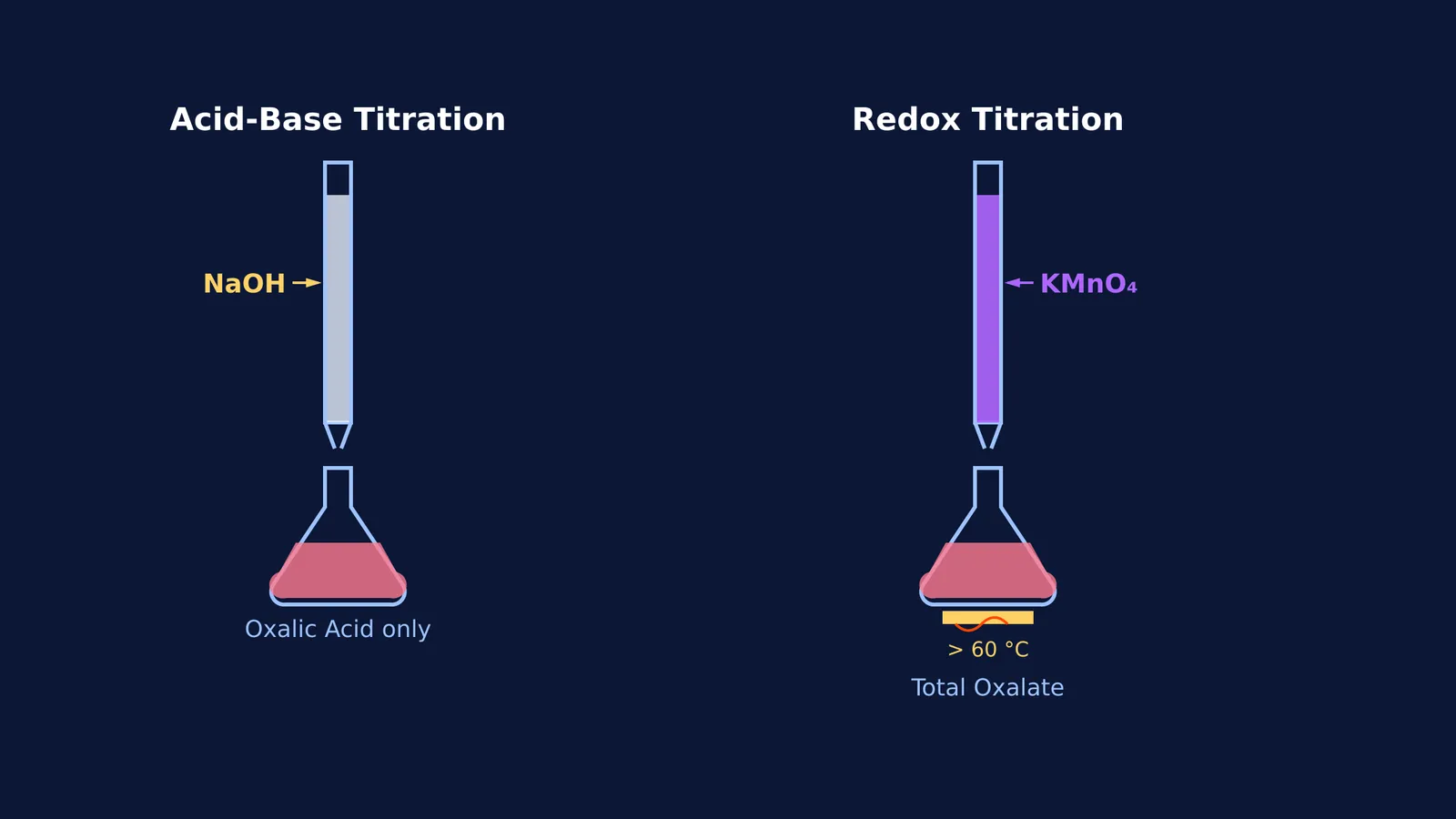
To calculate the exact composition of a mixture of oxalic acid and sodium oxalate, you must perform two titrations. An acid-base titration with sodium hydroxide measures only the oxalic acid, while a heated redox titration with potassium permanganate measures the total oxalate from both compounds.
The analysis relies on the fact that these two compounds react differently. Oxalic acid (H₂C₂O₄) is a diprotic acid, whereas sodium oxalate (Na₂C₂O₄) is a neutral salt. However, both compounds contain the oxalate ion (C₂O₄²⁻), which acts as a reducing agent.
Why use two different titrations?
A single titration cannot tell you how much of each compound is in the mixture.
Because sodium oxalate does not react with a base, titrating the mixture with NaOH measures only the oxalic acid. Conversely, the permanganate ion (MnO₄⁻) oxidises all the oxalate ions in the flask, regardless of whether they came from the acid or the salt. This means the KMnO₄ titration gives you the total amount of oxalate. By taking the difference between the two results, you can accurately determine the concentration of the sodium oxalate.
How does the acid-base titration work?
In the first step, a known volume of the mixture is pipetted into a flask and titrated against a standard NaOH solution. Because this is a classic acid-base reaction, phenolphthalein is used as an indicator.
Only the oxalic acid is neutralised during this step:
H₂C₂O₄ + 2NaOH → Na₂C₂O₄ + 2H₂O
Because one mole of oxalic acid reacts with two moles of sodium hydroxide, you can calculate the molarity of the oxalic acid from the volume of NaOH used. At the endpoint, the solution turns a faint, permanent pink.
Why is the redox titration heated?
In the second step, another equal volume of the mixture is titrated against a standard KMnO₄ solution. This titration must be done in a strongly acidic medium, so a full test tube of dilute sulphuric acid (H₂SO₄) is added to the flask.
The mixture is heated to above 60 °C before titrating because the redox reaction between permanganate and oxalate ions is far too slow at room temperature. The overall ionic equation for this process is:
2MnO₄⁻ + 5C₂O₄²⁻ + 16H⁺ → 2Mn²⁺ + 10CO₂ + 8H₂O
Here, the oxalate ions being oxidised to carbon dioxide come from both the oxalic acid and the sodium oxalate. The KMnO₄ acts as a self-indicator, turning the solution light pink at the endpoint when a tiny excess of permanganate is present. (To understand why hydrochloric acid cannot be used instead of sulphuric acid, see Why dilute sulphuric acid is used in KMnO4 titration, not HCl.)
How do you calculate the mixture's composition?
Once you have the results from both titrations, calculating the exact composition is straightforward using the concept of normality. Normality is particularly useful here because the equivalent weights account for the different reaction types (acid-base and redox).
Calculate the oxalic acid: Use the NaOH volume to find the normality of the oxalic acid (using the formula N₁V₁ = N₂V₂).
Calculate the total oxalate: Use the KMnO₄ volume to find the total normality of all the oxalate in the mixture using the same formula.
Find the sodium oxalate: Subtract the normality of the oxalic acid from the total normality. This difference gives you the normality of the sodium oxalate alone.
Convert to grams per litre: Multiply the normality of each component by its respective equivalent weight.
What is a worked example of the calculation?
Based on the molar masses from Wikipedia, let us assume you pipetted 20 mL of the mixture for each of the two titrations.
Step 1: Titration with NaOH Suppose the 20 mL mixture required 15 mL of 0.1 N NaOH. The normality of the oxalic acid (N_acid) is calculated as: N_acid = (15 × 0.1) / 20 = 0.075 N. To find the strength in grams per litre, you multiply this normality by the equivalent weight of hydrated oxalic acid, which is 63. Strength of oxalic acid = 0.075 × 63 = 4.725 g/L.
Step 2: Titration with KMnO₄ Suppose the same 20 mL mixture required 25 mL of 0.1 N KMnO₄. The total normality of all oxalate species (N_total) is: N_total = (25 × 0.1) / 20 = 0.125 N.
Step 3: Finding the Sodium Oxalate The normality contributed by the sodium oxalate (N_salt) is simply the difference between the total normality and the oxalic acid's normality. N_salt = N_total − N_acid = 0.125 − 0.075 = 0.050 N. To find its strength in grams per litre, multiply by the equivalent weight of sodium oxalate, which is 67. Strength of sodium oxalate = 0.050 × 67 = 3.35 g/L.
If you have gaps in your understanding of titrations, the Fermi Concept Library has every concept in physics, chemistry, biology, mathematics and computing, each with its own lesson and its place in the map.


