On this page
Push a small open disc through a function and ask: does the image still have room around every point? For real functions the answer is often no. For holomorphic functions it is always yes, unless the function is constant. That is the open mapping theorem, and it gives a short proof of the maximum modulus principle.
What does the open mapping theorem say?
A holomorphic function is one that is complex differentiable at every point of an open set (Holomorphic function, Wikipedia).
The theorem: if U is a domain (a connected open set) in the complex plane and f is a non-constant holomorphic function on U, then f is an open map, meaning the image of every open subset of U is open (Open mapping theorem, Wikipedia)). MathWorld puts it in one line: "a nonconstant analytic function on a domain D is an open map" (MathWorld).
The Wikipedia article draws a consequence: a non-constant holomorphic function cannot map an open disc onto a portion of a line. So f(z) = Re(z), which squashes the plane onto the real axis, is not holomorphic.
Both conditions matter. A constant function sends everything to one point, which is not open; on a disconnected set, f could be constant on one piece only.
Why does z ↦ z^k explain the whole theorem?
Take a point z0. Because f is not constant, f(z) − f(z0) has an isolated zero at z0 of some finite order k ≥ 1. Near z0 you can write f(z) = f(z0) + φ(z)(z − z0)^k with φ holomorphic and φ(z0) ≠ 0, and in suitable local coordinates f is simply w = z^k (Branch point, Wikipedia).
So the theorem comes down to one model map. Write z = r e^(iθ) and look at what z^k does to the disc |z| < r:
the modulus becomes r^k, so the disc of radius r goes into the disc of radius r^k;
the angle becomes kθ, so going once round a small circle takes you k times round its image.
Every w with 0 < |w| < r^k has exactly k different k-th roots, all inside the small disc, so the image is the whole open disc of radius r^k. A full disc around f(z0) therefore sits inside the image of any small disc around z0: that is openness.
When k = 1, f'(z0) ≠ 0 and f is conformal near z0, so it preserves angles (Conformal map, Wikipedia). When k ≥ 2, f'(z0) = 0 and angles at z0 are multiplied by k, but the image is still a full disc.
Why is x² not an open map when z² is?
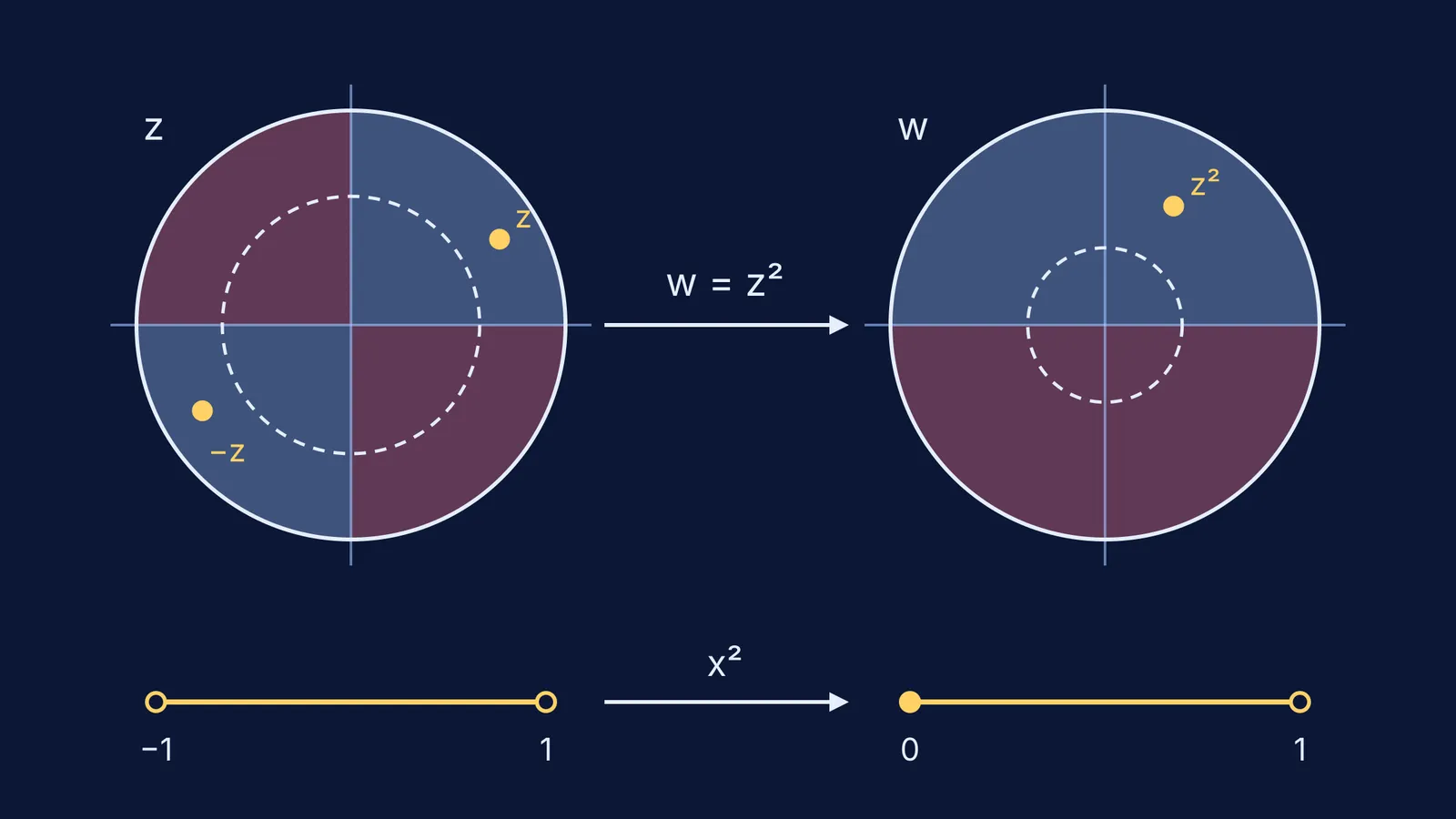
The Wikipedia article gives the standard contrast: f(x) = x² is differentiable, yet it sends the open interval (−1, 1) to the half-open interval 0, 1), which is not open because nothing to the left of 0 is reached ([Open mapping theorem, Wikipedia)).
At the point 0:
Real x²: the interval is folded in half. Both −0.5 and 0.5 go to 0.25, and the fold at 0 becomes an edge of the image.
Complex z²: the disc |z| < 1 is wrapped, not folded. Angles double, so the circle of radius 0.5 runs twice round the circle of radius 0.25, and every w with |w| < 1 is reached, including negative numbers such as −0.25 = (0.5i)².
How does the open mapping theorem prove the maximum modulus principle?
The maximum modulus principle says that if f is holomorphic on a connected open set D and |f(z0)| ≥ |f(z)| for all z near a point z0 of D, then f is constant on D (Maximum modulus principle, Wikipedia). That article says it can be viewed as a special case of the open mapping theorem. The argument:
Suppose f is non-constant and |f| has a local maximum at an interior point z0.
By the theorem, the image of a small disc around z0 is open, so it contains a small disc around w0 = f(z0).
That disc contains (1 + ε)w0 for a small ε > 0 (or any small non-zero number if w0 = 0), whose modulus is bigger than |w0|. Contradiction.
So if f is non-constant, holomorphic on a bounded domain and continuous up to its boundary, |f| reaches its largest value only on the boundary.
A five-minute self-check
What is the image of the disc |z| < 2 under z³? (The disc |w| < 8; every non-zero point is hit three times.)
Where does |e^z| reach its maximum on the square 0 ≤ Re z ≤ 1, 0 ≤ Im z ≤ 1? (Along the edge Re z = 1, since |e^z| = e^(Re z).)
If the z^k picture still feels slippery, the Fermi Concept Library gives every concept in mathematics its own lesson and its place in the map. For practice, the Fermi Problem Library has worked problems with a step-by-step solver that explains the reasoning rather than printing an answer.