On this page
Linear inequalities cost marks because most moves match those for equations, and the few that differ are easy to forget under time pressure. Here is every rule, with its condition, a short example and the usual mistake.
What are the rules for solving linear inequalities?
The NCERT Class 11 Mathematics textbook, Chapter 5 (Linear Inequalities) defines an inequality as two real numbers or two algebraic expressions related by the symbols <, >, ≤ or ≥. Strict inequalities use < or >; slack inequalities use ≤ or ≥. An inequality such as ax + b < 0 is linear in one variable when a ≠ 0, and ax + by < c is linear in two variables when a ≠ 0 and b ≠ 0.
The chapter then gives two rules.
Rule 1: equal numbers may be added to (or subtracted from) both sides without changing the sign. Example: 5x − 3 < 3x + 1 becomes 2x < 4, so x < 2.
Rule 2: both sides may be multiplied or divided by the same positive number. When you multiply or divide both sides by a negative number, the sign is reversed. Example: −5x ≤ −40 gives x ≥ 8.
Why Rule 2 flips: 3 > 2, but −3 < −2.
When does the inequality sign flip?
Adding or subtracting any number or expression: sign stays.
Multiplying or dividing by a positive number: sign stays.
Multiplying or dividing by a negative number: sign flips (< becomes >, ≤ becomes ≥).
Multiplying by an expression whose sign you do not know, such as x or x − 3: do not do it. You cannot know whether to flip.
How do you show the solution on a number line?
NCERT's chapter summary gives the convention: for x < a or x > a, draw an open circle at a and a dark line to the left or right; for x ≤ a or x ≥ a, draw a filled circle. In interval notation, x < 2 is (−∞, 2) and x ≥ 8 is [8, ∞).
Solve a double inequality as one unit, applying each rule to all three parts: −8 ≤ 5x − 3 < 7. Add 3 to get −5 ≤ 5x < 10, then divide by 5 to get −1 ≤ x < 2.
For a system in one variable, solve each inequality and keep the overlap: 3x − 7 < 5 + x gives x < 6 and 11 − 5x ≤ 1 gives x ≥ 2, so the solution is 2 ≤ x < 6, shown with a filled circle at 2 and an open one at 6.
Pitfall: ignoring the set. For natural numbers x, 30x < 200 gives x < 20/3, so the solution set is {1, 2, 3, 4, 5, 6}, not an interval. If set notation feels shaky, see our sets, relations and functions key terms for Class 11.
How do you graph a linear inequality in two variables?
The 2026-27 reprint of Chapter 5 works all its examples in one variable, but the NCERT Class 12 chapter on Linear Programming assumes you can graph systems in two variables: its shaded region is the set of points common to all the half-planes.
Replace the sign with = and draw the boundary line ax + by = c. Use a solid line for ≤ or ≥ (the line is included) and a dashed line for < or > (it is not).
Pick a test point not on the line, usually (0, 0).
If the test point satisfies the inequality, shade its side of the line; if not, shade the other side.
For a system, shade every inequality and keep only the overlap.
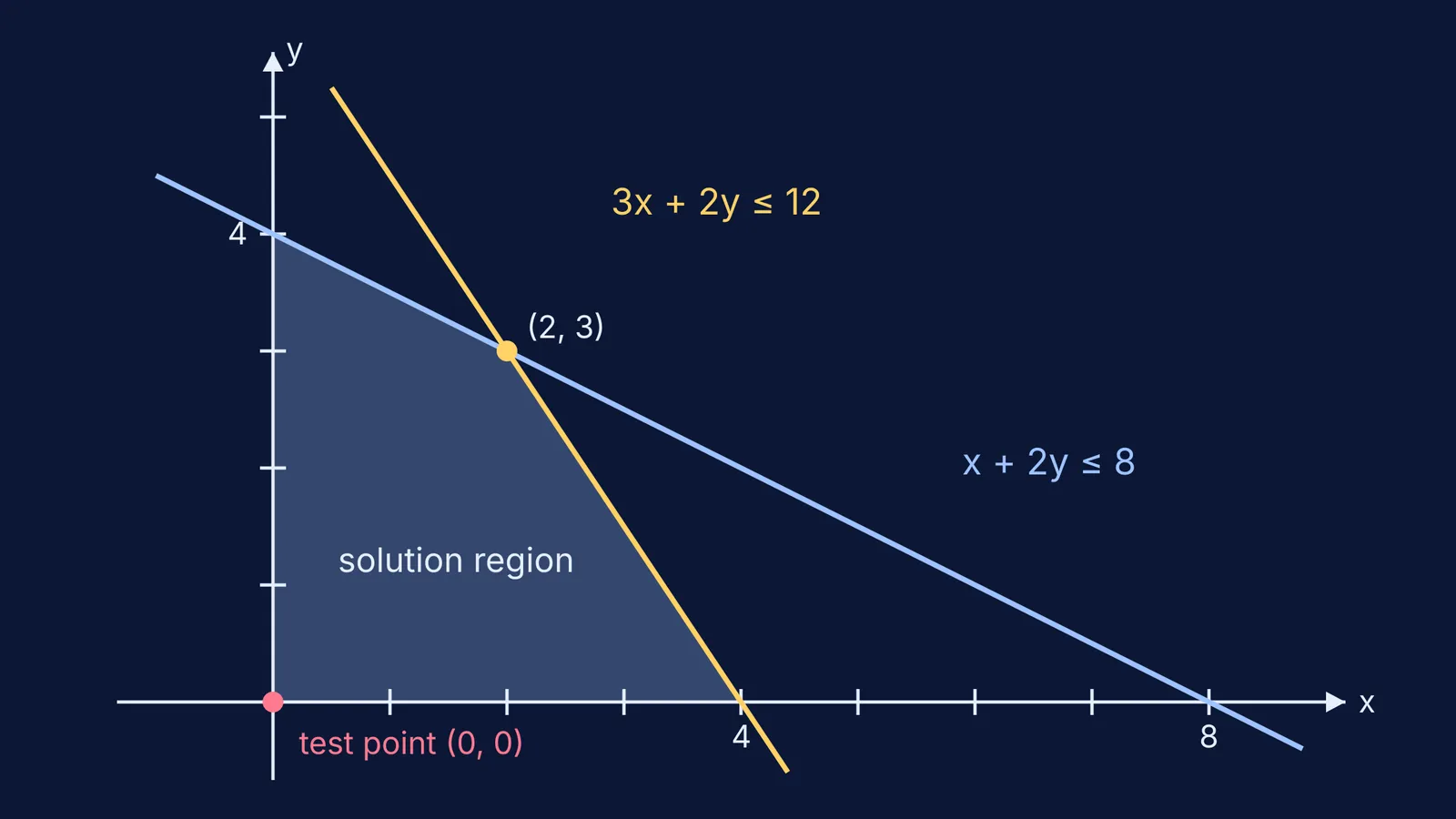
Worked example: x + 2y ≤ 8, 3x + 2y ≤ 12, x ≥ 0, y ≥ 0. The test point (0, 0) satisfies both, so shade towards the origin. Subtracting the first boundary equation from the second gives 2x = 4, so the lines meet at (2, 3). The solution region has corners (0, 0), (4, 0), (2, 3) and (0, 4), as in the diagram above.
Pitfall: using (0, 0) as the test point when the boundary passes through the origin, as in y ≥ 2x. Choose (1, 0) instead. For drawing boundary lines fast, see our straight lines Class 11 key terms.
A five-step self-check before your exam
Label every step Rule 1 or Rule 2.
Where you multiplied or divided, check the sign of the number.
Test one value inside your answer and one outside it.
Strict means open circle or dashed line; slack means filled or solid.
Check the set: natural numbers, integers or reals.
For mixed practice, try our case study questions on sets for Class 11, then work through inequality problems in the Fermi Problem Library, where a step-by-step solver explains the reasoning behind each step rather than printing an answer. If the idea of a half-plane itself is unclear, the Fermi Concept Library has a lesson for each concept in mathematics.