On this page
A Taylor series only works on a disc free of singularities. The Laurent series expands a function with poles anyway: you allow negative powers of z and work on a ring, an annulus, between the singularities.
What is a Laurent series?
The NIST Digital Library of Mathematical Functions states it precisely: if f is analytic in the annulus r₁ < |z − z₀| < r₂, then f(z) equals a sum of aₙ(z − z₀)ⁿ over all integers n, from minus infinity to plus infinity (DLMF §1.10(iii)). Each coefficient is a contour integral, aₙ = (1/2πi)∮ f(z)/(z − z₀)ⁿ⁺¹ dz, taken once anticlockwise around a circle inside the annulus.
You rarely compute that integral. Because the Laurent expansion is unique when it exists, any series that equals f on the annulus is the Laurent series, so you can build it from known geometric or Taylor series (Wikipedia: Laurent series).
The series is named after Pierre Alphonse Laurent, whose memoir containing it Cauchy reported on in 1843; Karl Weierstrass had proved it in 1841, but his paper appeared only in 1894 (MacTutor biography of Laurent).
How do you expand 1/((z−1)(z−2)) on each annulus?
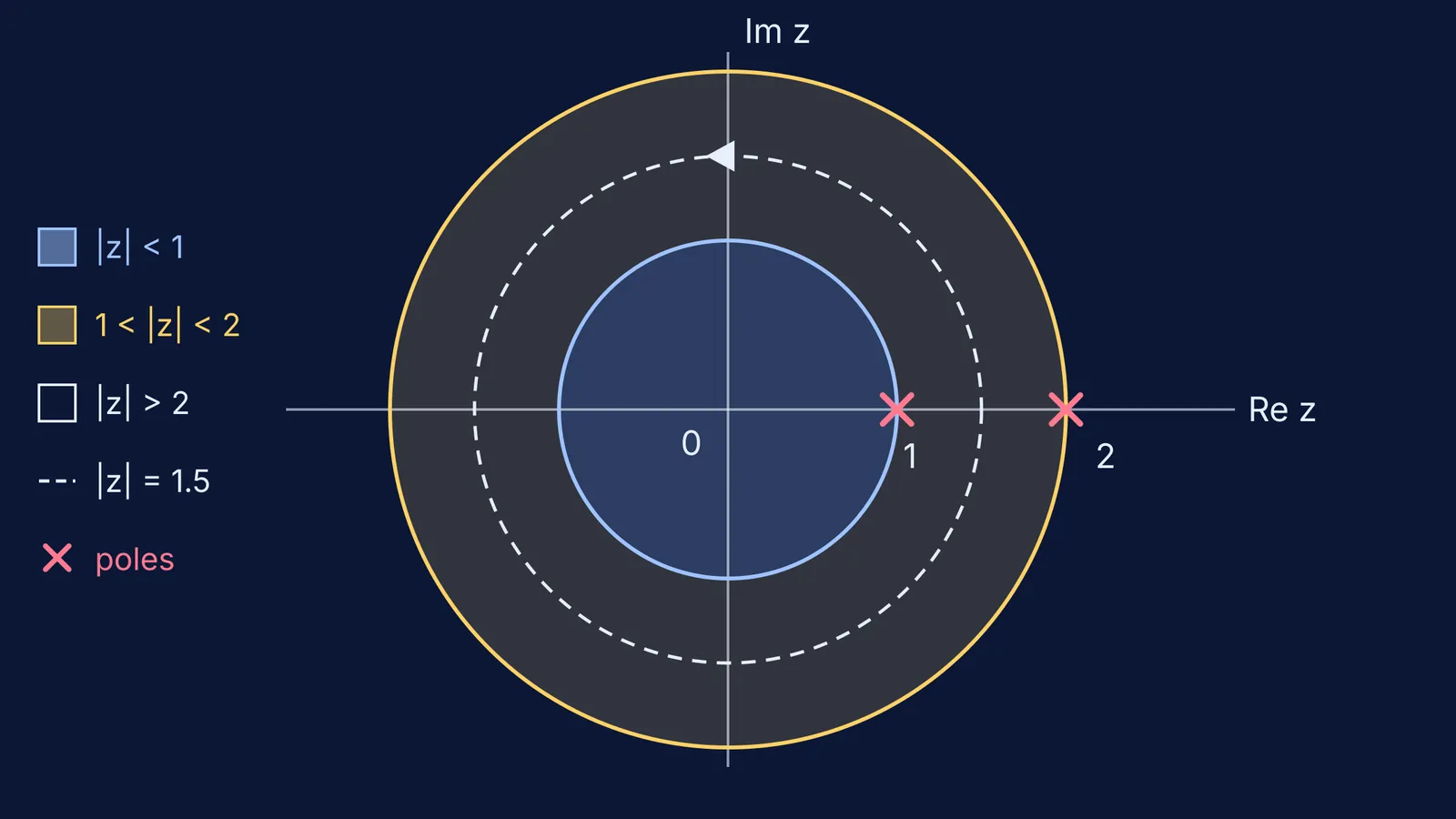
f(z) = 1/((z−1)(z−2)) has poles at 1 and 2. Circles through them split the plane into three regions around 0, each with its own series.
Step 1, partial fractions: f(z) = 1/(z−2) − 1/(z−1).
Step 2, one tool: 1/(1 − w) = 1 + w + w² + … when |w| < 1. For a term 1/(z − a), take w = z/a if |z| < |a| and w = a/z if |z| > |a|.
Region 1, |z| < 1. Here 1/(z−2) = −(1/2)(1 + z/2 + z²/4 + …) and −1/(z−1) = 1 + z + z² + …. Adding, f(z) = 1/2 + 3z/4 + 7z²/8 + …, with general coefficient 1 − 1/2ⁿ⁺¹. No negative powers: this is the Taylor series.
Region 2, 1 < |z| < 2. Now |1/z| < 1 but |z/2| < 1 still. So −1/(z−1) = −(1/z)(1 + 1/z + 1/z² + …) = −1/z − 1/z² − …, while 1/(z−2) keeps its region 1 form. Together: f(z) = … − 1/z² − 1/z − 1/2 − z/4 − z²/8 − …, infinite in both directions.
Check at z = 1.5: the negative powers sum to −2, the others to −2, total −4, and f(1.5) = 1/(0.5 · (−0.5)) = −4.
Region 3, |z| > 2. Both |1/z| and |2/z| are below 1. Then 1/(z−2) = 1/z + 2/z² + 4/z³ + … and −1/(z−1) = −1/z − 1/z² − …. So f(z) = 1/z² + 3/z³ + 7/z⁴ + …, with general term (2ⁿ⁻¹ − 1)/zⁿ. The 1/z terms cancel.
What is the principal part of a Laurent series?
The principal part is the portion of the Laurent series made of terms with negative powers (Wikipedia: Principal part). Region 2 has an infinite principal part, yet f is perfectly analytic at 0. That is allowed: when the inner radius is not 0, a function can be regular at the centre despite an infinite principal part (same source).
To classify a singularity, expand in a punctured disc around it. Put w = z − 1: then f = 1/(w(w−1)) = −(1/w)(1 + w + w² + …) = −1/w − 1 − w − … for 0 < |z − 1| < 1. The principal part is just −1/(z−1), so z = 1 is a simple pole.
How does the coefficient of 1/z give the residue?
The coefficient a₋₁ of (z − z₀)⁻¹ in the Laurent series is called the residue of f at z₀ (DLMF §1.10(iii)). Set n = −1 in the coefficient formula: ∮ f dz = 2πi · a₋₁, because every power except 1/z integrates to zero around a circle.
The residue at z = 1 is −1 (from the expansion above); at z = 2 it is +1. The residue theorem says (1/2πi)∮ f dz equals the sum of the residues inside the contour (DLMF §1.10(iv)). Our three series agree:
Region 1: a₋₁ = 0; no pole enclosed.
Region 2: a₋₁ = −1, the residue at z = 1, so ∮ f dz on |z| = 1.5 is −2πi.
Region 3: a₋₁ = 0 = −1 + 1.
A five-step checklist for any Laurent expansion
Mark every singularity and draw circles through them around your centre.
Split the function by partial fractions.
For each term 1/(z − a), use z/a inside |a| and a/z outside it.
Combine and write the general coefficient.
Check one numerical point, and check a₋₁ against the residues enclosed.
If poles feel shaky, the Fermi Concept Library gives every concept in mathematics its own lesson. To practise, the Fermi Problem Library has worked problems with a step-by-step solver that explains the reasoning rather than printing an answer.