

On this page
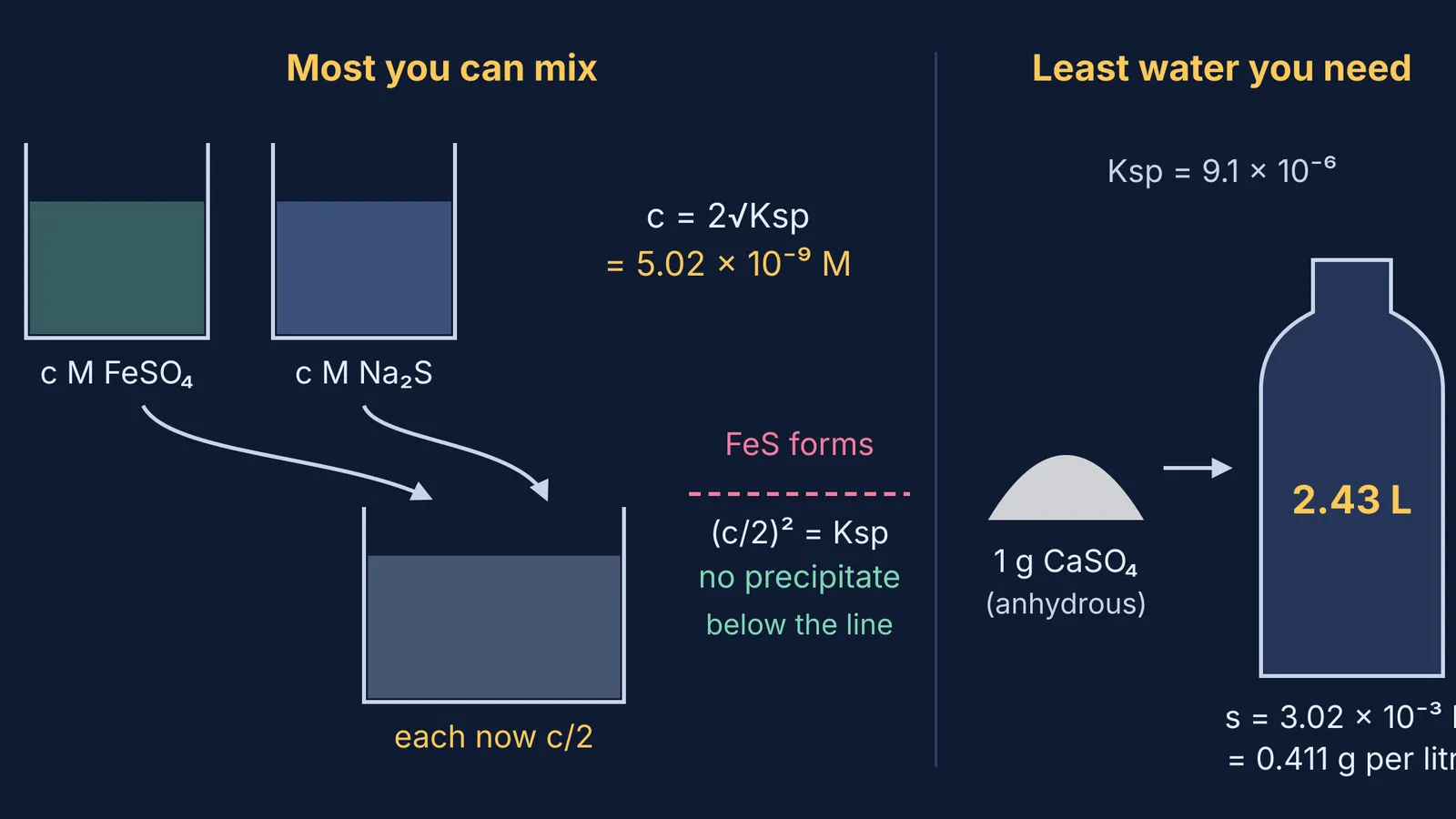
Most Ksp questions give you concentrations and ask whether a solid will come out. Two NCERT Equilibrium exercises run the other way. One asks for the highest concentration of FeSO₄ and Na₂S you can mix without FeS precipitating. The other asks for the least water that will dissolve 1 g of CaSO₄. Both are the same idea read from the other side: at the boundary, the ionic product equals Ksp, and you solve that equation for the unknown.
What does it mean to solve a Ksp problem in reverse?
In a forward problem you know the ion concentrations, work out the ionic product Q, and compare it with Ksp. If Q > Ksp, a precipitate forms. That method is set out in how to decide whether a precipitate will form using the ionic product.
In a reverse problem the answer is a limit. "The most you can mix" means the largest concentration for which Q is still not above Ksp. "The least water you need" means the smallest volume in which the solution is still not above saturation. Either way you set Q = Ksp and solve for what the question wants. Any concentration below the limit stays clear; any above it precipitates.
What is the highest concentration of FeSO₄ and Na₂S you can mix without precipitating FeS?
The NCERT question: equal volumes of equimolar FeSO₄ and Na₂S are mixed. What is the highest molarity they can have without FeS precipitating? Take Ksp of FeS = 6.3 × 10⁻¹⁸.
Write the equilibrium. FeS(s) ⇌ Fe²⁺(aq) + S²⁻(aq), so Ksp = [Fe²⁺][S²⁻].
Account for mixing. Call the concentration of each solution c before mixing. Mixing equal volumes doubles the total volume, so each ion is diluted to c/2. [Fe²⁺] = c/2 and [S²⁻] = c/2.
Set the ionic product equal to Ksp. (c/2) × (c/2) = 6.3 × 10⁻¹⁸.
Solve. c/2 = √(6.3 × 10⁻¹⁸) = 2.51 × 10⁻⁹ M.
Answer the question asked. The question asks about the solutions before mixing, so c = 2 × 2.51 × 10⁻⁹ = 5.02 × 10⁻⁹ M.
So each solution can be at most about 5.02 × 10⁻⁹ M. That is a tiny concentration, which tells you how insoluble FeS is.
What changes if the volumes are not equal?
The method is the same; only the dilution factors change. Suppose 100 mL of c M FeSO₄ is mixed with 300 mL of c M Na₂S. The total is 400 mL.
[Fe²⁺] = c × 100/400 = c/4, and [S²⁻] = c × 300/400 = 3c/4.
(c/4)(3c/4) = 3c²/16 = 6.3 × 10⁻¹⁸.
c² = 16 × 6.3 × 10⁻¹⁸ / 3 = 3.36 × 10⁻¹⁷, so c = 5.80 × 10⁻⁹ M.
The limit is slightly higher than in the equal-volume case, because the product of the two diluted concentrations is smaller for the same c.
What is the least volume of water needed to dissolve 1 g of CaSO₄?
The NCERT question: what is the minimum volume of water needed to dissolve 1 g of calcium sulphate at 298 K? Take Ksp = 9.1 × 10⁻⁶. "Minimum volume" means the solution ends up exactly saturated. Any less water and some solid stays undissolved.
Write the equilibrium. CaSO₄(s) ⇌ Ca²⁺(aq) + SO₄²⁻(aq). This is a 1:1 salt, so if the molar solubility is s, Ksp = s².
Find s. s = √(9.1 × 10⁻⁶) = 3.02 × 10⁻³ mol L⁻¹.
Convert to grams per litre. The molar mass of anhydrous CaSO₄ is 40.08 + 32.06 + 4 × 16.00 = 136.1 g mol⁻¹. So the solubility is 3.02 × 10⁻³ × 136.1 = 0.411 g L⁻¹.
Find the volume. One litre holds 0.411 g at saturation. To hold 1 g you need 1 ÷ 0.411 = 2.43 L.
So at least about 2.43 L of water is needed. This matches the NCERT answer. The step from s to grams is the reverse of the conversion in how to find Ksp when solubility is given in grams per litre.
Does it matter whether the 1 g is anhydrous CaSO₄ or gypsum?
Yes, and it is worth one line in your answer. The calculation above assumes anhydrous CaSO₄, 136.1 g mol⁻¹. If the 1 g is gypsum, CaSO₄·2H₂O (172.2 g mol⁻¹), it contains fewer moles: 1 ÷ 172.2 = 5.81 × 10⁻³ mol. Dividing by s gives 5.81 × 10⁻³ ÷ 3.02 × 10⁻³ = 1.93 L. The NCERT answer of 2.43 L uses the anhydrous salt, so state that assumption.
What if the water already contains sulphate ions?
Then you need more water, not less. In 0.010 M Na₂SO₄, the solubility satisfies s(s + 0.010) = 9.1 × 10⁻⁶. Solving the quadratic gives s ≈ 8.4 × 10⁻⁴ M, and 1 g of anhydrous CaSO₄ then needs about 8.7 L. This is the common ion effect, covered with more examples in solubility product, the common ion effect and precipitation.
Why are both questions really the same idea?
In both, the boundary between "all dissolved" and "some solid" is the point where the ionic product equals Ksp.
In the FeS question, the volume is fixed and you push the concentration up until Q reaches Ksp.
In the CaSO₄ question, the amount of salt is fixed and you add water until the concentration falls to the saturation value.
Write Q = Ksp with the right concentrations, then read the answer off for whatever the question names: concentration before mixing, mass, or volume.
How accurate are these textbook answers?
They are exercise answers, built on simplifications you should know about.
Sulphide hydrolysis. S²⁻ is a very strong base and reacts almost completely with water to give HS⁻ and OH⁻. The real free [S²⁻] in a Na₂S solution is far below the concentration written on the bottle. The NCERT exercise ignores this, and in an exam you should too, unless the question gives you the acid constants of H₂S.
Activities and ion pairs. Ksp is strictly a product of activities, not concentrations. Ca²⁺ and SO₄²⁻ also form ion pairs in solution. Both effects make real calcium sulphate more soluble than the Ksp calculation suggests; its measured solubility is roughly 2 g per litre, several times the textbook figure. Ksp values also differ between data tables. Treat 2.43 L as the textbook answer for the data given.
For practice on dilution and limit problems like these, the Fermi Problem Library has a step-by-step solver that explains the reasoning at each stage.
Quick checklist
At the limit, the ionic product equals Ksp. Set them equal and solve.
After mixing, find each ion's new concentration from the total volume first.
FeS: equal volumes mean each ion is c/2, so c = 2√Ksp = 5.02 × 10⁻⁹ M.
Answer the concentration the question asks for: before mixing, not after.
CaSO₄: s = √Ksp = 3.02 × 10⁻³ M, 0.411 g L⁻¹, so 1 g needs 2.43 L.
Say whether you used anhydrous CaSO₄ or gypsum (2.43 L vs 1.93 L).
A common ion lowers solubility, so more water is needed.


