On this page
If you know the classic proof that the harmonic series 1 + 1/2 + 1/3 + ... grows without limit, you already know the trick behind the Cauchy condensation test. It is a clean way to settle two questions most first courses on series ask: when does Σ1/nᵖ converge, and what about Σ1/(n ln n)?
What does the Cauchy condensation test say?
The test, as stated on Wikipedia's Cauchy condensation test page: for a non-increasing sequence of non-negative real numbers aₙ, the series Σaₙ converges if and only if the condensed series Σ2ᵏa(2ᵏ) converges. Here a(2ᵏ) is the term at n = 2ᵏ, starting from k = 0. MathWorld states the same test for positive terms with aₙ₊₁ ≤ aₙ.
The Wikipedia page also gives the estimate Σaₙ ≤ Σ2ᵏa(2ᵏ) ≤ 2Σaₙ, so when both converge, the condensed sum is at most twice the original.
In plain words: keep only the terms at n = 1, 2, 4, 8 and so on, and weight each by the number of terms it stands for.
Why does grouping in blocks of powers of 2 prove it?
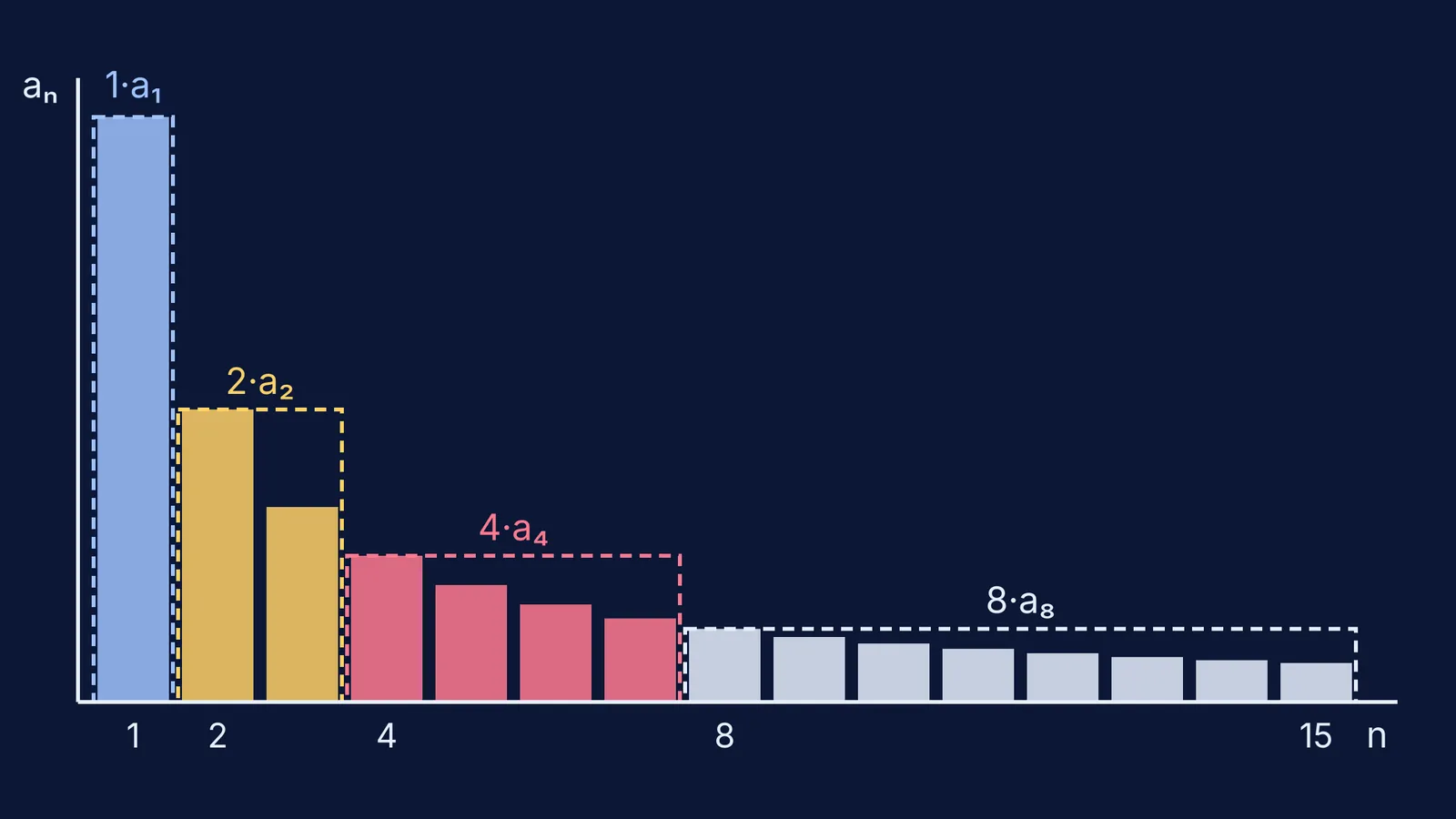
Cut the series into blocks that start at a power of 2: (a₁), (a₂ + a₃), (a₄ + ... + a₇), (a₈ + ... + a₁₅), and so on. Block k has exactly 2ᵏ terms.
Upper bound. Because the terms decrease, the first term of each block is its largest, so block k is at most 2ᵏ times its first term:
a₁ + (a₂ + a₃) + (a₄ + ... + a₇) + ... ≤ a₁ + 2a₂ + 4a₄ + 8a₈ + ...
So if the condensed series converges, the partial sums of Σaₙ are bounded, and Σaₙ converges. The hero diagram shows this for aₙ = 1/n.
Lower bound. Now group the other way, into blocks that end at a power of 2: a₂, then (a₃ + a₄), then (a₅ + ... + a₈). The block ending at 2ᵏ has 2ᵏ⁻¹ terms, each at least a(2ᵏ), so it is at least half of 2ᵏa(2ᵏ). Adding up, Σaₙ is at least half of (the condensed series minus its first term), so if the condensed series diverges, the original does too.
Wikipedia notes that this proof is patterned after Nicole Oresme's argument for the harmonic series, which the harmonic series article) dates to around 1350. That article describes the condensation test as a generalisation of Oresme's argument.
How do you use it on Σ1/nᵖ and Σ1/(n ln n)?
Example 1: the p-series. Take aₙ = 1/nᵖ with p > 0, which is positive and decreasing. Then 2ᵏa(2ᵏ) = 2ᵏ/2ᵏᵖ = (2¹⁻ᵖ)ᵏ. That is a geometric series with ratio r = 2¹⁻ᵖ, which converges exactly when r < 1, that is when 1 − p < 0, that is when p > 1. At p = 1 every condensed term equals 1, so the harmonic series diverges; Wikipedia puts it as the harmonic series being "transformed into the series Σ1". For p ≤ 0 the terms do not even tend to zero.
Example 2: Σ1/(n ln n), from n = 2. The terms are positive and decreasing. Condensing from k = 1:
2ᵏa(2ᵏ) = 2ᵏ / (2ᵏ · ln 2ᵏ) = 1/(k ln 2)
The condensed series is (1/ln 2) times the harmonic series, so it diverges, and Σ1/(n ln n) diverges too, even though from n = 3 its terms are smaller than 1/n.
Example 3: try it yourself. For Σ1/(n (ln n)²), the condensed term is 1/(k² (ln 2)²), a p-series with p = 2, so the original converges. Condensing turns ln n into k ln 2, which is why logarithms collapse so neatly.
Why must the terms be decreasing?
The decreasing condition makes the first term of each block its largest. Drop it and the test can mislead you:
Let aₙ = 1/n when n is a power of 2, and aₙ = 1/n² otherwise. Every term is positive.
The original series is at most Σ1/2ᵏ + Σ1/n², two convergent series, so it converges.
The condensed series has 2ᵏa(2ᵏ) = 2ᵏ · 1/2ᵏ = 1 for every k, so it diverges.
Condensation sampled exactly the spikes. Always check aₙ₊₁ ≤ aₙ, at least from some n onwards.
When should you reach for the condensation test?
A quick checklist:
Are the terms non-negative and decreasing, at least eventually? If not, choose another test.
Do the terms tend to 0? If not, the series diverges.
Does aₙ involve powers or logarithms of n? Those are what condensation simplifies.
Write 2ᵏa(2ᵏ) and simplify. You usually land on a geometric series or a p-series.
Ratio test stuck at limit 1? For any p-series it always is; condensation still decides.
If a step feels shaky, the gap is usually an earlier idea such as geometric series. The Fermi Concept Library covers every concept in mathematics, and the Fermi Problem Library has a step-by-step solver that explains the reasoning, so you see why a series converges, not just the verdict.
Next time a series has a logarithm in it, condense first and see what is left.