On this page
In Class 11 and 12 limits, a function near a troublesome point either settles to a value or shoots off to infinity. Complex functions have a third option, and it is much stranger. The Casorati–Weierstrass theorem describes it exactly, and its proof fits in five lines.
What are the three kinds of isolated singularity?
A point z0 is an isolated singularity of f when f is holomorphic (complex-differentiable) on a small disc around z0 with the centre removed. As the removable singularity article sets out, every such point is one of three kinds:
Removable: f stays bounded near z0, and Riemann's theorem says f then extends holomorphically to z0. Example: sin(z)/z at 0, which tends to 1.
Pole: |f(z)| grows without bound as z approaches z0. Example: 1/z^3 at 0.
Essential: neither. At an essential singularity, neither f nor 1/f has a limit, and the Laurent series of f has infinitely many negative-power terms.
What does the Casorati–Weierstrass theorem say?
The Casorati–Weierstrass theorem states that if f has an essential singularity at z0, the values of f on any punctured disc around z0 are dense in the complex plane.
In ε–δ form: for any complex number w and any ε > 0 and δ > 0, there is a z with 0 < |z − z0| < δ and |f(z) − w| < ε. MathWorld puts it in one line: "An analytic function approaches any given value arbitrarily closely in any ε-neighborhood of an essential singularity."
The name hides some history. The Wikipedia article, citing Collingwood and Lohwater, records that Sokhotski published it in his 1868 master's thesis, Casorati also in 1868 and Weierstrass in 1876, and that Briot and Bouquet had already stated it in the first edition of their 1859 book. Russian texts call it Sokhotski's theorem.
Worked example: how does e^(1/z) behave near 0?
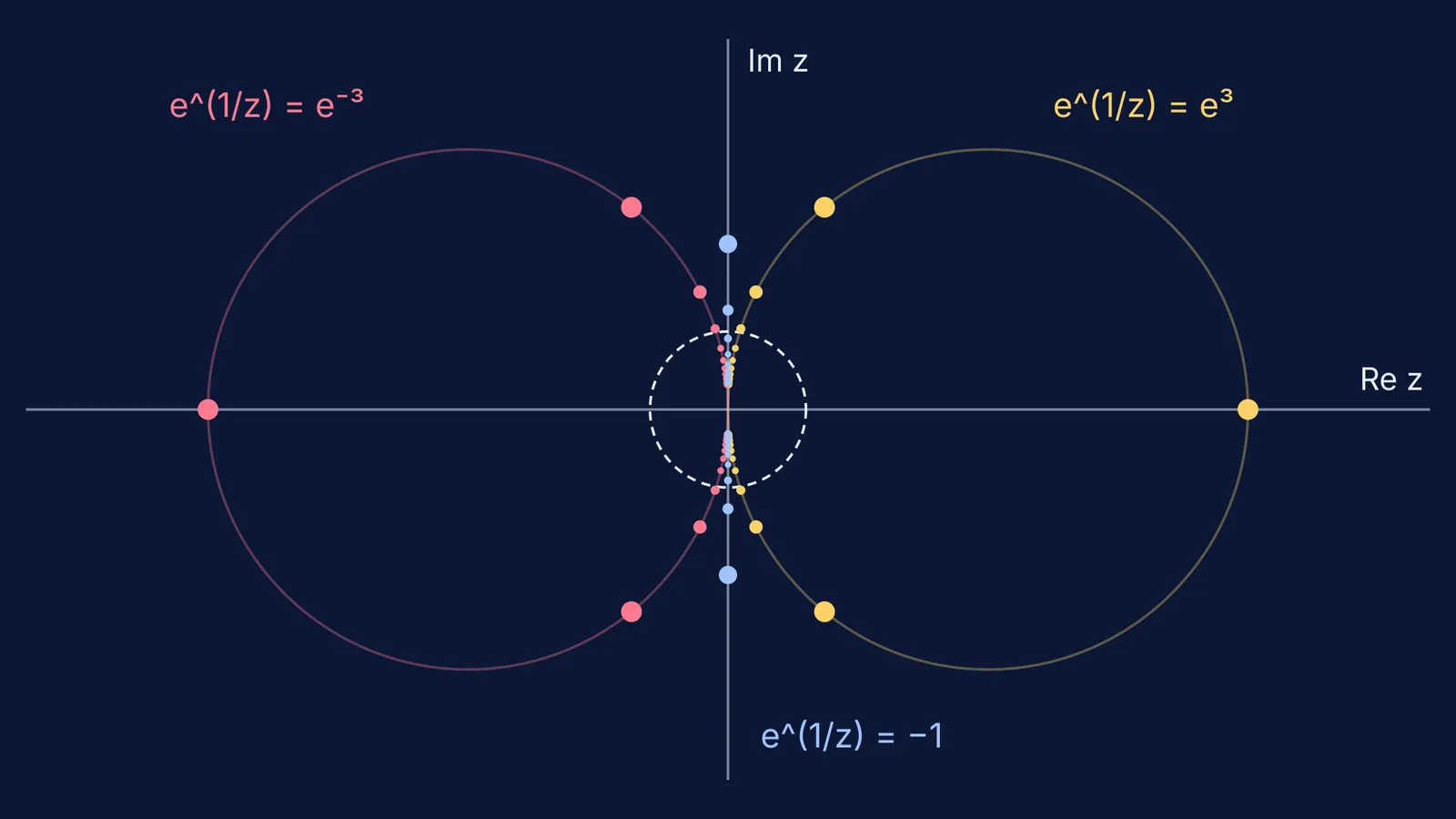
Expand: e^(1/z) = 1 + 1/z + 1/(2! z^2) + 1/(3! z^3) + ... Infinitely many negative powers, so 0 is an essential singularity. Walk towards 0 along three paths:
Positive real axis: 1/z tends to +∞, so e^(1/z) blows up.
Negative real axis: 1/z tends to −∞, so e^(1/z) tends to 0.
Imaginary axis: z = iy gives 1/z = −i/y, so |e^(1/z)| = 1 and the value keeps circling the unit circle.
Three paths, three answers: no limit, not even infinity. So 0 is neither removable nor a pole.
Now pick a target w other than 0 and solve e^(1/z) = w exactly. Taking logarithms, 1/z = Log w + 2πik for every integer k, so z_k = 1/(Log w + 2πik). The imaginary part of the denominator, Arg w + 2πk, grows like 2π|k|, so z_k shrinks to 0.
For w = −1, Log w = iπ and z_k = −i/(π(2k + 1)): the points −i/π, i/π, −i/(3π), i/(3π) and so on, marching into 0. However small a disc you draw around 0, infinitely many land inside. So e^(1/z) takes every nonzero value infinitely often near 0, as the theorem's Wikipedia page notes. It never takes the value 0, because an exponential is never zero.
How does the proof by contradiction work?
The proof on the theorem's Wikipedia page needs only Riemann's theorem on removable singularities.
Suppose the theorem fails: there is a value w, an ε > 0 and a punctured disc around z0 on which |f(z) − w| ≥ ε.
Define g(z) = 1/(f(z) − w). It is holomorphic on the punctured disc and bounded by 1/ε.
Bounded means removable, so g extends holomorphically to z0.
If g(z0) ≠ 0, then f = w + 1/g is holomorphic at z0, so z0 was removable. If g(z0) = 0, then |f| tends to infinity, so z0 was a pole.
Either way z0 is not essential. Contradiction.
The idea worth keeping is step 2: when a function stays away from a value, invert the distance to that value and you get something bounded to work with.
How does Picard's great theorem strengthen it?
Picard's great theorem, named after Émile Picard, says that on every punctured neighbourhood of an essential singularity, f takes every complex value, with at most one exception, infinitely often. Casorati–Weierstrass promises that f comes close to every value; Picard says it actually hits them.
The one exception cannot be dropped, and e^(1/z) shows why: it has an essential singularity at 0 but never equals 0, as the Picard article notes. Our worked example is Picard's theorem in miniature.
To practise, redo the e^(1/z) calculation for w = 2 and w = i, then write the five proof steps from memory. If singularities still feel shaky, the Fermi Concept Library gives every concept in mathematics its own lesson and its place in the map, so you can revisit holomorphic functions or Laurent series first.