

On this page
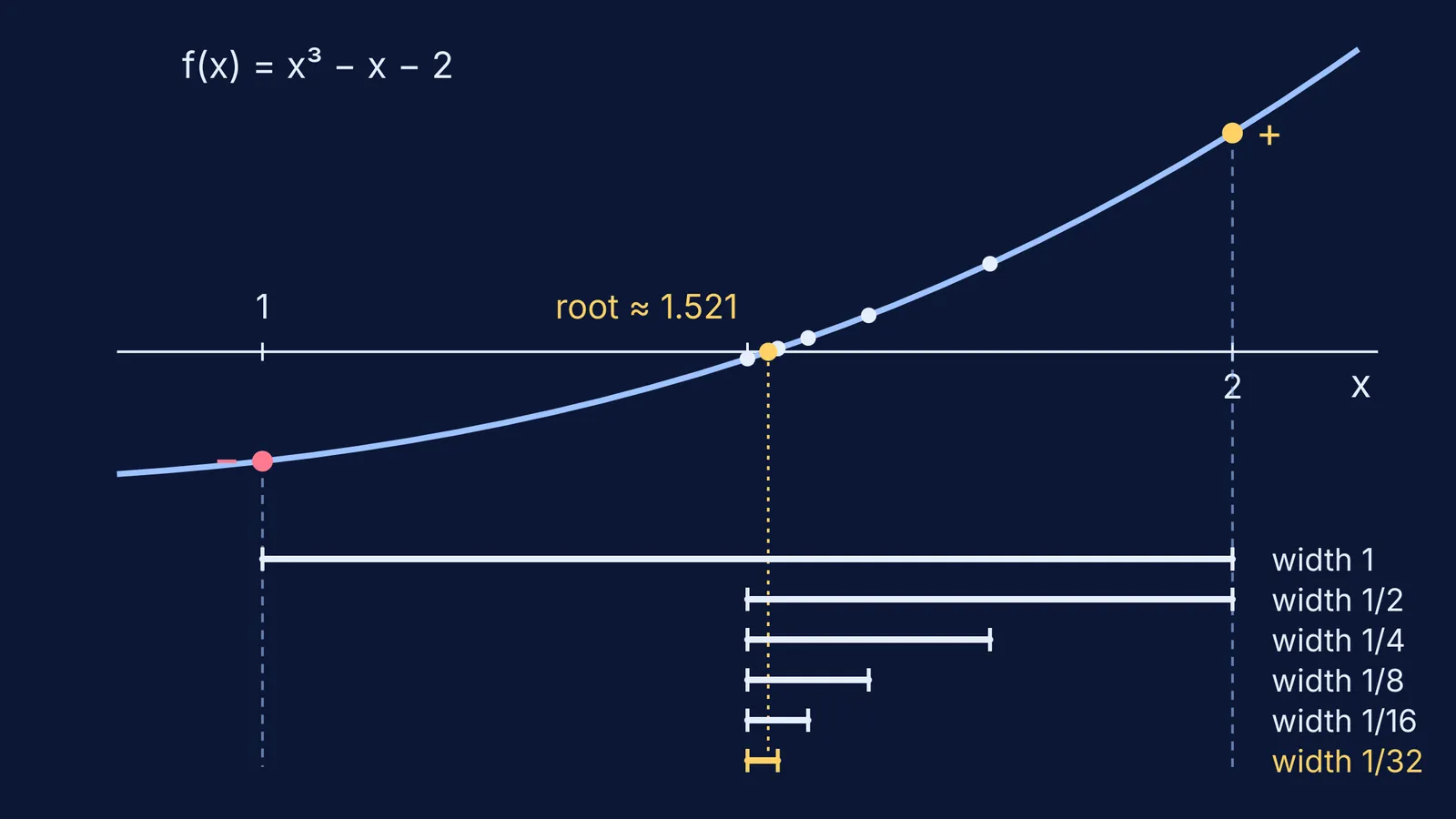
Take x³ − x − 2 = 0. Try x = ±1 and x = ±2 and none works, so there is no rational root to factor out. The bisection method still finds the root, using only sign checks and patience.
What is the bisection method?
The bisection method is a root-finding method for any continuous function where you know two inputs whose outputs have opposite signs. It repeatedly cuts the interval in half and keeps the half in which the function still changes sign, so each step reduces the interval by 50%.
Here is the whole algorithm:
Find a and b with f(a) and f(b) of opposite signs.
Compute the midpoint c = (a + b)/2 and evaluate f(c).
If f(c) = 0, you have the root. If f(c) has the same sign as f(a), replace a with c. Otherwise replace b with c.
Repeat until the interval is as narrow as the accuracy you need.
Why does the bisection method always converge?
Two facts do all the work. The first is the intermediate value theorem: a continuous function on [a, b] takes every value between f(a) and f(b). Its corollary, Bolzano's theorem, says that if a continuous function has opposite signs at the two ends of an interval, it has a root in that interval.
Step 3 keeps that sign change alive: the half you keep always has ends of opposite sign, so a root stays trapped inside.
The second fact is the halving. MIT's course notes on the convergence of bisection write it as Iₙ = I₀/2ⁿ: after n bisections the interval is the starting width divided by 2ⁿ. A trapped root inside an interval whose width goes to zero has nowhere to hide. That argument needs only continuity, not a nice-looking function.
How many steps does bisection need for a given accuracy?
You can count the steps before you begin. The same MIT notes give the rule: to shrink a starting width I₀ below a tolerance δ, you need N > log₂(I₀/δ) bisections.
For a starting interval of width 1, that rule gives:
width below 0.1: 4 steps (1/16 = 0.0625)
width below 0.01: 7 steps (1/128 ≈ 0.0078)
width below 0.001: 10 steps (1/1024 ≈ 0.00098)
width below 0.000001: 20 steps
Each extra correct decimal place costs about 3.3 more halvings, since log₂ 10 ≈ 3.32. The MIT notes call this behaviour linear convergence: the error at one step is proportional to the error at the step before. That steady pace is why Wikipedia's article describes the method as simple and robust but relatively slow, and notes it is often used to get a rough answer that a faster method then refines.
Worked example: bisection on x³ − x − 2
This example comes from the Wikipedia article on bisection; check each line against its table. Start with f(1) = 1 − 1 − 2 = −2 and f(2) = 8 − 2 − 2 = 4. The signs differ, and a polynomial is continuous, so a root lies in [1, 2].
c = 1.5, f(1.5) = −0.125. Negative, like f(1), so the new interval is [1.5, 2].
c = 1.75, f(1.75) ≈ 1.609. Positive, so [1.5, 1.75].
c = 1.625, f(1.625) ≈ 0.666. Positive, so [1.5, 1.625].
c = 1.5625, f(1.5625) ≈ 0.252. Positive, so [1.5, 1.5625].
c = 1.53125, f(1.53125) ≈ 0.059. Positive, so [1.5, 1.53125].
c = 1.515625, f(1.515625) ≈ −0.034. Negative, so [1.515625, 1.53125].
Wikipedia's table carries on the same way. After the 10th halving the interval is [1.5205078, 1.5214844], 1/1024 wide, as the step rule predicted for 0.001. The article notes that by 13 iterations the midpoints have clearly settled near 1.521, and its table runs to 15.
What mistakes do students make with bisection?
A checklist before you hand in:
Check continuity first. A sign change guarantees a root only for a continuous function.
Replace the right endpoint. Compare the sign of f(c) with the sign of f(a).
Stop on width, not on a small f(c). The interval width is what bounds your error.
Keep extra digits in midpoints. Rounding c early can push the root outside your interval.
If you keep updating the wrong end and cannot see why, the Fermi Problem Library has worked problems with a step-by-step solver that explains the reasoning rather than printing an answer. If the gap is the theorem underneath, the Fermi Concept Library gives each concept in mathematics its own lesson and its place in the map.
Now try x³ − 2x − 5 = 0 from [2, 3], where f(2) = −1 and f(3) = 16. The MIT step rule says 7 halvings give width below 0.01; you should end at [2.09375, 2.1015625].


