On this page
The Baire category theorem says that some sets are so thin that a complete space can never be built out of countably many of them. It feels abstract until you see the short proof and what it proves.
What does the Baire category theorem say?
A set is nowhere dense if its closure has empty interior, according to the Wikipedia article on nowhere-dense sets. In plain words, its closure contains no open ball, however small. The integers are nowhere dense in the real line, but the rationals are not, because they are dense everywhere.
A countable union of nowhere-dense sets is called a meagre set (the same article). The theorem then says: a non-empty complete metric space is not meagre in itself.
The Wikipedia article on the Baire category theorem states it the other way round: in a complete metric space, every countable intersection of open dense sets is dense. The two forms say the same thing. Take complements: if F is closed and nowhere dense, then its complement U is open and dense.
The same article records the history. Osgood proved a version for the real line in 1897, Baire proved one for Euclidean space in 1899, and Hausdorff proved the general statement for completely metrizable spaces in 1914.
How does the nested closed balls proof work?
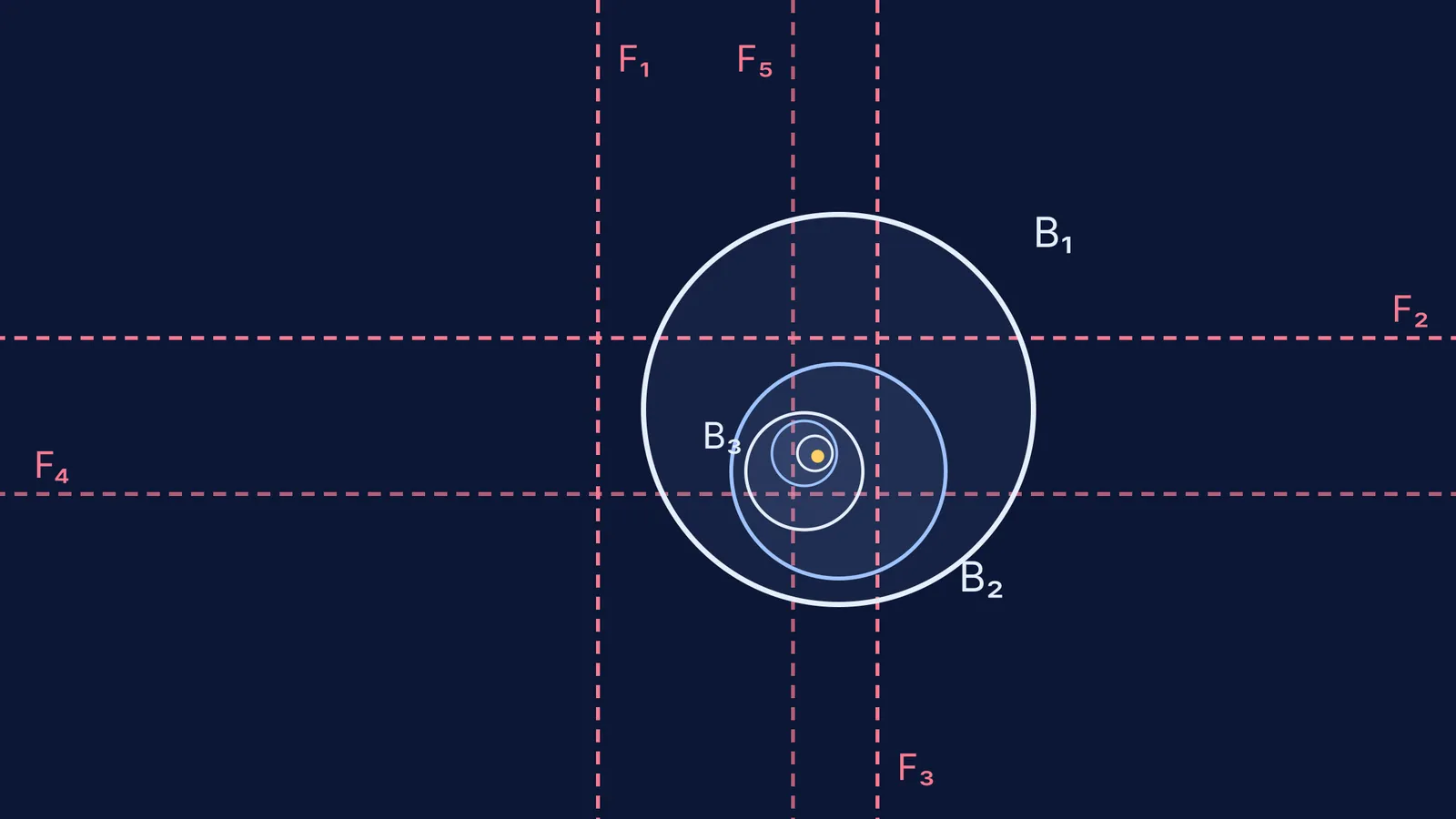
Suppose a non-empty complete metric space X equals F1 ∪ F2 ∪ F3 ∪ …, where each Fn is closed and nowhere dense. (If the sets are not closed, replace each one by its closure, which is still nowhere dense.) We find a point that lies in none of them. That contradicts the assumption.
F1 is nowhere dense, so it cannot contain all of X. Pick a point x1 outside F1. Because F1 is closed, some closed ball B1 around x1 with radius r1 < 1 misses F1.
F2 contains no open ball, so the inside of B1 has a point outside F2. Around that point, choose a closed ball B2 inside B1 that misses F2, with radius r2 < 1/2.
Repeat. At step n you get a closed ball Bn inside the previous one, missing Fn, with radius rn < 1/n.
The centres x1, x2, x3, … form a Cauchy sequence, because all the centres after step n sit inside Bn, whose radius shrinks to 0.
Completeness is used here. The centres converge to some point x. Every ball is closed and contains all later centres, so x lies in every Bn.
Since Bn misses Fn, the point x lies in no Fn. So X is not the union of the Fn.
The Baire category theorem article gives this proof in its open-dense form.
Why is completeness needed?
The rational numbers Q are a good test case. Q is countable, so it is the union of its single points {q}. In Q, every ball around q contains other rationals, so each {q} is closed and has empty interior. Each one is nowhere dense. That makes Q a countable union of nowhere-dense sets, which the theorem says no complete space can be.
You can watch the proof break. Run the nested-ball steps inside Q, and the centres can form a Cauchy sequence of rationals that closes in on an irrational number such as √2. The limit the proof needs is not in Q, so step 5 fails. Completeness is exactly the property that rules this out.
What does the Baire category theorem prove?
R is uncountable. A non-empty complete metric space with no isolated points is uncountable: if it were countable, it would be a countable union of nowhere-dense single points (Baire category theorem article). The real line is complete and has no isolated points.
Rough functions are typical. In the space C[0, 1] of continuous functions with the uniform metric, the nowhere-differentiable functions form a comeagre set: their complement is meagre. The Wikipedia article on the Weierstrass function) cites papers by Mazurkiewicz and Banach, both from 1931, for this result. Weierstrass's 1872 example looked strange, yet in this sense most continuous functions behave like it.
Functional analysis. The open mapping theorem, the closed graph theorem and the uniform boundedness principle can all be proved with it (Baire category theorem article).
How should you study this theorem?
Try this four-step check before an exam, on paper and without notes:
Write both forms of the statement and turn one into the other by taking complements.
Draw the nested balls and mark where you used "closed", "nowhere dense" and "complete".
Explain in two sentences why the proof fails in Q.
Prove that R is uncountable from the theorem alone.
If step 2 or step 4 stalls, the gap is usually in the definitions (closure, interior, Cauchy sequence), not in the proof. You can revisit those ideas in the Fermi Concept Library, which covers concepts across mathematics, physics, chemistry, biology and computing.
Then close the book and rebuild the proof from the picture of shrinking balls.