On this page
These ten questions are our own practice set; your school sets its own paper. Each was checked against the NCERT chapter Sets (Reprint 2026-27).
How do you answer assertion-reason questions?
Sets is the first chapter of Unit I, Sets and Functions, which carries 23 of the 80 theory marks in the CBSE 2026-27 Class XI Mathematics syllabus. The options below are worded as in the CBSE Class XII Mathematics sample paper for 2025-26, where each assertion-reason question carries 1 mark.
(A) Both (A) and (R) are true and (R) is the correct explanation of (A).
(B) Both (A) and (R) are true but (R) is not the correct explanation of (A).
(C) (A) is true but (R) is false.
(D) (A) is false but (R) is true.
Judge A alone, then R alone. If both are true, ask: would R open your proof of A?
Sets assertion-reason questions with answers
Q1 (easy). Assertion (A): {x : x ∈ N and 1 < x < 2} is the empty set. Reason (R): There is no natural number between 1 and 2.
Answer: (A). R is exactly why the set has no element.
Trap: thinking 1.5 counts.
Q2 (easy). A: {1, 2, 3} = {3, 2, 2, 1}. R: In roster form, the order in which elements are listed matters.
Answer: (C). A is true: repeating an element does not change a set. R is false: NCERT says the order is immaterial.
Trap: reading the repeated 2 as a new element.
Q3 (easy). A: ϕ ⊂ {1, 3}. R: The empty set is a subset of every set.
Answer: (A). A is R applied to the set {1, 3}.
Trap: writing ϕ ∈ {1, 3}; ϕ is not an element of it.
Q4 (medium). A: The set of letters in the word SCHOOL has 6 elements. R: Elements of a set are not repeated.
Answer: (D). The set is {S, C, H, O, L}, with 5 elements, so A is false. R is true, and it is the reason A fails.
Trap: counting letters, not distinct letters.
Q5 (medium). A: The set of prime numbers is infinite. R: The set of real numbers cannot be written in roster form.
Answer: (B). NCERT states both, but R is about a different set.
Trap: marking (A) because both lines sound right.
Q6 (medium). Let A = {1, 2, 3, 4, 5} and B = {4, 5, 6}. A: A − B = {1, 2, 3} and B − A = {6}. R: A − B = B − A for any two sets.
Answer: (C). A is true and is itself a counterexample to R.
Trap: assuming difference is commutative, like union.
Q7 (medium). A: The interval [−3, 5) contains exactly 8 integers. R: An interval contains infinitely many points.
Answer: (B). The integers run from −3 to 4. R is true but counts real numbers, so it cannot give 8.
Trap: counting 5; the round bracket excludes it.
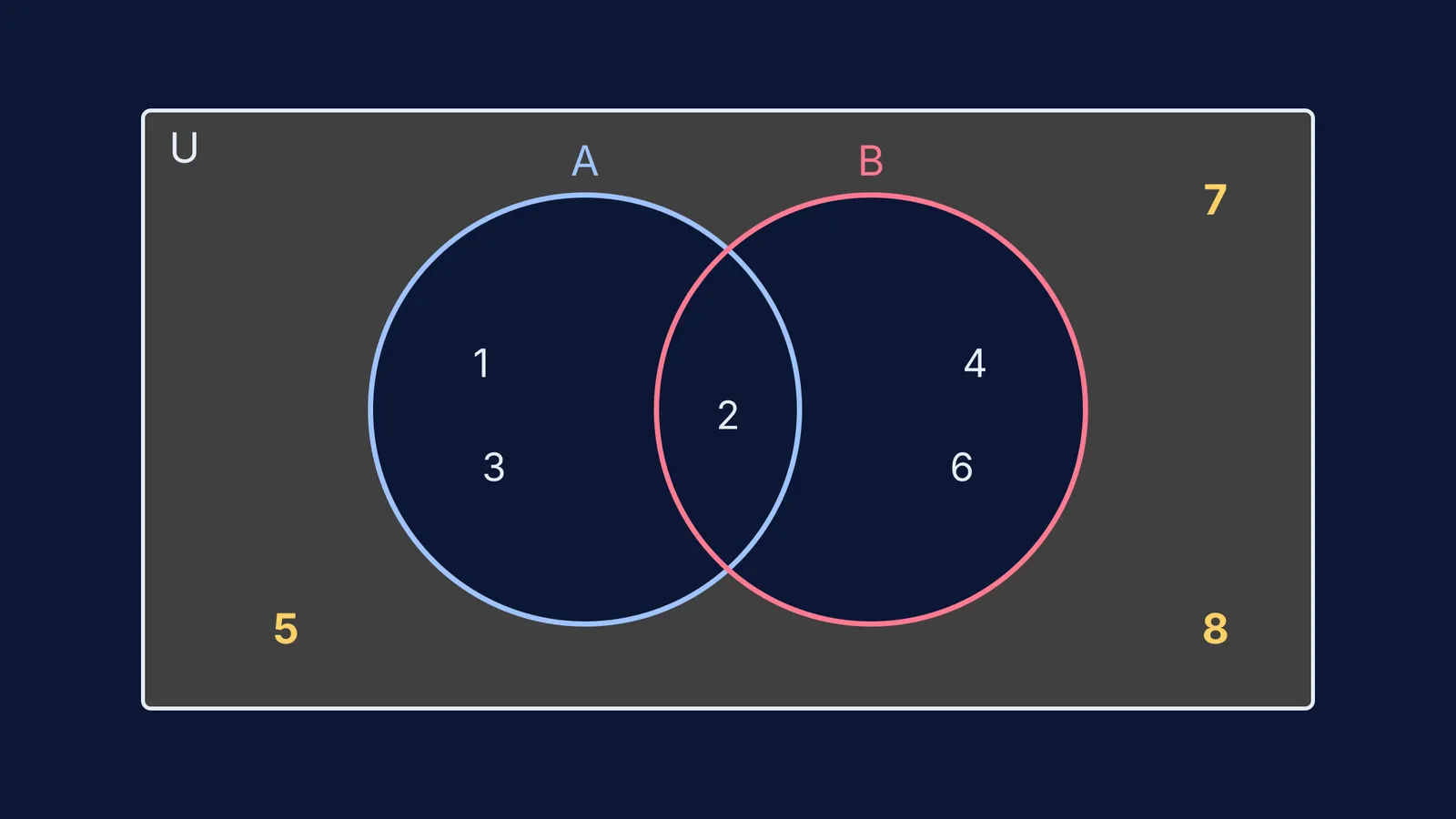
Q8 (hard). Let U = {1, 2, 3, 4, 5, 6, 7, 8}, A = {1, 2, 3} and B = {2, 4, 6}. A: (A ∪ B)′ = A′ ∪ B′. R: (A ∪ B)′ = A′ ∩ B′ for any subsets A and B of U.
Answer: (D). R is De Morgan's law. (A ∪ B)′ = {5, 7, 8}, but A′ ∪ B′ = {1, 3, 4, 5, 6, 7, 8}, so A is false.
Trap: keeping the union sign; complements flip it to intersection.
Q9 (hard). A: If A ∪ B = A ∩ B, then A = B. R: For any sets A and B, A ⊂ A ∪ B and A ∩ B ⊂ B.
Answer: (A). Chain R through A: A ⊂ A ∪ B = A ∩ B ⊂ B, so A ⊂ B; likewise B ⊂ A.
Trap: testing one example and calling it a proof.
Q10 (hard). A: If A ∩ B = A ∩ C, then B = C. R: If A ∪ B = A ∪ C and A ∩ B = A ∩ C, then B = C.
Answer: (D). Take A = {1}, B = {1, 2} and C = {1, 3}: A ∩ B = A ∩ C = {1}, yet B ≠ C. R is true (NCERT Miscellaneous Exercise, Q3) because it uses both conditions.
Trap: cancelling A as if sets were numbers.
How should you use these questions?
Do all ten in 12 minutes, marking each statement T or F first.
For each miss, note the failure: A, R, or the link.
Redo Q8, Q9 and Q10 a day later without the answers.
If a definition still feels shaky, the Fermi Concept Library gives every concept in mathematics its own lesson and its place in the map. For a question you cannot finish, the Fermi Problem Library has a step-by-step solver that explains the reasoning rather than printing an answer.
Next, revise with our Sets Class 11 guide with solved examples, try the Sets case study questions for Class 11, or our three-check method for assertion-reason questions.