On this page
Integration by parts moves the derivative from one factor to the other. Summation by parts does the same for sums, and it is the tool behind the usual proofs that a series like sin(1)/1 + sin(2)/2 + sin(3)/3 + ... converges, even though its terms change sign with no regular pattern.
What is Abel summation by parts?
Summation by parts transforms a sum of products of two sequences into another sum that is often easier to estimate (Summation by parts, Wikipedia). It is also called Abel's lemma or the Abel transformation, after Niels Henrik Abel, who introduced it in 1826 (same source).
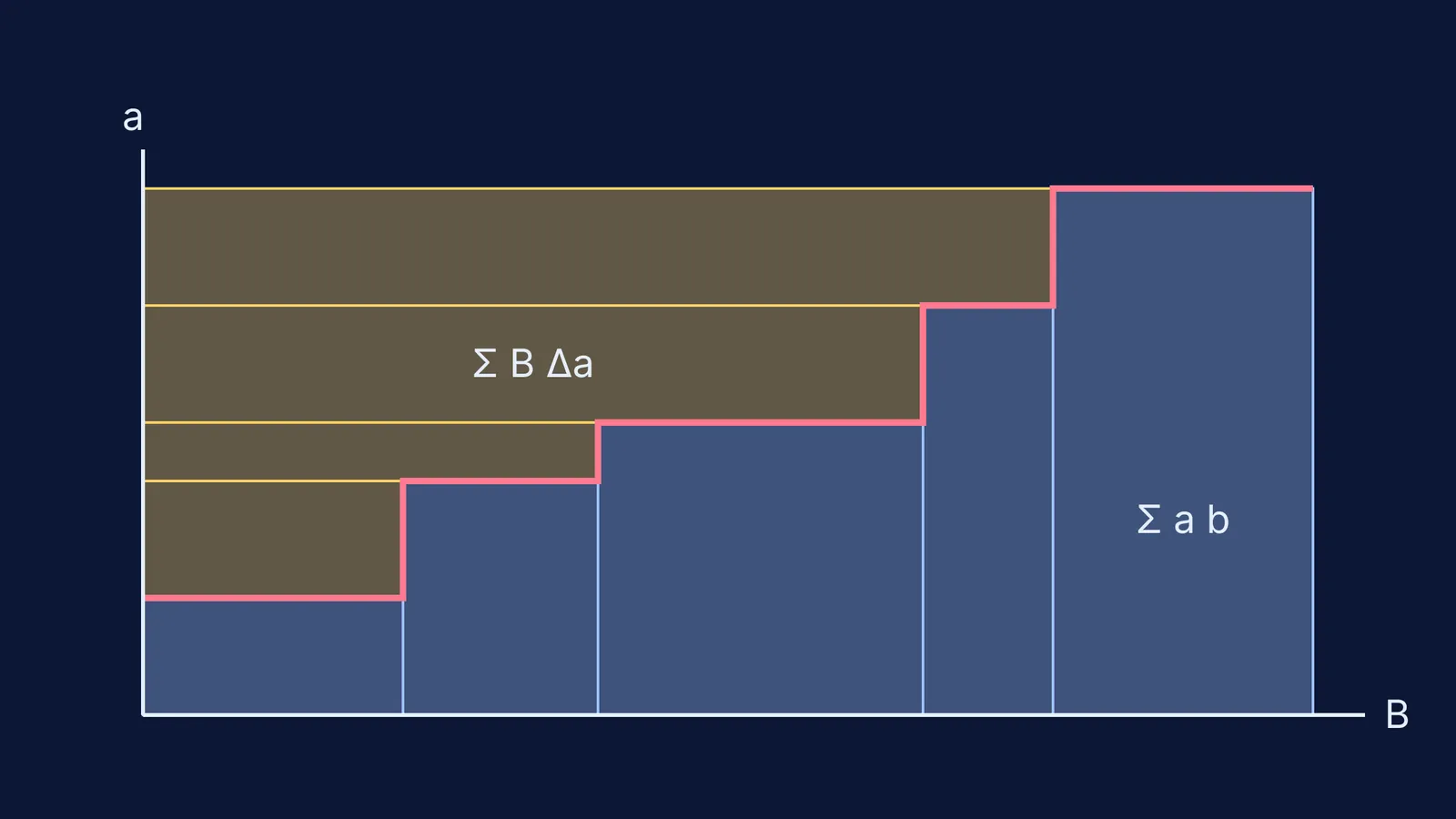
In integration by parts one factor is differentiated and the other integrated; in summation by parts one sequence is differenced (a(n) becomes a(n+1) − a(n)) and the other is summed (b(n) becomes its partial sum B(n)) (Summation by parts).
How does the formula work with partial sums?
Take two sequences a(n) and b(n), and let B(n) = b(1) + b(2) + ... + b(n) be the partial sums of b, with B(0) = 0. Because b(n) = B(n) − B(n−1), you can substitute and regroup the terms:
a(1)b(1) + ... + a(N)b(N) = a(N)B(N) − [B(1)(a(2) − a(1)) + B(2)(a(3) − a(2)) + ... + B(N−1)(a(N) − a(N−1))]
This is the form used in the standard proof of Dirichlet's test (Dirichlet's test, Wikipedia). Check it yourself with N = 2: the right side is a(2)(b(1) + b(2)) − b(1)(a(2) − a(1)), which simplifies to a(1)b(1) + a(2)b(2).
The right side needs only bounded partial sums B(n) and differences of a(n) whose sizes add up to something finite. If a(n) only goes down, the sizes of those differences telescope to a(1) − a(N).
Worked example: does Σ sin(n)/n converge?
Let a(n) = 1/n and b(n) = sin(n). The signs follow no fixed pattern, so the alternating series test does not apply.
Bound the partial sums of sin(n). Writing sin(n) with complex exponentials and summing two geometric series gives sin(1) + ... + sin(N) = [sin(1) + sin(N) − sin(N+1)] / (2 − 2cos(1)) (Dirichlet's test). The numerator is at most 3 in size and 2 − 2cos(1) is about 0.919, so |B(N)| is less than 3.3 for every N. Call this bound M.
Apply the formula to the tail, the terms from n = N+1 to K. It becomes a(K)B(K) − a(N+1)B(N) plus the sum of B(n)(a(n) − a(n+1)) for n from N+1 to K−1.
Bound each piece. Every B is at most M in size. Since 1/n decreases, every difference a(n) − a(n+1) is positive, and together they telescope to a(N+1) − a(K). So the tail is at most M·a(K) + M·a(N+1) + M·(a(N+1) − a(K)) = 2M/(N+1).
Read the answer. The tail bound 2M/(N+1) shrinks to zero, so the series converges. With M = 3.3, the first 1,000 terms pin the sum down to within 6.6/1001, which is under 0.007. Starting the same argument at n = 1 shows that no partial sum ever exceeds 3.3 in size.
How does summation by parts prove Dirichlet's and Abel's tests?
Dirichlet's test says that if a(n) is monotonic with limit 0 and b(n) has bounded partial sums, then Σa(n)b(n) converges (Dirichlet's test). It was published after Dirichlet's death, in 1862 (same source). The proof is steps 2 to 4 above with a general bound M (for an increasing a(n), flip the signs):the boundary term a(N)B(N) goes to 0, and the remaining sum converges by comparison with a telescoping sum. The alternating series test is the special case b(n) = (−1)^n, whose partial sums never exceed 1 in size (same source).
Abel's test says that if Σa(n) converges and b(n) is monotone and bounded, then Σa(n)b(n) converges; Abel proved it in 1826 (Abel's test, Wikipedia). It follows from Dirichlet's test: b(n) has a limit, say b. Write a(n)b(n) = a(n)(b(n) − b) + b·a(n). The first part converges by Dirichlet's test, because b(n) − b is monotone with limit 0 and a convergent series has bounded partial sums. The second part is b times a convergent series.
How should you practise summation by parts?
Spot the split: one factor monotone, the other oscillating.
Sum the oscillating factor and find a bound for its partial sums, often from a geometric series.
Difference the monotone factor and check that the differences telescope.
Write the boundary term and the remainder, then bound each by M.
Test the identity by hand for N = 2 or 3 before trusting your algebra.
Try it next on Σcos(n)/√n and on Σ(−1)^n/log(n) for n from 2. If partial sums or convergence tests still feel shaky, the Fermi Concept Library gives every concept in mathematics its own lesson and its place in the map, so you can go back one idea at a time. When a step in your working stalls, the Fermi Problem Library has a step-by-step solver that explains the reasoning rather than printing an answer.
Pick one series tonight, run the four steps, and check your bound against the identity at N = 3.