On this page
If you have just joined a BTech programme at an AICTE-approved college, two things on your timetable may puzzle you: three weeks of induction before regular classes, and a later course called Universal Human Values with no equations in it. Both come from the same AICTE plan, and both count.
What is the universal human values course in BTech?
Universal Human Values (UHV) is a compulsory value-education course in AICTE's model curriculum, taught in two parts, according to AICTE's model curriculum document on UHV, updated December 2020. The 3-week mandatory Student Induction Program (SIP), based on UHV, was one of a package of measures AICTE approved at its 49th meeting on 14 March 2017, the same document says.
UHV-I is Module 1 of the induction programme and runs for 22 hours.
UHV-II: Understanding Harmony (code H-102 in the model curriculum) is a 3-credit course with 2 lectures and 1 tutorial a week, placed in semester 3 or 4.
UHV-II is run as a dialogue, not a moral-science lecture: the teacher puts forward "proposals" and you check them against your own experience. Its five modules move outward from you:
Introduction to value education
Harmony in the human being: the self and the body
Harmony in the family and society: trust and respect
Harmony in nature and existence
What this means for professional ethics
Together that is 28 lectures and 14 practice sessions of one hour each. The named textbook is A Foundation Course in Human Values and Professional Ethics by R R Gaur, R Asthana and G P Bagaria.
What happens in the 3-week induction programme?
Besides UHV-I, the same AICTE document recommends hours for eight other modules, including physical health and activities (51 hours), creative practices such as music and painting (49 hours), literature (30 hours) and a visit to the local area (10 hours). The UHV-I sessions cover your goals, self-management, health, hostel life, homesickness, ragging, peer pressure, society and nature.
Induction also sets up two relationships meant to last through your time at college: one faculty mentor for every group of about 20 students, and a senior student buddy for every group of about 5. Our guide to getting the most from a college mentor-mentee programme explains how to use those meetings.
How is UHV-II graded?
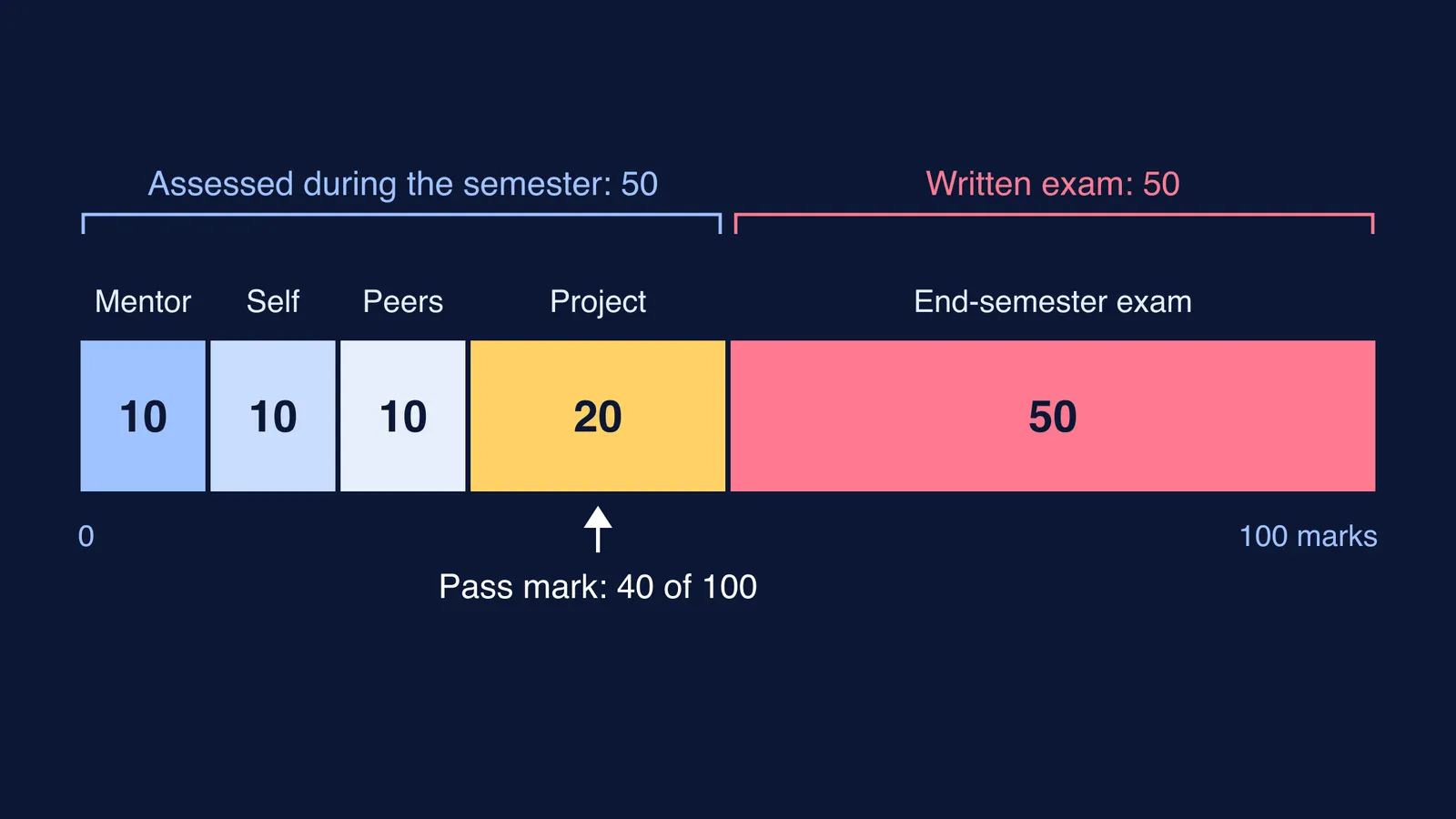
AICTE's suggested assessment for UHV-II gives in-semester assessment as many marks as the exam, according to the model curriculum document. Its example split of 100 marks:
Assessment by faculty mentor: 10
Self-assessment: 10
Assessment by peers: 10
Socially relevant project, group activities or assignments: 20
Semester-end examination: 50
In that example the overall pass mark is 40%, and a student who fails must repeat the course. This is only an example and your university may differ, so read your own syllabus in the first week and ask your UHV teacher how self- and peer-assessment marks are given.
How do you get real use out of UHV?
The AICTE model curriculum says that for this course "the laboratory is everyday life". Treat it that way and the self-assessment, project and exam all get easier to fill with something real. A simple plan for the semester:
Keep a one-page log each week. Note one ordinary situation (say, an argument over the room light), what you felt, and which idea from that week's lecture it tests.
Try one practice session on a real problem. A worked example is below.
Use the log for your self-assessment and the exam. An answer built on a real situation is easier to write, and to remember, than a memorised definition.
Choose a project you would do anyway. A hostel water-saving drive or teaching a few children near campus beats a downloaded report.
Worked example: the trust exercise with a roommate
Practice session 7 asks eight questions in two halves. The first four are about intention: do I want to make myself happy, do I want to make the other happy, does the other want to make me happy? The second four are about competence: am I always able to? Say your roommate plays music at 1 am. On intention you will probably answer yes; the gap is competence, because they may not know it bothers you. The course's point is that we judge ourselves by our intention and others by their competence. A script that follows: "I don't think you're doing this to annoy me. Can we agree on earphones after midnight?"
What if the rest of first year feels harder?
If it is mathematics or physics that worries you, not UHV, our post on the common first-year BTech subjects lists what those papers cover. If a Class 12 idea is missing, the Fermi Concept Library has a lesson for every concept in physics, chemistry, biology, mathematics and computing, so you can fill the gap before the next lecture builds on it.
If the homesickness induction talks about has not lifted after a few weeks, read how to cope with loneliness in first-year college, talk to your mentor, or call Tele MANAS on 14416, a free 24x7 national mental-health helpline.