

On this page
If your college has put you in a mentor group, one teacher has the job of knowing how you are doing. It is easy to meet that teacher once and never go back. Used well, one meeting can settle an elective choice or a plan for a weak subject.
What is a faculty mentor scheme in college?
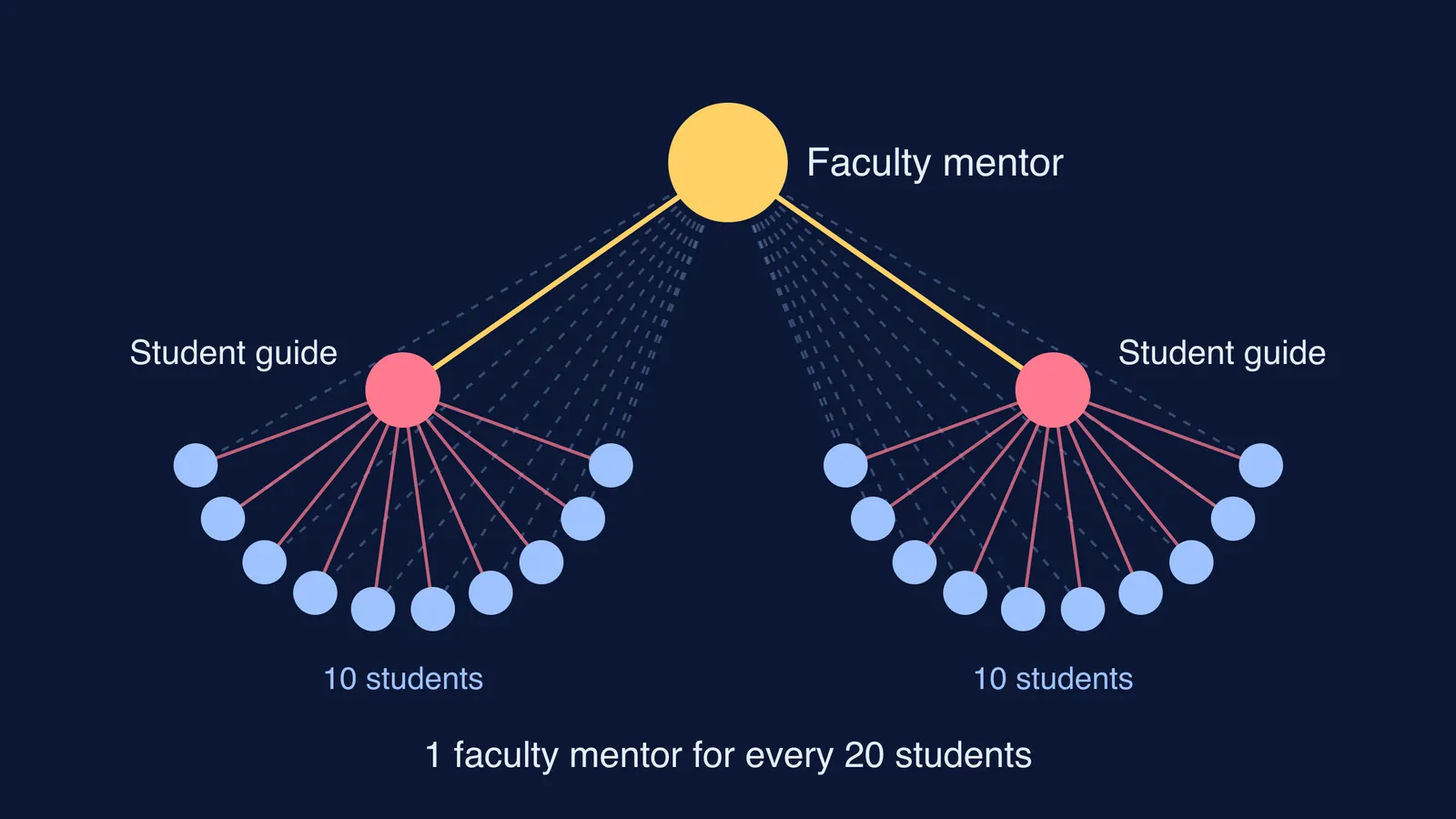
In India, much of the guidance for these schemes comes from the University Grants Commission. UGC's Deeksharambh guide to student induction (July 2019) recommends one faculty mentor for every group of 20 students, plus a senior student guide for every 10 first-year students.
The same guide says you should feel free to approach your faculty mentor or student guide with any kind of problem, whether academic, financial or psychological. It suggests mentor groups meet their faculty mentor for an hour every week during the first semester after induction, and that each group stays together for your whole time at college.
Colleges adapt this, so names and frequency vary. If nobody has told you who your mentor is, ask your class coordinator.
Does having a mentor actually help?
In the 2014 Gallup-Purdue Index, a survey of nearly 30,000 US graduates, people who recalled a professor who cared about them, made them excited about learning and encouraged their dreams had more than double the odds of being engaged at work. Only 14% of those graduates strongly agreed they had that kind of support. It is a survey of memories, so it shows a link, not proof of cause.
Indian medical students in two surveys said they value mentoring. In a survey of 203 second-year MBBS students by Darshan Dave and Jitendra Patel, 98% said there is a definite need for mentorship in medical education. At a Delhi medical college, 231 students answered a survey after a structured mentoring programme began, and most preferred one-to-one mentoring, with faculty rather than senior students as mentors.
What should you talk about with your faculty mentor?
Use a simple agenda: one course, one decision, one future question.
One course: the subject where you are losing marks, with evidence such as your internal assessment score or attendance.
One decision: a choice due this term, such as an open elective, a minor, a club or a summer project.
One future question: higher studies, research, placements or a field you are curious about, and who you should talk to next.
End every meeting with one action and a date to report back.
What can you say at your first mentor meeting?
“Good afternoon ma’am, I’m in your mentor group, first-year mechanical.”
“I’m managing most subjects, but I scored 9 out of 25 in the first maths internal and I’m not sure why.”
“I have to choose an open elective by next Friday. I’m deciding between data science and economics. Which fits better if I’m thinking about a master’s later?”
“Is there a senior or a teacher working in that area you’d suggest I talk to?”
“Can I come back in four weeks and tell you how it went?”
This made-up student brings a number, a deadline and a specific ask, not “Everything is fine.” For the elective question, our guide to choosing electives in college lists what to check before you decide.
How do you prepare for a mentor meeting?
Before: write your three questions down and bring your marks and attendance.
During: take notes, and ask “What would you do in my place?” if the answer stays general.
After: send a two-line email saying thanks and what you will do. Our guide on how to email a professor has a format.
If your mentor points to a gap in your foundations (say, integration holding back engineering mechanics), the Fermi Concept Library has a lesson for every concept in physics, chemistry, biology, mathematics and computing, each in its place on the concept map, so you can find the idea underneath the one you are stuck on.
Tele MANAS, launched by the Ministry of Health and Family Welfare, is a free 24x7 national mental-health helpline on 14416; IIT Kanpur's counselling page has details.
What if your mentor is hard to reach?
Most mentors also teach, so try these in order:
Email one specific question and suggest two time slots.
Go to their posted office hours; our guide to using professor office hours covers how to make the most of them.
Ask your senior student guide.
Find a second, informal mentor: a teacher whose subject you enjoy and who answers questions after class.
Parents can help by asking “Who is your mentor, and when did you last meet?” rather than contacting the mentor themselves.
If you leave a meeting knowing you must rebuild a subject but not where to start, Fermi’s AI tutor works out what you already know and builds a plan for the session, so you start with a clear next step.
Write your three questions today and book your next mentor slot.


