On this page
If you are struggling with a difficult topic or working through a tough problem set, professor office hours are one of the most effective resources on campus. Yet they are often empty. A 2022 Student Voice survey by Inside Higher Ed found that 28% of undergraduates had never attended office hours that academic year, with 20% citing scheduling conflicts and many saying they felt intimidated.
Taking the time to visit your professors outside of class can improve your understanding of the material and help you build a study routine that lasts beyond the first few weeks of the semester. Here is how to make those visits count.
What are office hours for?
Many students think they should only attend office hours if they are failing a class or have an emergency. In reality, office hours are dedicated time for any student to seek help, clarify ideas and get to know the faculty.
You can use this time to:
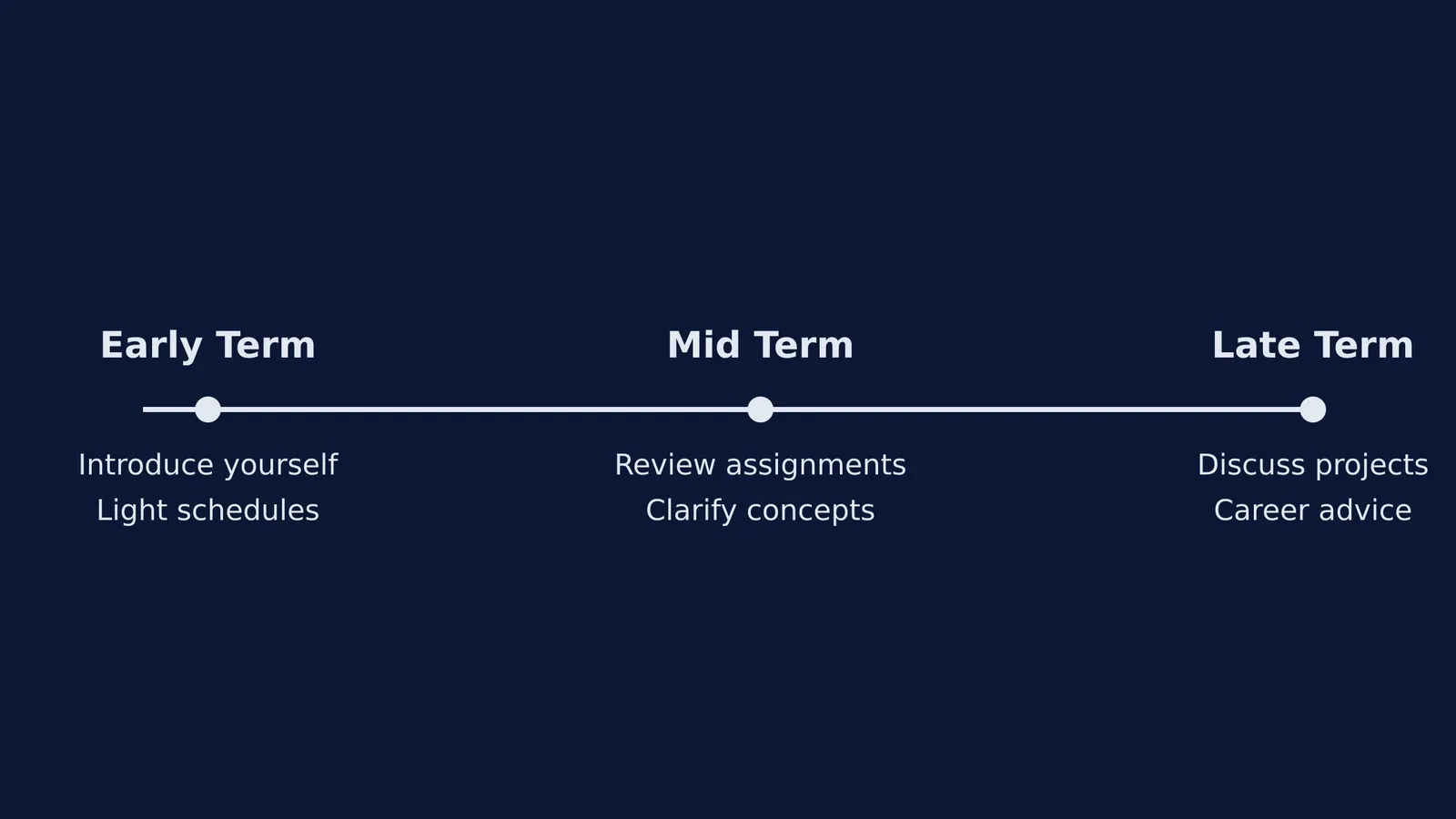
Review a concept from a recent lecture that you did not fully grasp.
Go over mistakes on a midterm or assignment to understand what went wrong.
Discuss how the course material applies to a research project or real-world problem.
Ask for advice on careers, graduate school or research opportunities in the professor's field.
Why visit early in the semester?
It is tempting to wait until the week before the final exam to ask for help, but visiting early in the term has distinct advantages.
First, the professor's schedule is usually much lighter during the first few weeks, so you will not have to compete with a long line of stressed students. Second, establishing a connection early makes it much easier to ask for help later when the material gets harder. If you introduce yourself in September, you are no longer a stranger when you need guidance in November. Finally, catching a misunderstanding early prevents it from snowballing into a larger problem on the midterm.
How to prepare questions for office hours?
Don't just show up and say, "I don't get it." Professors appreciate students who have clearly put in effort before asking for help.
Bring your textbook, your notes and your attempted work. If you are stuck on a physics derivation or a coding assignment, bring your partial solution and point to the exact step where you hit a wall. Instead of asking the professor to re-teach the entire lecture, ask a specific question.
If you are stuck on a problem and the professor is not available, you can use the Fermi Problem Library to trace where your method went wrong. This helps you figure out exactly what you are missing, so you can bring a targeted, specific question to your next office hour visit. Alternatively, Fermi's AI tutor can work out what you already know and build a plan for the session, which helps you isolate the concepts you need to discuss with your professor.
What if your schedule conflicts with office hours?
Since schedule conflicts are a common barrier, you are not alone if you cannot make the listed times. Professors understand that students have jobs, labs and other classes.
If the posted hours do not work for you, send a polite email to your professor explaining your conflict and asking if they have any alternative availability. Offer a few specific time windows when you are free, which makes it easier for them to say yes. Many professors are happy to schedule a brief appointment outside of their regular hours, or even meet virtually via video call. If your professor is completely booked, they might direct you to a teaching assistant or a course coordinator who can provide the same level of help.
What to say during office hours?
If you feel intimidated or feel that your progress has stalled—a common reason why some JEE aspirants plateau—it helps to have a script ready. Here are a few ways to start the conversation:
To clarify a concept: "In class, you mentioned that we should use a non-parametric test here. Could we walk through why the assumptions for a t-test weren't met in this case?"
To review a mistake: "I lost points on question four of the midterm. I understand how to calculate the p-value, but I'm struggling to interpret what it means in this context."
To discuss a project: "I want to study the impact of X on Y for my final paper, but I'm worried my variables are too correlated. How would you recommend I isolate the effect?"
To ask about careers: "I really enjoyed the unit on organic synthesis. Are there any seminal papers or specific lab groups you'd recommend I look at to learn more about this field?"
How to follow up after an office hour visit?
Once you have had a productive meeting, a quick follow-up can help solidify the connection. You do not need to send a thank-you note for every routine question, but if a professor spent significant time reviewing your project proposal or giving you career advice, a short email of appreciation goes a long way.
More importantly, apply the advice they gave you. If they recommended a specific study method or suggested reading an extra chapter, try it out before your next visit. When you return, you can briefly mention how their suggestion helped you improve. This shows that you value their time and are taking your coursework seriously.