On this page
Your first year of BTech looks much the same whether you got mechanical, electronics or computer science. AICTE's model curriculum sets out one first-year credit table for undergraduate engineering, colleges such as IET Lucknow run first year common to all branches, and later courses assume you learned it properly.
What do you study in first year BTech?
The AICTE model curriculum for undergraduate engineering, dated January 2018, sets out a first year of nine core courses. In its computer science version they are:
Mathematics-I: calculus and linear algebra
Mathematics-II: probability and statistics
Physics: semiconductor physics, with a lab
Chemistry-I, with a lab
Programming for Problem Solving, with a lab
Basic Electrical Engineering, with a lab
Engineering Graphics and Design
Workshop/Manufacturing Practices
English
The same document says a mandatory three-week induction programme should run at the very start of first year, with physical activity, creative arts, universal human values, visits to local areas and familiarisation with departments.
Universities adapt the model. At the Institute of Engineering and Technology, Lucknow, an autonomous constituent institute of AKTU, the first-year scheme effective from 2020-21 is common to all branches. It lists some courses as alternatives in each semester, such as Engineering Physics or Engineering Chemistry. Your own college's scheme is the final word, so download it in week one.
How are first-year subjects counted in credits?
AICTE counts one hour of lecture a week as 1 credit and two hours of lab a week as 1 credit (AICTE model curriculum).
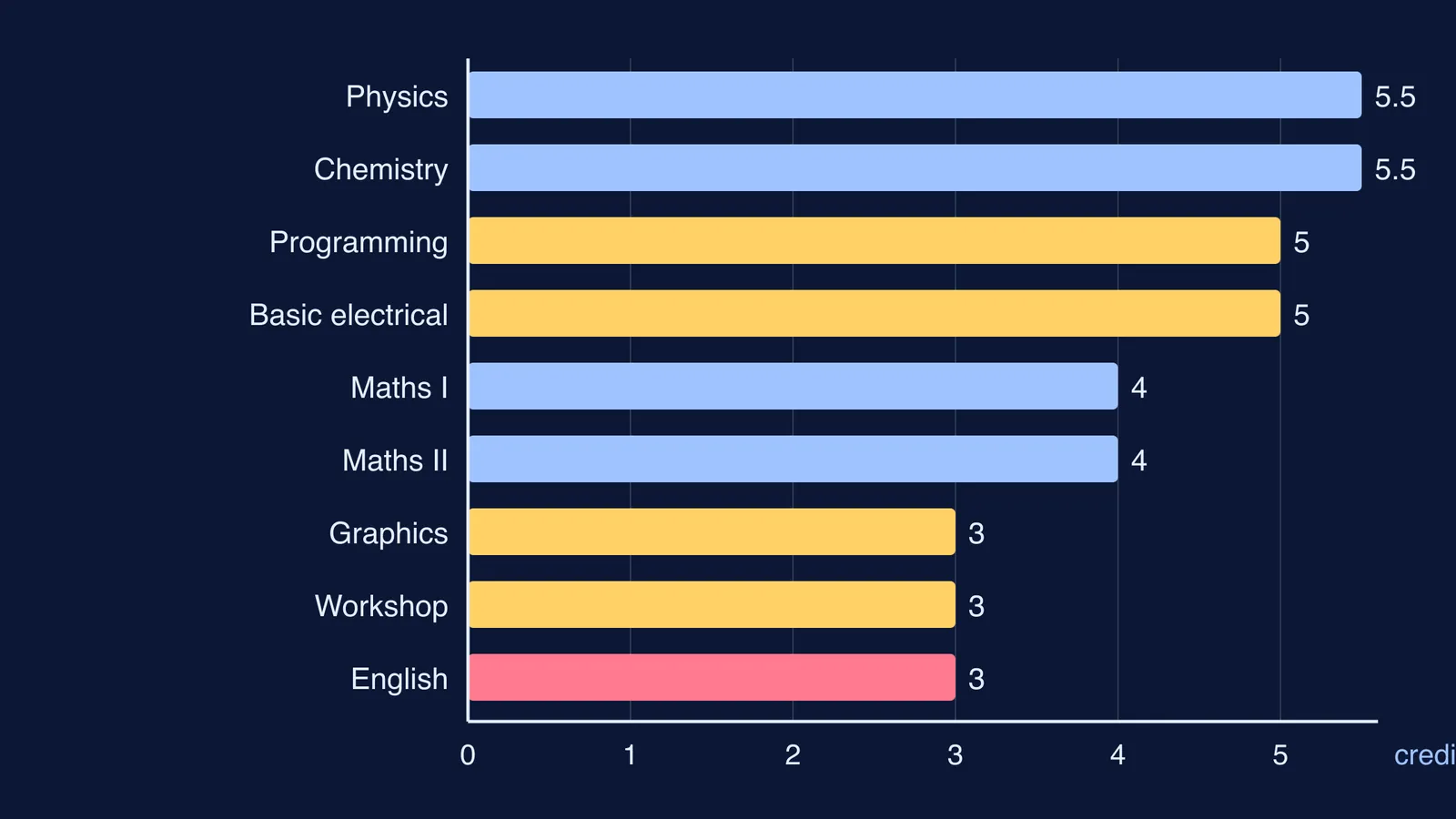
Its first-year table gives Physics and Chemistry-I 5.5 credits each, Programming for Problem Solving and Basic Electrical Engineering 5 each, Mathematics-I and II 4 each, and English, Engineering Graphics and Workshop 3 each. That adds up to 38 credits. The same document sets 150 to 160 credits for the whole degree, so first year is roughly a quarter of what you need to graduate.
Labs carry real weight. Physics and Chemistry each include 3 hours of lab a week, and Graphics and Workshop each have 4 hours of practical work for 1 hour of lecture.
Marks during the semester count too. At IET Lucknow, each theory paper is out of 150: 50 from class tests and teacher assessment, and 100 from the end-semester exam (IET Lucknow first-year scheme).
Why do first-year subjects matter later?
The clearest evidence is in the prerequisites. In AICTE's computer science curriculum, Data Structures and Algorithms in the third semester lists Programming for Problem Solving as its prerequisite (AICTE model curriculum). Analog Electronic Circuits, Digital Electronics, Discrete Mathematics and Signals and Systems follow in the second and third years.
How the first-year pieces connect:
Calculus and linear algebra are the language of circuits, signals, mechanics and almost every model you will meet later.
Probability and statistics sit under data analysis, quality control and machine learning.
Programming feeds data structures directly, and you will use code for lab analysis and projects in most branches.
Semiconductor physics explains the diodes and transistors you meet again in electronics courses.
Chemistry returns in materials, corrosion, batteries and environmental topics.
Basic electrical engineering gives you the circuit laws that electronics and power courses build on.
Graphics and workshop teach you to read a drawing and see how parts are made, which any hardware project needs.
If you are hoping to change branch, colleges that allow it decide at the end of the second semester on your first-year results, so read how branch change works after first year BTech early.
How should you plan your first year?
Use this plan from the first week:
Week one: download the scheme and syllabus. List every course with its credits, lab hours and internal-assessment split.
Every week, one maths bridge hour: revisit the school topic that the week's lecture builds on. Our guide to first-year college maths after JEE shows what to revise and what is new.
Code on non-lab days: type and run one small program. Data structures will assume you can.
Finish lab records the same day, while the readings are fresh.
Do one graphics sheet a week rather than five the night before submission.
Sunday review, one line per course: what was new, which later course it feeds, and what you could not yet do.
That last line is your to-do list. If the gap is a concept from school, such as integration or electric potential, the Fermi Concept Library has a lesson for every concept in physics, chemistry, biology, mathematics and computing, so you can patch it before a later course depends on it. If you understand the idea but keep choosing the wrong method in problem sets, the Fermi Problem Library works through problems with a step-by-step solver that explains the reasoning rather than printing an answer.
To fit this into a week, see our daily routine for engineering college students.