

On this page
College fundamentally changes the rules of studying. Unlike high school, where your daily schedule is tightly managed by teachers and administrators, an engineering degree gives you large blocks of unstructured time alongside long laboratory sessions and intensely fast-paced lectures. The challenge is building a routine that fits coursework, technical clubs, exercise and sleep without burning out in your very first semester. Getting this balance right early on can set the tone for your entire degree.
What does a daily routine for engineering college students look like?
A typical engineering week includes a heavy load of lectures and laboratory sessions. When divided across the weekdays, you will likely spend roughly half your working day in class. Because practical sessions often run continuously for a long block, your days will not look identical.
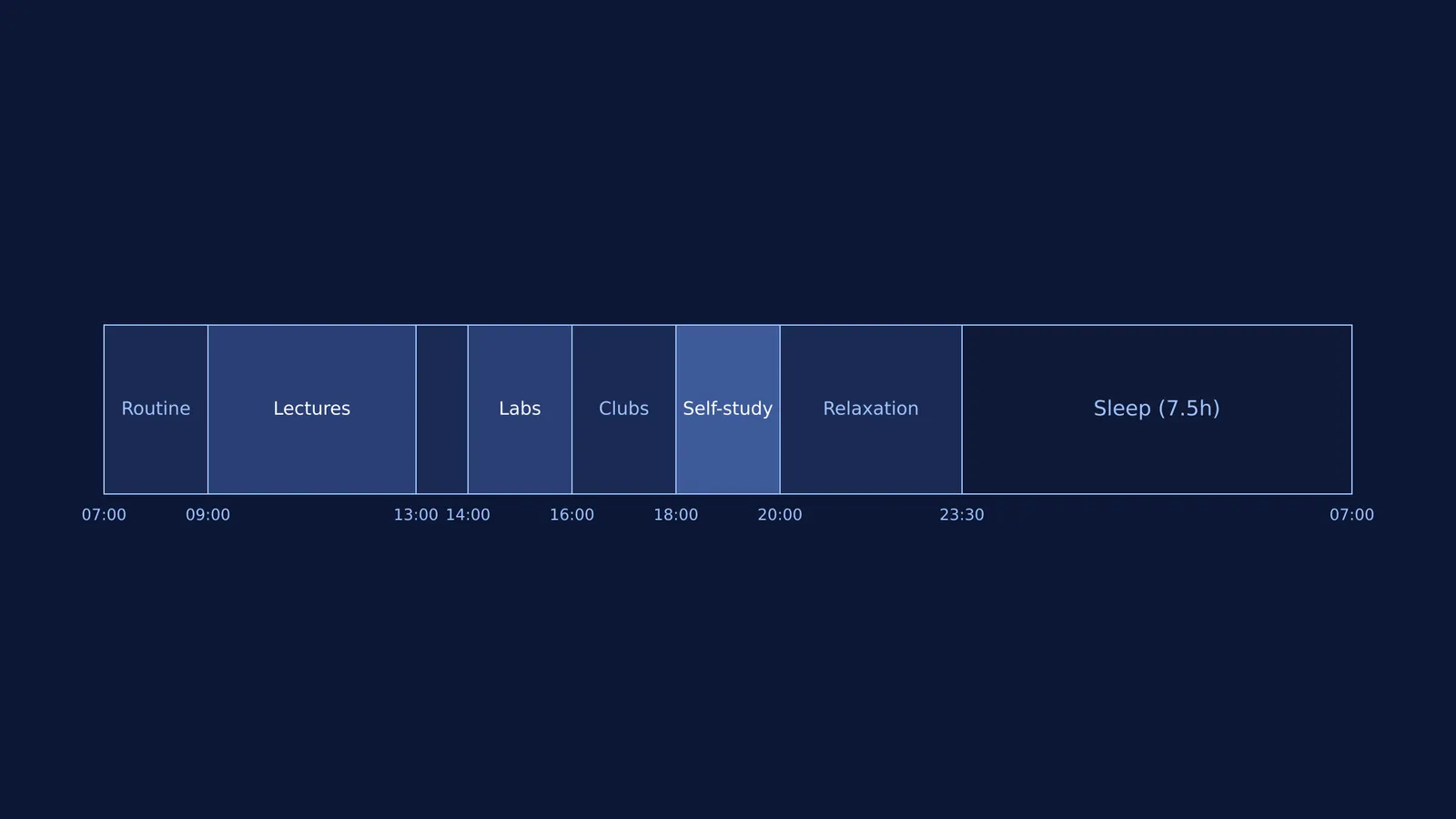
A sustainable weekday schedule might look like this:
07:00 to 09:00: Wake up, exercise and breakfast
09:00 to 13:00: Morning lectures and tutorials
13:00 to 14:00: Lunch
14:00 to 16:00: Laboratory session
16:00 to 18:00: Club activities or downtime
18:00 to 20:00: Self-study and assignments
20:00 to 23:30: Dinner and relaxation
23:30: Sleep
This framework leaves room for flexibility. On days without a laboratory session, you might use the afternoon block to work on a group project or catch up on reading. You can adapt it whether you commute from home or need to figure out how to set up a study desk in a hostel room.
How many hours should engineering students sleep?
Engineering students often sacrifice sleep for assignments, but research shows this reliably hurts grades. A 2026 study of college students by Ruchika Yadu, Suneel Munder and Riya Sen (DOI: 10.36948/ijfmr.2026.v08i02.72972) found that sleep duration positively predicted academic performance.
Alarmingly, 15.8% of students in the study slept less than five hours on weekdays, and 31.1% reported irregular sleep schedules. The study concluded that circadian disruption and daytime sleepiness negatively affect academic outcomes, meaning that losing sleep to cram for an exam is often counterproductive.
Aim for seven to eight hours of sleep at the exact same time each night. If you stay up until 2 AM one night and sleep at 10 PM the next, the resulting circadian disruption will make it harder to concentrate in your morning classes. Keeping a consistent wake-up time, even on weekends, is the easiest way to anchor your daily routine and protect your focus.
How much time should you spend on self-study?
Instead of massing your practice—cramming the weekend before a test—use spaced repetition. A 2026 study by Meng Cao and Paulo F. Carvalho (DOI: 10.31234/osf.io/bd6ks_v1) confirmed that under time constraints, spaced practice produced greater initial memory strength and slower forgetting than massed practice.
This means if you attend most of your classes, two focused hours of self-study a day is usually enough to stay on top of the syllabus, provided you space it out across the week. Reviewing a concept for 20 minutes across three different days is significantly better than studying it for an hour straight on a Sunday. You can build an interleaved practice plan to mix different subjects—like alternating between engineering mathematics and physics—in a single evening study block to keep your mind engaged.
How to stay unstuck during evening study?
Self-study often derails when you hit a concept you do not understand. In college, you cannot always wait for the next day's doubt counter to get unstuck, and searching for answers online can waste your evening study block.
This is where Fermi's AI tutor can help. When you bring a topic or a problem set, Fermi works out what you already know, builds a plan for the session, and teaches through it—writing on a board, drawing the figure, running the simulation, and checking understanding as it goes. If you are struggling with a specific mathematical derivation or physics problem, the Fermi Problem Library provides worked problems with a step-by-step solver that explains the reasoning rather than just printing an answer. This keeps your evening study block moving efficiently instead of stalling on one hard question.


