

On this page
After JEE you already know much of the maths your first semester uses. What changes is the question: fewer "find the value", more "show that this is always true". Use the weeks before college to tighten the JEE topics first-year courses reuse, and to get comfortable with definitions, symbols and short proofs.
What JEE maths does first-year college maths build on?
The official JEE (Advanced) 2026 syllabus already includes the intermediate value property, Rolle's theorem, Lagrange's mean value theorem, one-one and onto functions, and matrices with determinants and inverses up to order three. The 2014 syllabus of IIT Madras course MA1010, Calculus I opens with boundedness and convergence of sequences and tests of convergence of series, then covers limits, Rolle's theorem, the mean value theorem and Taylor's formula. Another IIT Madras course, MA1102 Series and Matrices, takes matrices on to linear independence, basis and dimension, rank and eigenvalues.
What to revise, and where each topic leads:
Functions (one-one, onto, composition, inverse) lead to proofs about functions and to matrices as linear transformations.
Limits, continuity, Rolle and mean value theorems lead to Taylor's formula, and to proving results you used to just apply.
Infinite geometric series lead to convergence tests for many more series.
Matrices and simultaneous equations lead to Gaussian elimination, rank and eigenvalues.
Sets and De Morgan's laws lead to set proofs, the gentlest place to start writing proofs.
If a definition here has gone fuzzy, the Fermi Concept Library has a lesson for every concept in mathematics, each with its place in the map.
Why does first-year maths feel so different?
A 2023 systematic review in Educational Studies in Mathematics by Pietro Di Martino, Francesca Gregorio and Paola Iannone examined 114 conference reports, papers and book chapters on the school-to-university move from 2008 to 2021. It recalls an earlier review by Ghislaine Gueudet (2008) that named three shifts: in ways of thinking, a "transition to proof and the technical language of mathematics", and in the unwritten rules of teaching, the "didactical contract".
The same review notes that many successful students, once at university, perceive "that their ability in mathematics is suddenly reduced". It links many such difficulties to a sudden change in how students see themselves in mathematics. If low mood lasts, talk to your college counselling centre or call Tele MANAS, the free 24x7 national mental-health helpline, on 14416 or 1800-891-4416.
How do you read a definition like ε–N?
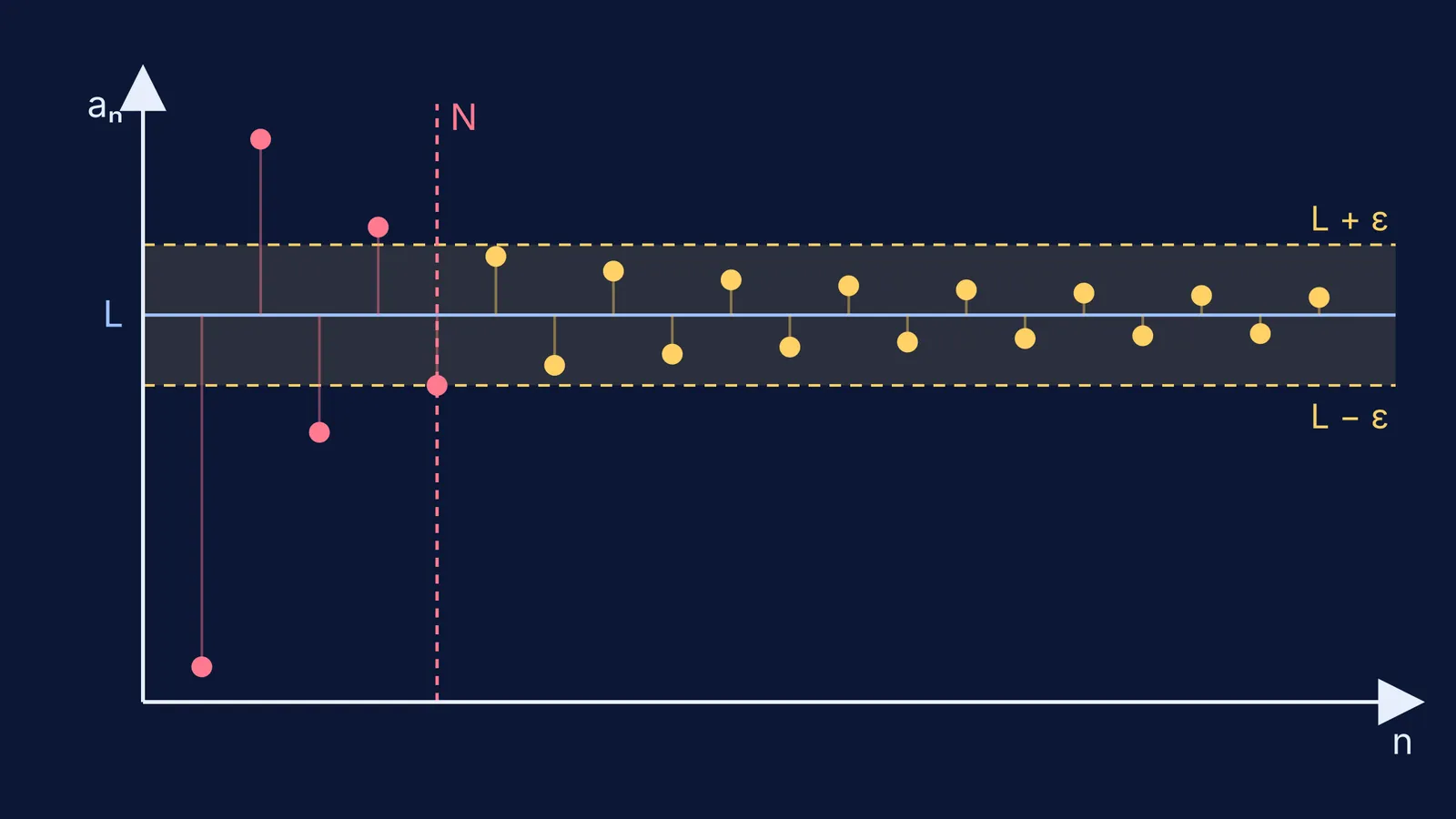
Here is the formal definition behind convergence of sequences, the first topic in that Calculus I syllabus. A sequence (aₙ) converges to L if for every ε > 0 there is a natural number N such that |aₙ − L| < ε for all n > N.
Read it as a game. Someone hands you a tolerance ε, however small; you reply with an N after which every term stays within ε of L. The proof is your strategy for replying.
Worked example: aₙ = 1 + (−1)ⁿ/n, with L = 1.
Find the distance: |aₙ − 1| = |(−1)ⁿ/n| = 1/n.
You need 1/n < ε, which holds whenever n > 1/ε.
So reply with any natural number N ≥ 1/ε. Then for every n > N, 1/n < 1/N ≤ ε.
Test it with ε = 0.2, so N = 5. From a₆ = 7/6 onwards, every term is within 0.2 of 1. But a₅ = 0.8 sits exactly 0.2 away, which is why the definition says n > N.
How should you prepare in the four weeks before semester one?
Our 8-week plan for after Class 12 covers the whole break; this is the maths part, about an hour a day.
Week 1, functions and sets: write the definitions of one-one and onto in words and in symbols, then prove that the composition of two one-one functions is one-one. Add two set proofs by element chasing.
Week 2, calculus theorems: state Rolle's theorem and the mean value theorem with every hypothesis, then break one. f(x) = |x| on [−1, 1] has f(−1) = f(1), yet f′ is never zero, because f is not differentiable at 0.
Week 3, sequences and induction: repeat the ε–N example for 1/n and for (n + 1)/n, and write three proofs by mathematical induction.
Week 4, matrices: solve a 3×3 system by row reduction, and ask what a row of zeros tells you.
Before calling a proof finished, check:
Did I write down what I am assuming?
Did I write down what I must show?
Does every line follow from a definition, a theorem or the line before?
Does the last line say exactly what was asked?
When a step will not come, the Fermi Problem Library has worked problems with a step-by-step solver that explains the reasoning rather than printing an answer. If you are unsure where to begin, Fermi's AI tutor works out what you already know and builds a plan for the session.
Start today: write one week-1 definition in words and in symbols.


