

On this page
Many students accept a seat in a branch they are not enthusiastic about, banking on the hope that they can upgrade to Computer Science (CS) or Electronics after two semesters. This is known as a branch change or branch sliding.
While it sounds like a perfect backup plan, it is statistically the hardest path to a preferred degree. In recent years, the rules governing these transfers have undergone a massive shift, with several top-tier institutes scrapping the policy entirely to protect student wellbeing.
How does the branch change process work?
For engineering colleges that still permit a branch change, the process happens at the end of the second semester. It is a one-time opportunity based entirely on your first-year Cumulative Grade Point Average (CGPA). You cannot try again in your second or third year.
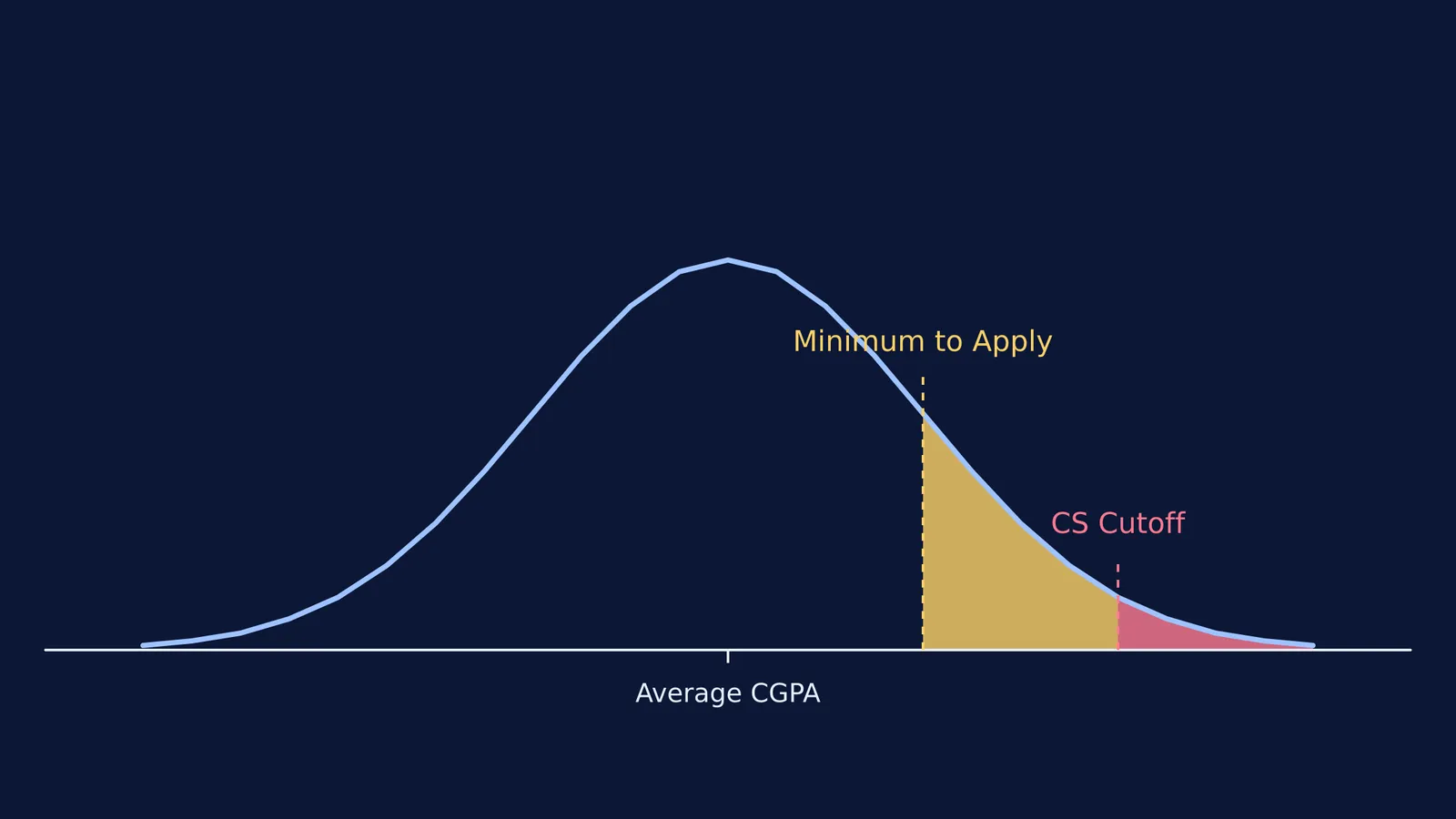
To even be eligible to apply, most National Institutes of Technology (NITs) require a high minimum CGPA without any backlogs. You must clear all your first-year subjects in the first attempt.
However, being eligible does not mean you will get the seat. Institutes enforce strict capacity caps so that departments do not become overcrowded or completely empty. Because almost every applicant wants to move into Computer Science or Electronics, the actual cutoff CGPA routinely sits near absolute perfection, and only a tiny fraction of applicants successfully secure a change.
Because engineering colleges use relative grading, your CGPA is a measure of how you perform compared to your peers. Scoring a near-perfect CGPA means you must consistently place at the very top of a highly competitive cohort across every single subject, from physics and mathematics to engineering drawing and communication skills.
Why are top IITs abolishing branch change?
Recognising the severe mental health toll this competition takes on students, several leading institutes have completely abolished the branch change option.
IIT Bombay removed the option starting with its 2023 batch. In 2024, IIT Madras and IIT Kharagpur followed suit, eliminating branch changes for all incoming students. The academic committees at these institutes noted that the intense pressure to score a near-perfect CGPA was causing widespread depression and burnout. With the vast majority of students failing to make the cut, many were left feeling defeated and exhausted at the very start of their four-year journey.
This shift reflects a broader understanding that the first year of college should be about adapting to a new environment, exploring extracurricular activities, and building a foundation, rather than functioning as a second, even more stressful entrance examination.
Should you plan for a branch change?
The simplest advice is no. You should never choose a college-branch combination that you would be miserable studying for four years. The odds of securing a branch change are simply too low to stake your career on.
Instead of fighting for a near-perfect CGPA just to escape your assigned department, focus on adjusting to the new academic demands. The transition from school to college is steep, and you can read our guide on what to expect during your first semester at science or engineering college to prepare yourself.
If you do want to aim for the top grades—whether for a branch change, a double major, or simply a strong academic foundation—you need a deliberate study strategy. You can follow our research-backed semester plan to improve your CGPA.
First-year courses like engineering mathematics, mechanics, and thermodynamics are notoriously difficult because they require a deep, structural understanding rather than rote memorisation. When you encounter a challenging topic, the Fermi Concept Library maps out every concept in physics, chemistry, biology, mathematics and computing, each with its own lesson and its place in the map. If you find yourself stuck on a hard problem set, Fermi's AI tutor works out what you already know, builds a plan for the session, and teaches through it — writing on a board, drawing the figure, running the simulation, and checking understanding as it goes.
What is a practical plan for your first year?
If you missed your dream branch during counselling, use this three-step framework to build your career instead of relying on a branch change:
Check the actual rules: During your orientation week, read your institute's latest academic rulebook. Check if branch changes are actually allowed, what the exact seat caps are, and whether a Minor or Double Major is offered instead.
Learn the core skills independently: If you want to work in software, you do not need a formal degree in Computer Science. Use your open electives to take data structures and algorithms, and build your own coding projects outside of class to show employers.
Protect your mental health: Set a realistic target CGPA that keeps you eligible for almost all campus placements and internships. This allows you to build a strong profile without the crushing stress of chasing absolute perfection.


