On this page
Every board season the same advice goes round: underline your keywords and the examiner will give you more marks. The useful version is narrow. Underlining helps when it points a hurried reader to the exact words the marking scheme is looking for. It stops helping the moment it covers everything.
What does a board examiner actually look for?
A good clue is in the general instructions printed at the start of CBSE's own marking schemes. In the Class 12 Punjabi marking scheme for 2025, the Board tells evaluators that the scheme "carries only suggested value points for the answers", that students "can have their own expression", and that evaluation must be carried out "strictly as per value points for each answer".
The same instructions say every examiner must work full working hours, 8 hours a day, and evaluate 20 answer books per day in main subjects and 25 in other subjects (CBSE marking scheme, 2025). Spread evenly, that is about 24 minutes for each answer book in a main subject, covering every question, the totals and the title page.
So the examiner is reading quickly, with a list of value points beside them, checking whether each one is in your answer. Anything that makes those points easy to find saves them effort. Anything that buries them costs you.
Does underlining keywords really help?
There is no study of underlining in Indian board answer books, so be wary of anyone who quotes a number of extra marks. The closest research is on cueing: colour, arrows or highlighting that point a learner to the important part of a lesson.
A 2017 meta-analysis by Xie and colleagues pooled 32 articles on multimedia lessons and found that cues improved what learners remembered and how well they applied it, and linked this to lower cognitive load (PLoS ONE, 2017). Those studies tested learners working through lessons, not examiners reading handwritten answers, so treat the link as a sensible idea rather than proof.
Do not confuse this with underlining while you study. A 2013 review led by John Dunlosky gave highlighting and underlining a low utility rating as study techniques (Association for Psychological Science). Underlining your textbook does little for your memory. Underlining in an answer is for someone else's eyes.
How much should you underline, and with what?
Use these rules, which come from the logic of value-point marking:
Underline terms, not sentences. A single technical word or short phrase per paragraph, at most two.
Underline the words a marking scheme would list: a definition's key condition, a law's name, a named process, a cause and its effect.
In numericals, box the final answer with its unit instead of underlining it. Leave the working plain so the steps stay readable.
Use the same pen you are writing with, or another colour only if your board allows it. Check the instructions on your admit card and the answer book cover. Skip highlighters and sketch pens.
Draw one quick freehand line as you finish each paragraph. Do not go back with a ruler at the end; that time belongs to revision.
Skip underlining entirely in one-mark answers, MCQs and long maths derivations, and whenever you are short of time. A complete answer with no underlines beats an underlined half answer.
What does good underlining look like?
Take a 3-mark Class 10 Science question: state Ohm's law and write its mathematical form.
An over-underlined answer has a line under every sentence. The examiner's eye has nowhere to land, and the page looks messy.
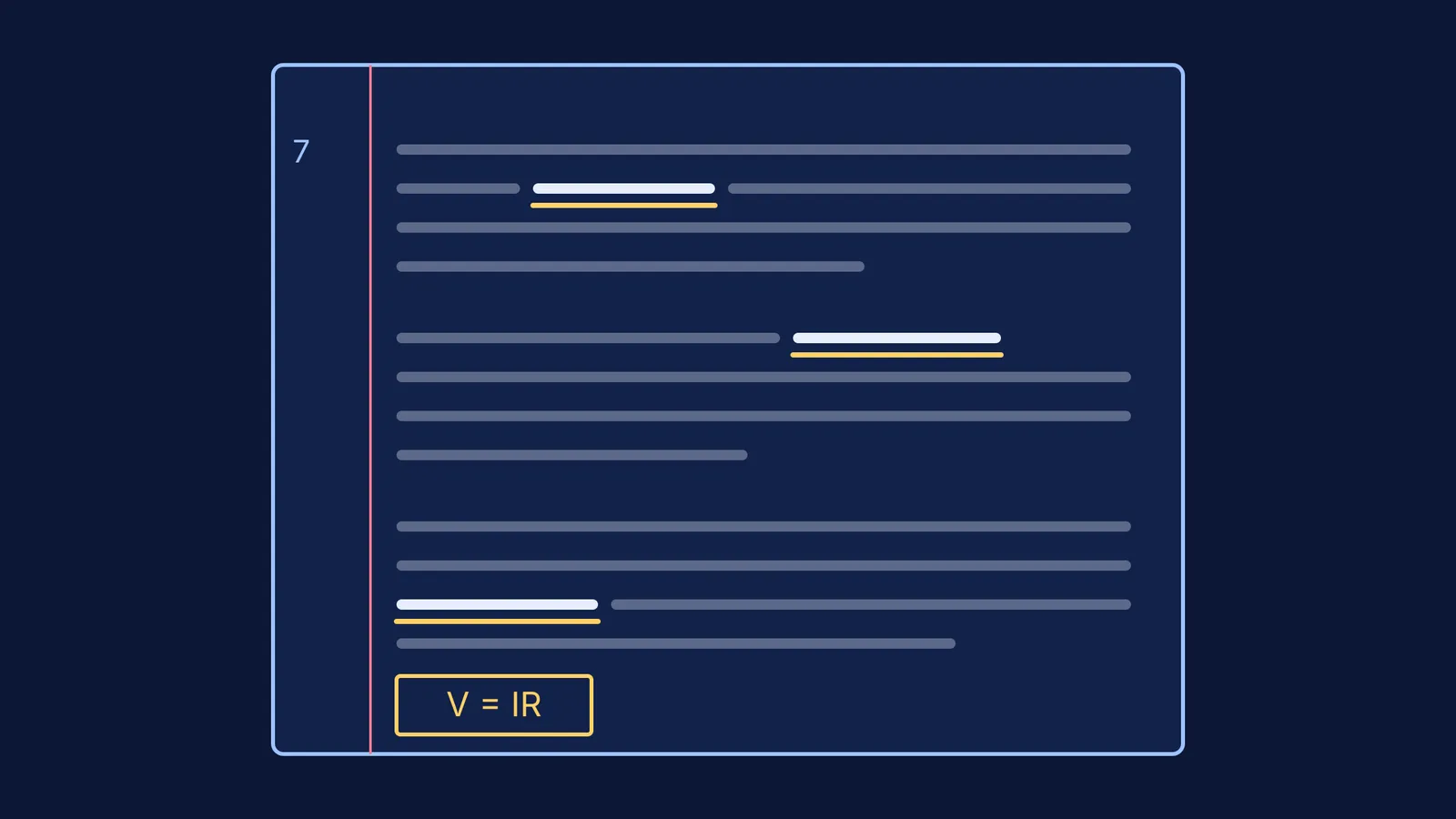
A well-underlined answer reads normally and has three marks on it:
the condition "at constant temperature"
the relationship "directly proportional" (current to potential difference)
the boxed equation V = IR, with V, I and R defined in words below it
Those three are the kind of points a value-point list for this question would contain. If you are not sure which words in an answer are the value points, that usually means the concept itself is shaky. The Fermi Concept Library has a lesson for each concept in physics, chemistry, biology and mathematics, so you can pin down the core idea before you practise writing it.
When should you practise this?
Practise during timed papers at home, not for the first time in the exam hall. Underlining should become a reflex that costs you seconds, not a decision you weigh on every line. It works best alongside the rest of your layout: see our guide to presenting board exam answers neatly and our structure for five-mark answers. For which pens to pack, use the board exam stationery kit checklist.
In your next practice paper, try the one-or-two rule on every long answer and ask a teacher to read just the underlined words.