

On this page
Many long answers in board exams lose marks for a simple reason: the right ideas are there, but the examiner cannot find them quickly. A 3- or 5-mark theory answer is marked point by point, so your job is to make each point easy to see and tick. Below is a five-part structure and a before-and-after example from CBSE's own 2026-27 sample paper.
How are long answers marked in board exams?
CBSE examiners mark against a marking scheme, and the CBSE marking scheme for the Secondary School Examination 2025 says it carries "only suggested value points" and that students "can have their own expression", with due marks if that expression is correct. The same 2025 instructions ask each examiner to evaluate 20 answer books a day in main subjects, working 8-hour days. A point buried mid-paragraph is easy to miss.
You can see value points at work in the CBSE Class 10 Science marking scheme for 2026-27. In one 3-mark part on breathing, four steps of inhalation earn half a mark each and one line about the alveoli earns a full mark.
How should you structure a 3- or 5-mark answer?
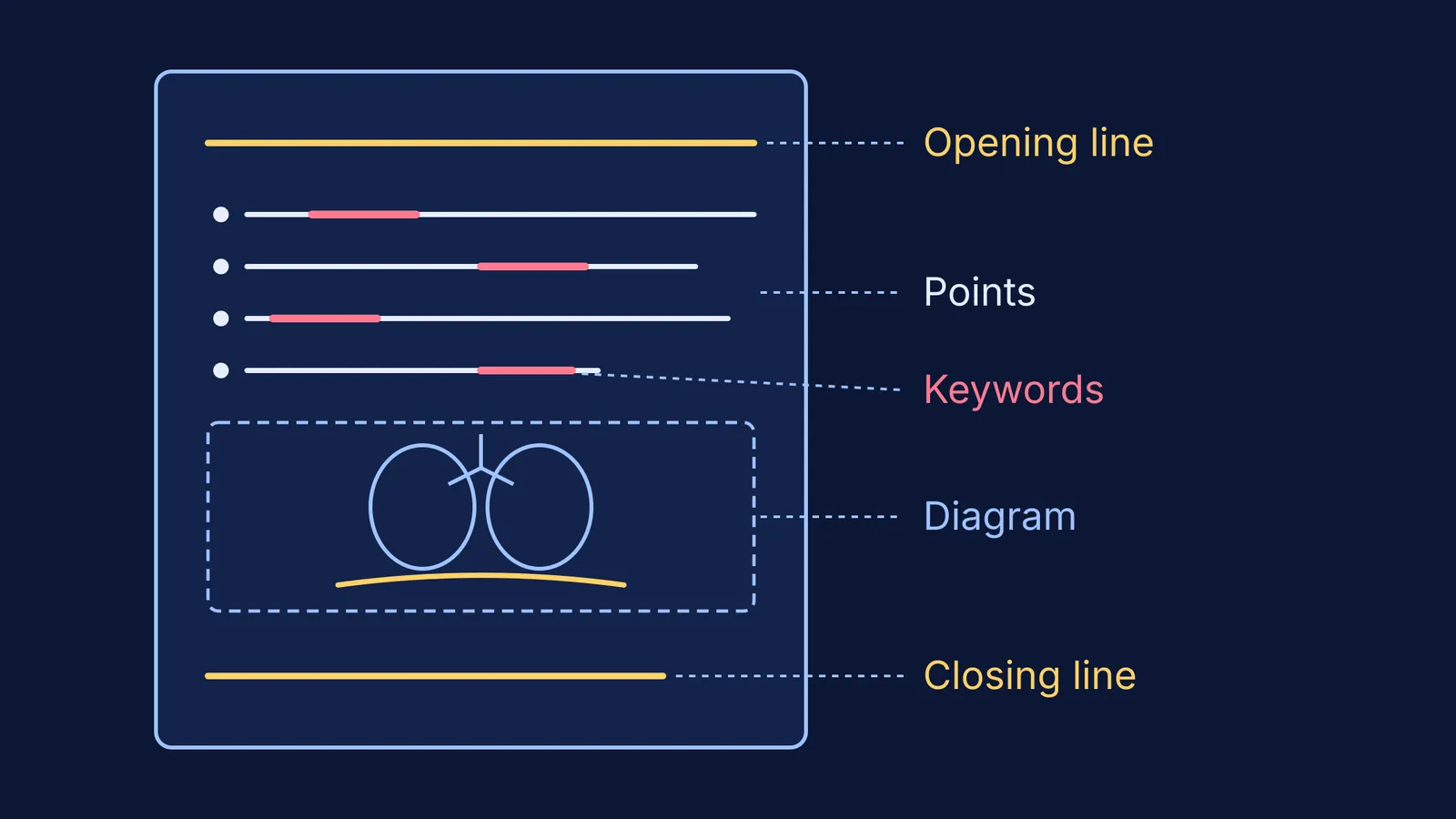
Use the same five parts every time, in this order:
Opening line. One sentence that answers the question or defines the key term. If the examiner read only this line, it should still earn credit.
Points. One idea per line, numbered or bulleted. Plan at least as many points as there are marks. If the question has parts (I, II), answer each under its own label.
Diagram. Add a neat, labelled sketch when asked, or when a picture explains faster: a ray diagram, a circuit, a cross-section.
Keywords. Use the textbook's exact terms (diaphragm, alveoli, catenation) and underline them lightly. The Science marking scheme writes its value points in these words.
Closing line. One sentence that ties your points back to the question. Not a repeat of everything, just the "so" at the end.
Respect word limits when the paper gives them. The CBSE Class 10 Social Science sample paper for 2026-27 says answers to 3-mark questions should not exceed 60 words and answers to 5-mark questions should not exceed 120 words. The Science paper sets no limit, but brevity still helps.
What does a before-and-after answer look like?
Here is the text-only version of Question 16 B (I) from the CBSE Class 10 Science sample paper for 2026-27, worth 3 of the question's 5 marks: "Describe the process of inhalation and also mention how are the lungs designed in human beings to maximise the area for exchange of gases?"
Before, a typical answer:
"Inhalation means breathing in. When we breathe in, our lungs fill with air and become bigger. The lungs are very important and have a large area so that oxygen can easily go into the blood. This is how we breathe."
Checked against the marking scheme, only one value point is clearly there (air comes in). The ribs, the diaphragm, the larger chest cavity, the alveoli and their blood vessels are all missing.
After, the same knowledge in five parts:
Opening line: Inhalation is breathing in; air is drawn into the lungs when the chest cavity becomes larger.
Point 1: The ribs get lifted.
Point 2: The diaphragm flattens.
Point 3: The chest cavity becomes larger.
Point 4: Air is sucked into the lungs.
Lung design: The lungs have a very large number of alveoli, and their walls carry an extensive network of blood vessels, so the area for gas exchange is large.
Diagram (if time allows): a small sketch of the rib cage and lungs with the flattened diaphragm labelled and an arrow for air coming in.
Closing line: So inhalation fills the alveoli, and their large, blood-rich surface lets oxygen pass into the blood.
Underline the keywords. Every value point now sits on its own line.
How can you practise long answers before the boards?
Once a week, for one subject:
Pick three long questions from the official sample paper.
Write each answer against a timer, using the five parts.
Mark it yourself with the official marking scheme: tick each value point you wrote and circle each one you missed.
Copy only the missed points into your notes, as keywords.
Next week, take a new chapter and redo one old question.
It pairs well with notes that pair labelled diagrams with words, neat, well-laid-out working and a plan for checking your answers in the last 10 minutes of an exam.
If you keep circling the same missed point, the gap is often the concept, not the writing. The Fermi Concept Library has a lesson for every concept in physics, chemistry, biology, mathematics and computing, and Fermi's AI tutor checks your understanding as it goes, so you can fix the idea before you practise the answer again.
Tonight, take one long question from the chapter you are studying, write it in five parts, and mark it against the scheme.


