On this page
If you loved the waves chapter or are always the one fixing the speakers at school functions, sound engineering is a real career where physics, electronics and taste meet. What surprises many students is the order: India's national film institute asks for a degree before its sound courses.
Can you do a sound engineering course right after 12th science?
Not at the Film and Television Institute of India (FTII). The FTII Admission Prospectus 2025-26 lists a three-year MFA in Cinema with specialisation in Sound Recording & Sound Design, with 11 seats. It also lists a one-year Post Graduate Certificate in Television with specialisation in Sound Recording & Television Engineering, also with 11 seats. Both ask for a bachelor's degree or equivalent in any discipline. Admission is through FTII-ET, a written test followed by a practical assessment, and the final merit list weights the two stages 25% and 75%.
The national skills standards show the other way in. The Media & Entertainment Skills Council's Sound Engineer qualification pack (MES/Q3402, version 1.0, drafted in 2014) defines the job as recording and mixing sound for film, television, radio, animation, gaming and advertising. It sits at NSQF level 4 and asks for Class XII, "preferably with a background in physical sciences", plus 1-3+ years of work experience installing or working with studio equipment.
The entry-level role is the Sound Assistant (MES/Q3403, NSQF level 3), also called a sound technician or boom operator. Its minimum qualification is Class X, and it covers setting up equipment, aligning sound systems and capturing sound, largely under supervision.
So a realistic route after 12th science is a degree, hands-on work from the first year, then a specialised course or a studio job.
What physics does a sound engineer actually use?
Mostly the waves chapter you already study. NCERT Class 11 Physics gives the relation v = λν and lists the speed of sound in air at 20 °C as 343 m/s (NCERT Class 11 Physics, Chapter 14: Waves).
Worked example: why bass is hard to control
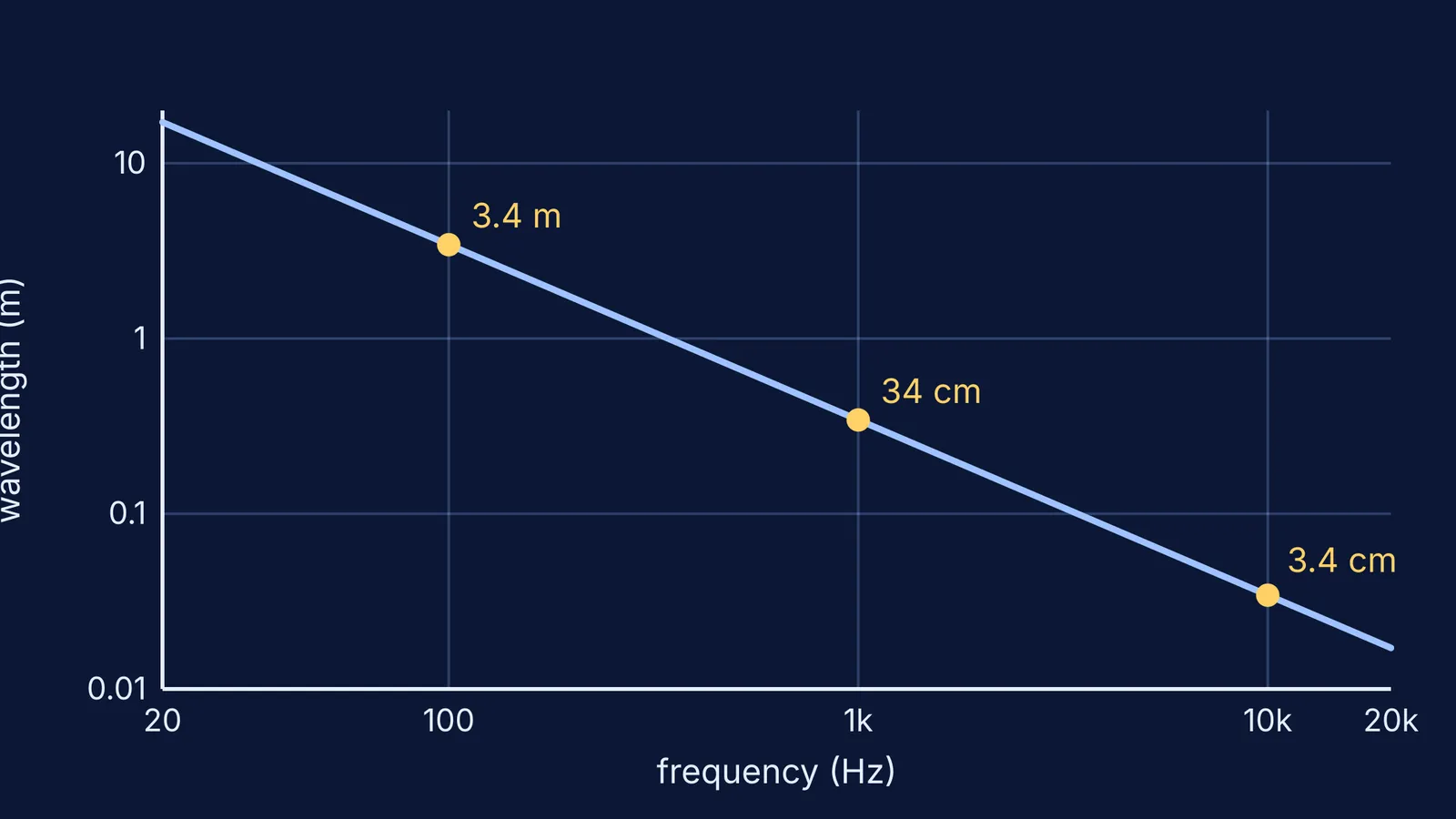
A 100 Hz bass note: λ = 343 / 100 = 3.43 m, longer than a small room is wide.
A 1,000 Hz tone: λ = 343 / 1,000 = 0.343 m, about the length of a ruler.
A 10,000 Hz cymbal shimmer: λ = 343 / 10,000 = 3.4 cm, smaller than your thumb.
A foam panel a few centimetres thick is large compared with a 3.4 cm wave but tiny compared with a 3.43 m one. That is why a studio can sound clean in the treble and still boom in the bass.
Worked example: timing at a live show
At 343 m/s, sound takes 34.3 / 343 = 0.1 s to cross 34.3 m. A listener near a speaker tower that far from the stage can hear two copies of the band, a tenth of a second apart, unless the engineer delays the tower's signal to match. The chapter also asks why a violin note and a sitar note of the same frequency sound different; the answer is overtones, the mix of frequencies that an engineer shapes with equalisation.
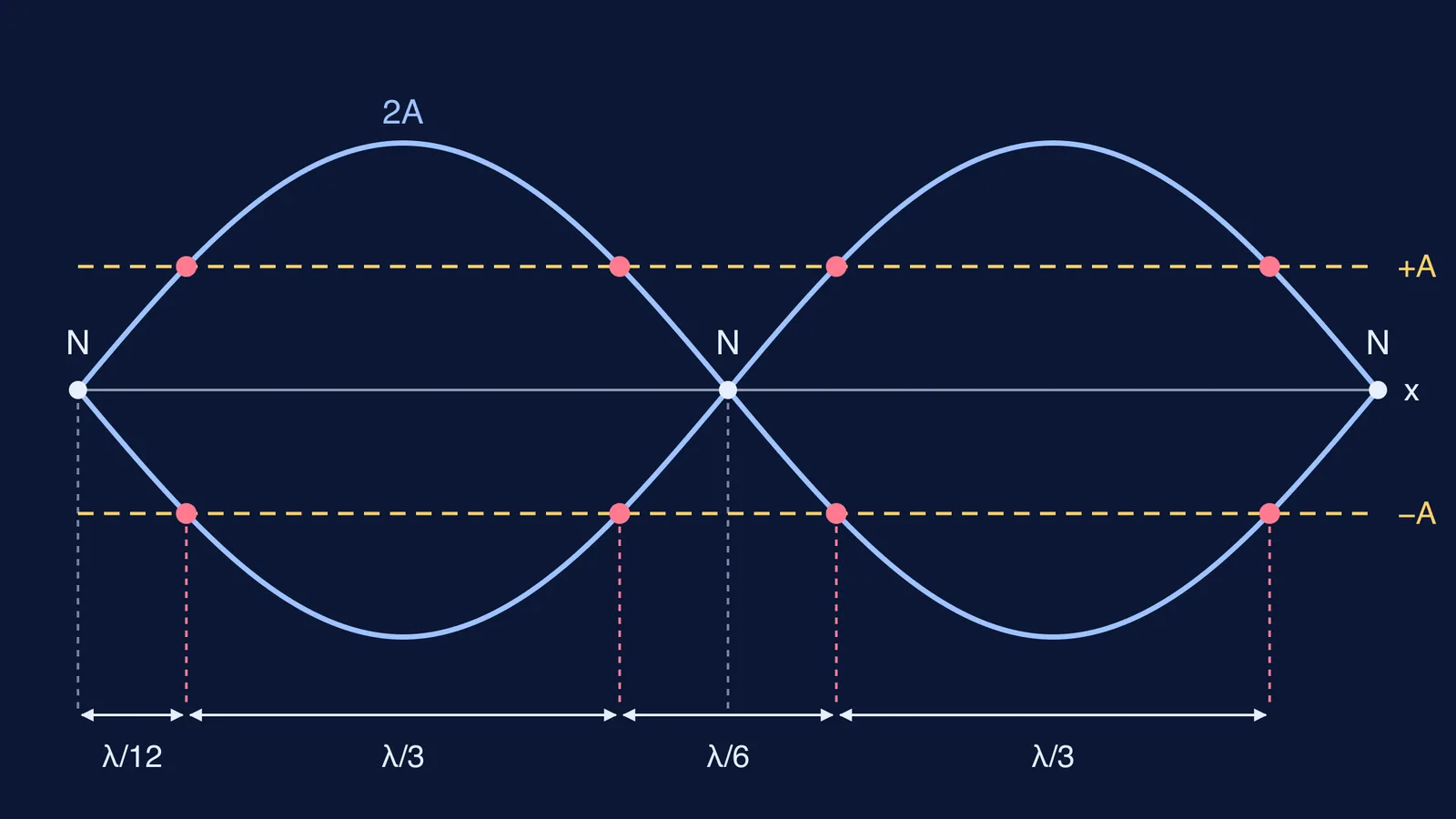
Two more school topics show up daily: how a microphone turns sound waves into electric current, and the logarithms behind sound intensity level in decibels. If standing waves and phase still feel abstract, the Fermi Simulation Lab has interactive simulations for ideas that are easier to see than to read.
Studio or live events: which career fits you?
Studio and post-production work means recording, editing and mixing, often for long hours at a screen. Live work means setting up equipment and fixing problems fast, in front of an audience. Both qualification packs include a unit on workplace health and safety.
That includes your own ears. The WHO-ITU standard on safe listening, written for personal audio devices such as phones and headphones, sets a reference exposure of 80 dB for 40 hours a week for adults and 75 dB for 40 hours a week for children. Treat earplugs as part of your kit, not an option.
If you are drawn more to rooms, buildings and noise control than to mixing music, read our guide to the acoustic engineer career and its study path.
A two-year plan from Class 12 to your first sound job
Class 12: keep physics and maths strong; they keep engineering and science degrees open.
Summer after boards: record and mix five short pieces (a friend's song, a podcast, a school event) on free software.
First year of college: volunteer at fests, theatre shows and the radio club to learn cabling and mic placement.
Second year: assist a local studio or event company; aim at the Sound Assistant tasks listed above.
If the physics is what is holding you back, the Fermi Concept Library has every physics concept, each with its own lesson, so you can fix gaps in waves and logarithms before you need them in a studio.