
On this page
If you enjoy the waves chapter, here is a job built on it. Acoustic engineers decide how a classroom, a concert hall or a car cabin sounds, and much of that work is Class 11 physics used carefully.
What does an acoustic engineer actually do?
A careers article by Keeta Jones of the Acoustical Society of America and engineer Noah Jenkins describes acoustics as including "the production, control, transmission, reception, and effects of sound" (SPS Observer, 2023). Its examples span the branches people work in: architectural acoustics (modelling the reverberation of an opera house), noise control (reducing noise from trains), underwater acoustics and sonar, bioacoustics, and medical ultrasound. It says acousticians work in large companies, consulting firms, government agencies and universities.
In practice the work falls into three kinds of job:
Rooms: making a lecture hall clear for speech, or an auditorium rich for music, by choosing shapes and surfaces.
Buildings: stopping sound travelling between flats, from a road, or from a lift motor into a bedroom.
Products: quieter mufflers, fans, appliances and vehicles, often called NVH (noise, vibration and harshness) work.
India's rules give that work a target. The Noise Pollution (Regulation and Control) Rules, 2000 set daytime limits of 55 dB(A) for residential areas and 50 dB(A) for silence zones; a state government can declare an area of at least 100 metres around hospitals, educational institutions and courts a silence zone (text of the rules, Central Pollution Control Board). Night-time limits are 10 dB lower, at 45 and 40 dB(A), with night defined as 10 p.m. to 6 a.m. (same source).
Which physics does an acoustic engineer use?
More of your syllabus than you might expect. The NPTEL course Fundamentals of Acoustics from IIT Kanpur's mechanical engineering department moves from decibels and the wave equation to waves in tubes, spherical waves, interference, mufflers, sound in rooms, absorption coefficients, reverberation time, the FFT and microphones (course syllabus). The syllabus names automotive, railways and power generation among the industries it applies to.
The tool you will meet first is the Sabine formula for reverberation time, the time a sound takes to fade by 60 dB after its source stops: T = 0.161 V / A, with V the room volume in cubic metres and A the total absorption in square metres (sengpielaudio calculator). A is the sum, over every surface, of its area times its absorption coefficient α (same source). α runs from 0 for a surface that reflects everything to 1 for one that absorbs everything.
A worked example: why some classrooms echo
Take a classroom 10 m long, 8 m wide and 3.5 m high and apply Sabine's formula. The absorption numbers are illustrative, not values for a real material.
Volume: V = 10 × 8 × 3.5 = 280 cubic metres.
Surfaces: floor 80, ceiling 80, walls 2 × (10 + 8) × 3.5 = 126, so 286 square metres in all.
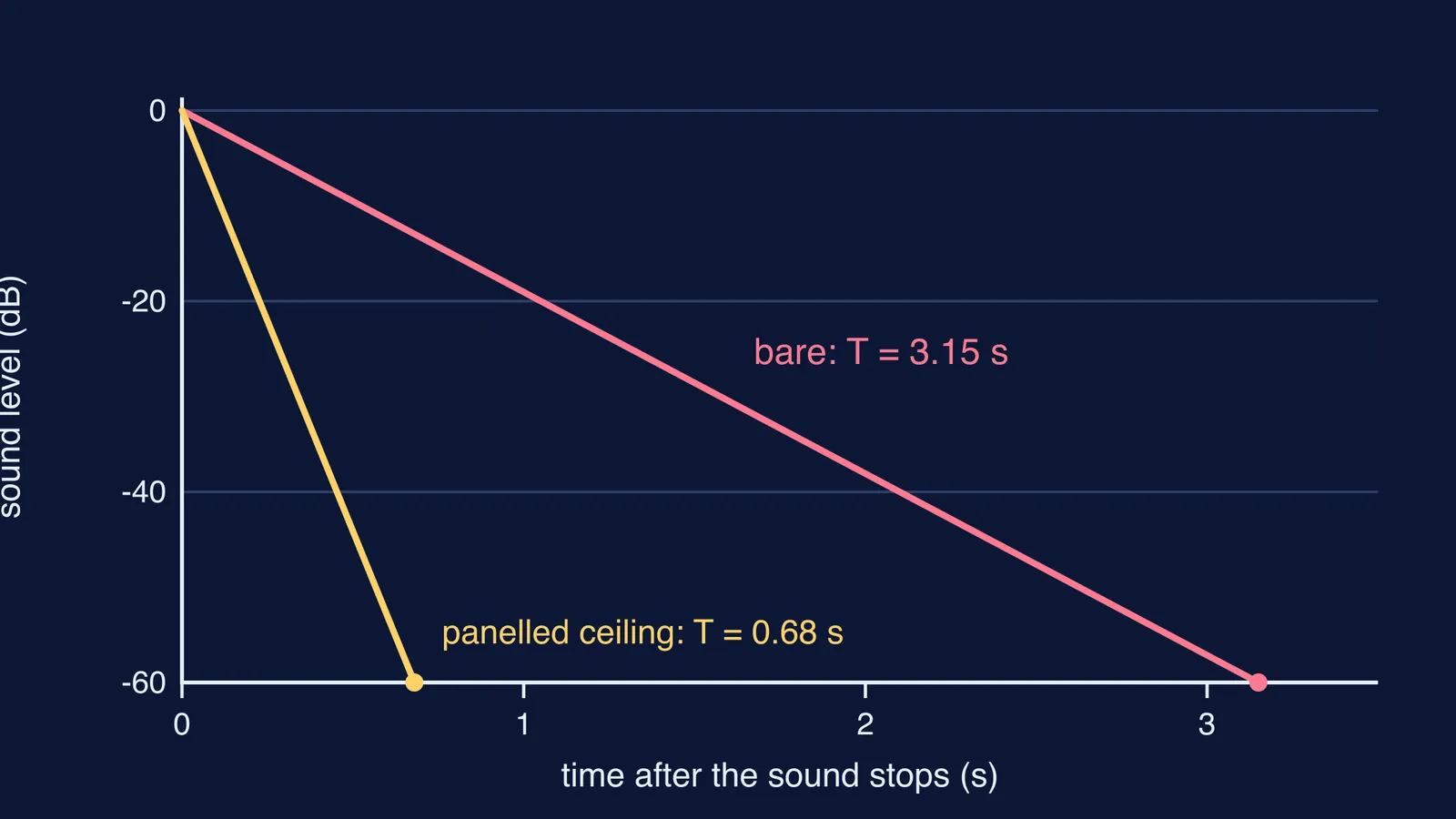
Bare room: suppose plaster and concrete everywhere give an average α of 0.05. Then A = 286 × 0.05 = 14.3, and T = 0.161 × 280 / 14.3 ≈ 3.15 seconds. Each word your teacher says is still sounding while the next ones arrive.
Treated room: replace the ceiling with panels of α = 0.7. Now A = 206 × 0.05 + 80 × 0.7 = 10.3 + 56 = 66.3, and T = 0.161 × 280 / 66.3 ≈ 0.68 seconds.
One surface changed and the echo time fell to about a fifth. That is the job in miniature: a model, a number, a design choice, then a measurement to check it. If the link between a wave reflecting off a wall and a decay curve is hard to picture, the Fermi Simulation Lab has interactive simulations for ideas that are easier to see than to read.
How do you become an acoustic engineer in India?
The SPS Observer article is clear that there is no single path: the route depends on which field of acoustics you want, and the grounding can come from physics, aerodynamics, engineering, speech and hearing, or anatomy (SPS Observer).
A plan you can follow from Class 11:
Class 11-12: take oscillations, waves, the Doppler effect and logarithms seriously (decibels are logarithms).
Undergraduate: pick a degree that keeps waves and vibrations in it: mechanical, electrical, civil, architecture, or a BSc in physics.
First acoustics course: the IIT Kanpur NPTEL course above asks that you be in a B.Tech or equivalent programme and have finished at least its second year (syllabus).
Build evidence: record a clap in your classroom, estimate its reverberation time, compare it with Sabine's formula and write up why they differ.
Specialise: a master's or research degree in rooms, products, underwater sound or ultrasound.
If the waves chapter itself has gaps, the Fermi Concept Library gives each physics concept its own lesson, so you can fill in standing waves or decibels first.
Start this week: time how long a clap rings in the emptiest room at home and work out its volume.