On this page
If you are doing a BSc Agriculture, or about to start one, soil science is the subject underneath all the others. The FAO estimates that 95 percent of our food is directly or indirectly produced on our soils. The same FAO story says one-third of the world's soils are moderately or highly degraded. Someone has to measure that soil and suggest a fix.
What does a soil scientist actually do?
A soil scientist measures what is in the soil and works out what it means for a crop, a building or the water nearby. ICAR's syllabus for its master's entrance exam.pdf) lists soil science under its Physical Science group and covers: soil physics (texture, porosity, bulk density, Stokes' law), soil chemistry (clay minerals, cation exchange capacity, acid, saline and sodic soils), fertility and soil testing, soil survey with remote sensing and GIS, soil microbes, and soil and water pollution.
That work leads in three directions:
Farming: testing soil and turning the results into fertiliser and crop advice.
Environment: polluted and degraded land, carbon stored in soils, and the quality of compost made from waste.
Construction: soil as the ground that holds up a building. On building sites this is usually the job of geotechnical engineers, who come in through civil engineering (see our guide to a geotechnical engineering career in soil, foundations and slopes).
Where are the soil science jobs in India?
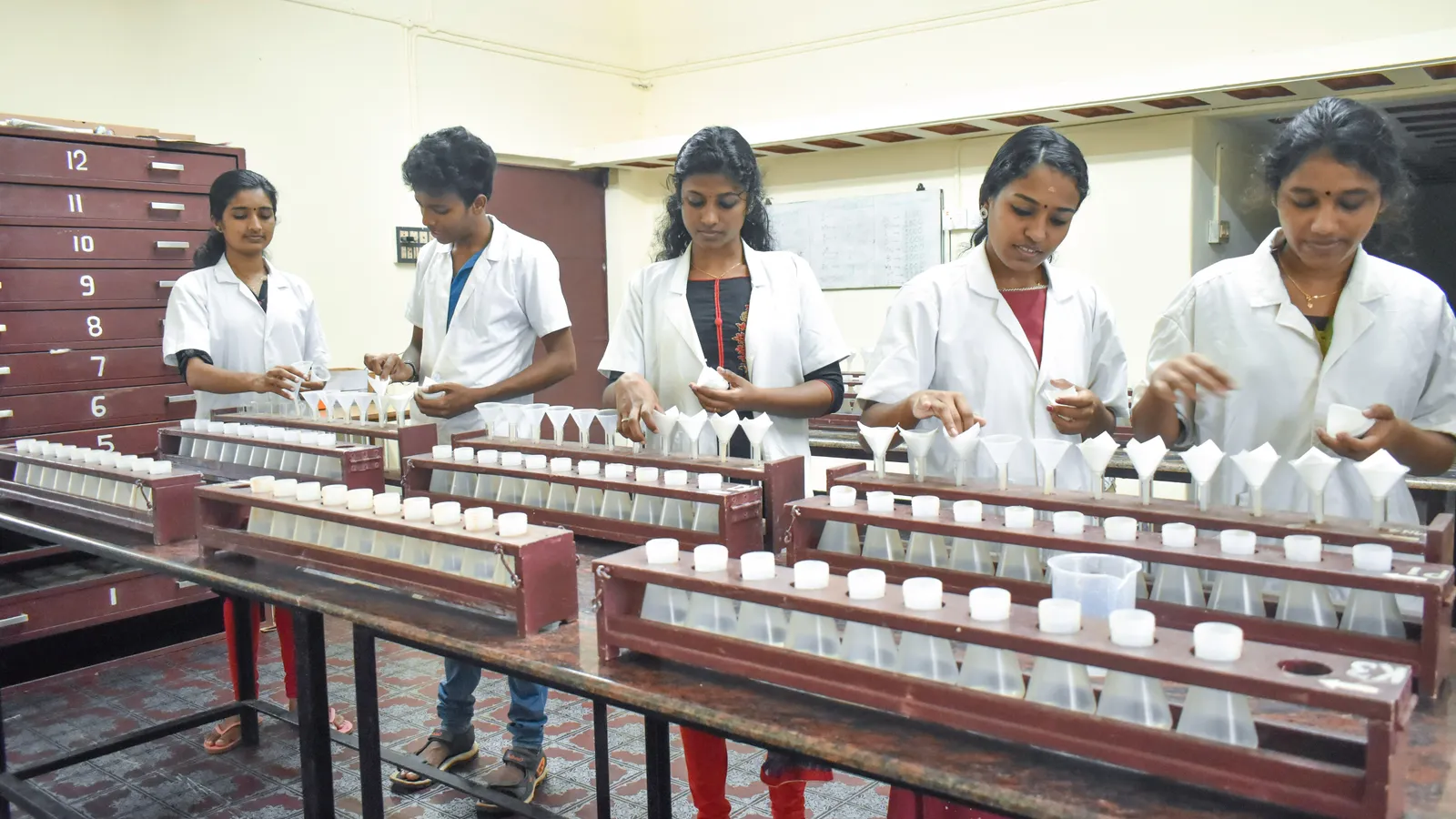
The most visible part of the field is India's soil testing network. India had set up 8,272 soil testing labs by February 2025: 1,068 static labs, 163 mobile labs, 6,376 mini labs and 665 village-level labs. Those figures come from a Press Information Bureau backgrounder on the Soil Health Card scheme dated 16 August 2025. The same document says more than 25 crore Soil Health Cards had been handed out to farmers by July 2025. One of the scheme's stated aims is to strengthen testing labs by engaging agricultural students. It also names students from agricultural colleges among the people who collect samples.
Soil scientists also work in state agriculture departments, in state agricultural universities and in ICAR institutes. One example is the ICAR-Indian Institute of Soil Science in Bhopal, which ICAR says was set up in 1988 to do research on soils "to enhance and sustain soil productivity with minimal environmental pollution". Research and teaching posts generally need a master's, and often a PhD.
What does a soil test tell a farmer? A worked example
A Soil Health Card reports 12 parameters: nitrogen, phosphorus, potassium and sulphur; zinc, iron, copper, manganese and boron; plus pH, electrical conductivity (EC) and organic carbon, according to the PIB backgrounder.
The same document describes a farm in Nalanda district, Bihar. The test showed high EC and low organic carbon, nitrogen, phosphate and boron. The advice was compost and manure, with measured doses of DAP and urea. The demonstration plot yielded 32 quintals per hectare, while the farmer's usual field gave 27.5.
The arithmetic to check:
Difference: 32 − 27.5 = 4.5 quintals per hectare.
Relative gain: 4.5 ÷ 27.5 = 0.164, or about 16 percent, which matches PIB's "over 16% more".
Caution: this is one plot in one season, not a controlled trial. A scientist would want repeated plots and several seasons before calling the advice proven.
Every step uses school chemistry: pH, salts and ion exchange. If those feel shaky, the Fermi Concept Library has a lesson on each chemistry and biology concept, so you can patch a gap before it costs you in a soil chemistry course.
How do you build a soil science career after BSc Agriculture?
A five-step plan:
Use your degree years. Take the soil courses seriously and ask to help with sampling drives. The scheme already counts agricultural college students among its sample collectors.
Pick a direction early. Lab and advisory work, environmental work or research.
Prepare for the master's entrance. In ICAR's syllabus, Soil Science and Agricultural Chemistry is sub-subject 3.2 in the Physical Science group (code 03). The National Testing Agency runs the exam, ICAR AIEEA (PG), and dates change every year, so check the NTA ICAR exam page.
Learn basic GIS. The same syllabus includes remote sensing, GIS and GPS, and soil fertility maps are made with these tools.
For research, plan for a PhD. NTA also runs the ICAR AICE-JRF/SRF (PhD) entrance for doctoral admission and fellowships.
If you are still choosing a specialisation, compare this route with a plant breeding career for agriculture students. Or go back to basics with soil profile layers: the A, B and C horizons. If entrance prep feels too big to start, Fermi's AI tutor can work out what you already know and build a plan for the session, so you sit down to a clear next step.
Your next step: find your district's soil testing lab and arrange one visit this term.