

On this page
Dig a deep trench, look at the side of a steep cliff, or observe the foundations being dug for a new building, and you will see that the earth is not a uniform mass. It is arranged in distinct, horizontal layers. Understanding these layers tells us the history of the land and explains why certain plants thrive while others fail.
What is a soil profile?
"A vertical section through different layers of the soil is called the soil profile" [[1]](https://ncert.nic.in/textbook/pdf/gesc109.pdf). Each individual layer in this vertical cross-section is referred to as a horizon [[1]](https://ncert.nic.in/textbook/pdf/gesc109.pdf).
These horizons differ from one another in their feel (or texture), colour, depth, and chemical makeup. Soil itself is formed over thousands of years through a continuous process called weathering. This involves the breaking down of rocks by the action of wind, water, and climate. The nature of any soil depends heavily on the rocks from which it has been formed and the specific type of vegetation that grows in it.
If you are exploring the physical world, the Fermi Concept Library maps out every concept in physics, chemistry, biology, mathematics and computing, each with its own lesson and its place in the map. Visualising how these concepts connect can help you understand large-scale environmental changes.
What are the A, B and C horizons of soil?
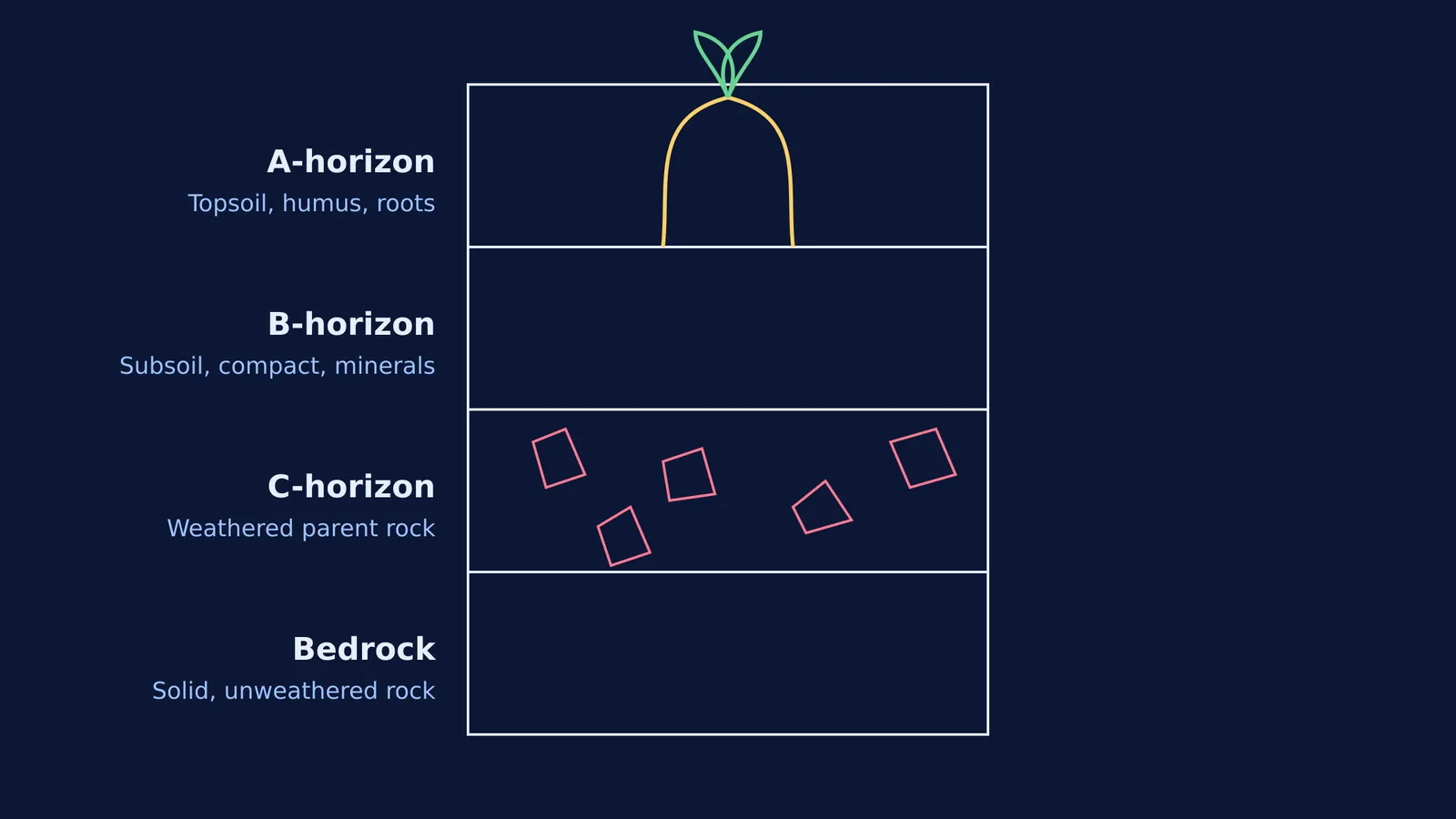
The standard soil profile diagram you encounter in Class 7 science splits the earth into four main sections. Each serves a specific purpose in the ecosystem.
The A-horizon (Topsoil) "The uppermost horizon is generally dark in colour as it is rich in humus and minerals" [[1]](https://ncert.nic.in/textbook/pdf/gesc109.pdf). Humus is the rotting dead matter in the soil that makes it fertile and provides essential nutrients to growing plants [[1]](https://ncert.nic.in/textbook/pdf/gesc109.pdf). This layer is generally soft, porous, and can retain more water than the layers beneath it [[1]](https://ncert.nic.in/textbook/pdf/gesc109.pdf). Because it is so nutrient-rich, the roots of small plants are embedded entirely in the topsoil [[1]](https://ncert.nic.in/textbook/pdf/gesc109.pdf). It also provides shelter for many living organisms such as worms, rodents, moles, and beetles [[1]](https://ncert.nic.in/textbook/pdf/gesc109.pdf).
The B-horizon (Middle Layer) Beneath the topsoil lies the B-horizon, which is often referred to as the middle layer or subsoil. "The next layer has a lesser amount of humus but more of minerals" [[1]](https://ncert.nic.in/textbook/pdf/gesc109.pdf). Structurally, this layer is generally harder and more compact than the topsoil [[1]](https://ncert.nic.in/textbook/pdf/gesc109.pdf). It acts as a reservoir for minerals that wash down from the surface, though it lacks the rich organic life found above it.
The C-horizon "The third layer is the C-horizon, which is made up of small lumps of rocks with cracks and crevices" [[1]](https://ncert.nic.in/textbook/pdf/gesc109.pdf). This is the weathered parent material from which the upper layers gradually formed over thousands of years. It sits just above the solid foundation of the earth and contains almost no organic matter.
Bedrock "Below this layer is the bedrock, which is hard and difficult to dig with a spade" [[1]](https://ncert.nic.in/textbook/pdf/gesc109.pdf). It is the solid, unweathered rock that supports the entire soil profile. Water often collects above this solid rock layer, creating crucial groundwater reserves.
What are the different types of soil?
As rocks weather over long periods, they break down into particles of various sizes. The proportion of these particles determines the type of soil, which in turn dictates how well it can support life.
Sandy soil: If the soil contains a greater proportion of large particles, it is called sandy soil. Because the particles are large, they cannot fit closely together, leaving large spaces filled with air. This makes sandy soil well-aerated but poor at retaining water.
Clayey soil: If the proportion of fine particles is relatively higher, then it is called clayey soil. These small particles pack tightly together, leaving little space for air. Clayey soil is heavy because it retains more water than sandy soil.
Loamy soil: If the amount of large and fine particles is about the same, the soil is called loamy soil. Loam is a mixture of sand, clay, and another type of soil particle known as silt. It has the right water-holding capacity for plant growth and is considered the best topsoil.
How to memorise the soil profile for exams?
If you or your child are preparing for a science exam, memorising lists of facts from a textbook can be tedious. Instead, use a practical drawing exercise to build a mental model.
Here is a step-by-step framework to sketch and remember the soil profile:
Start from the bottom: Draw the solid bedrock first. Knowing that everything rests on solid, unbroken rock gives you a logical foundation. Label it as "hard and difficult to dig".
Add the broken rock: Draw the C-horizon as cracked, chunky polygons on top of the bedrock. Note that this is the transition zone where rock begins to break apart.
Build the mineral layer: Draw the B-horizon and label it as the compact, mineral-rich middle zone. Remind yourself that minerals from the topsoil wash down and accumulate here.
Finish with life: Draw the A-horizon at the very top. Add roots, small insects, and dark shading to represent humus. Label this as the soft, porous zone that holds water.
This active approach to learning is why Fermi's AI tutor teaches rather than answers. It holds a line of reasoning across a whole session, notices where a student is stuck, and decides whether to explain, ask, or show. Connecting these ideas to related topics, like Nature's treasures in Class 6, also helps build a robust understanding of how the natural world works.


