On this page
Every bridge pier, metro tunnel and hill road in India rests on soil or rock that nobody designed. Geotechnical engineering works out how that ground will behave under load, in rain and over time, and you can start building towards it with Class 11 physics.
What does a geotechnical engineer actually do?
The Colorado Association of Geotechnical Engineers defines the field as "the application of soil and rock mechanics principles to the development of infrastructure" (CAGE). The same page lists its scope as foundations, slopes, retaining structures, embankments, roadways, tunnels, levees, wharves, landfills and other systems made of or supported by soil or rock.
The work falls into three kinds:
Site investigation: drilling boreholes, collecting samples and running field tests such as the standard penetration test and the cone penetration test.
Foundation design: choosing between a shallow footing, a raft or piles, sizing them and predicting how much they will settle.
Stability: checking that slopes, retaining walls and tunnels will stand, during construction and for decades after.
Slopes matter a great deal in India. The Geological Survey of India says about 0.42 million sq km, or 12.6% of the country's land area excluding snow-covered area, is prone to landslides (GSI Bhusanket). Most of that lies in the north-east and north-west Himalaya, with 0.09 million sq km in the Western Ghats and Konkan hills, according to the same GSI page.
If you are still comparing branches, our guide to career options after civil engineering in India maps the other routes, and what a site engineer does in civil construction describes the job many graduates start in.
What do you study to become a geotechnical engineer?
The usual route is a B.Tech or BE in civil engineering, followed by electives, an M.Tech in geotechnical engineering or work experience in the field. The GATE 2027 Civil Engineering syllabus from IIT Madras, the organising institute, has eight sections, and Geotechnical Engineering is Section 3 (GATE 2027 CE syllabus). Its topics include effective stress, consolidation, shear strength, slope stability, Boussinesq's theory of stress distribution, Terzaghi's and Meyerhof's bearing capacity theories, and pile foundations.
Under the jargon sits physics you already know: pressure as force over area, stress and strain, fluid flow and friction. If those Class 11 ideas feel shaky, the Fermi Concept Library has a lesson for every concept in physics and mathematics, so you can firm up the basics before soil mechanics builds on them. To fit GATE around your degree, read how to prepare for GATE during your B.Tech.
How does a geotechnical engineer check a foundation?
Here is a classroom-sized version of the first check. A column carries 600 kN, roughly the weight of 61 tonnes. Suppose the site investigation report gives an allowable bearing pressure of 150 kN/m² (a number assumed for this example).
Footing area = load ÷ allowable pressure = 600 ÷ 150 = 4 m², so a 2 m × 2 m square footing.
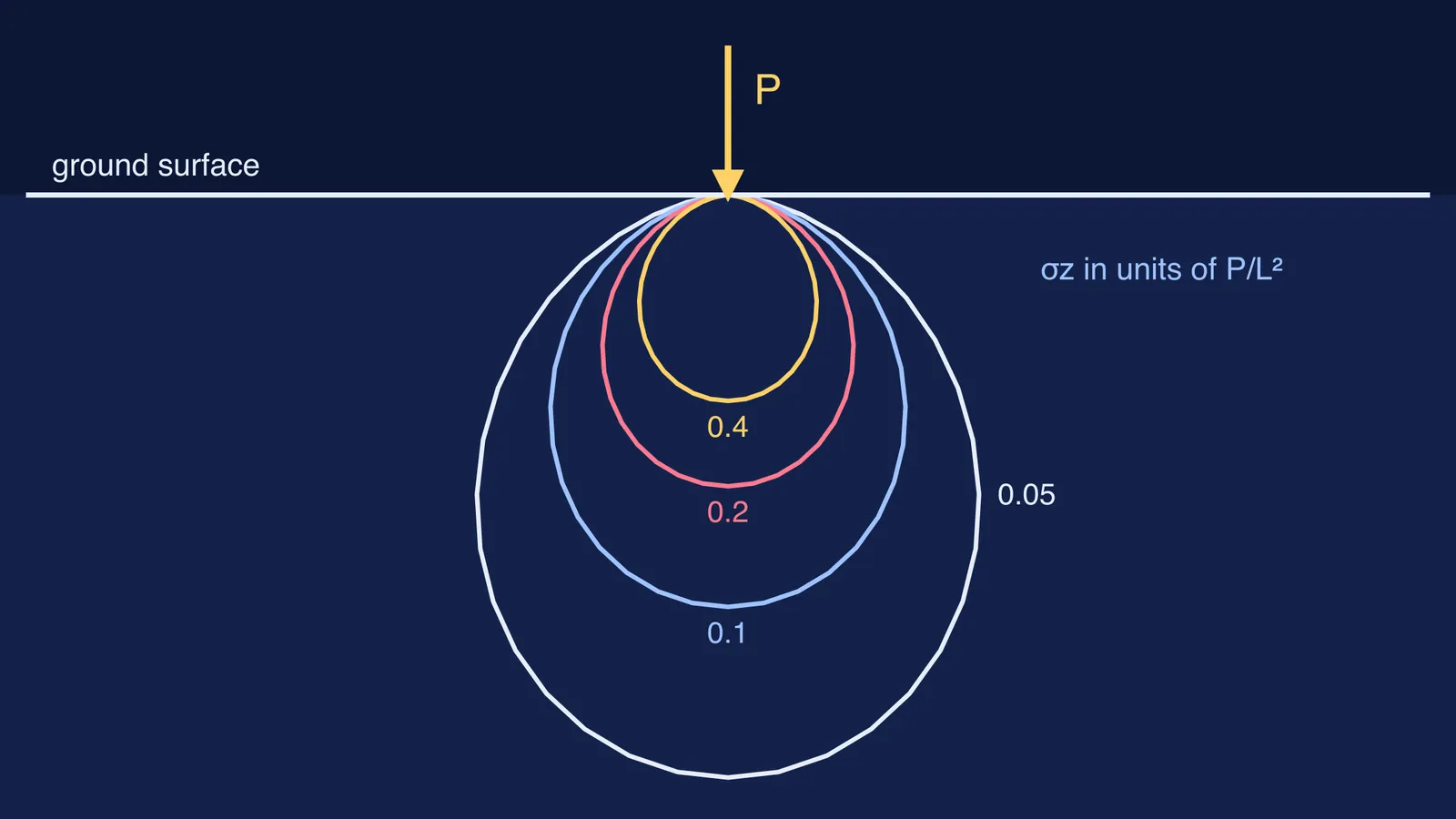
Next, ask how deep the load reaches. Boussinesq's 1885 solution for a vertical point load on an elastic half-space gives the vertical stress as σz = 3Pz³/(2πR⁵), where R is the distance from the load (Olson and Lai, stress distribution notes). Directly below the load this becomes σz ≈ 0.477 P/z².
Treating the column load as a point load, at 2 m depth: 0.477 × 600 ÷ 4 ≈ 72 kN/m². At 4 m: about 18 kN/m². At 6 m: about 8 kN/m².
The lesson: stress fades with the square of depth but does not vanish. A soft clay layer 4 m down still feels about 18 kN/m² and may settle, which is why borehole depth matters. The diagram at the top shows these curves of equal stress, called pressure bulbs.
To practise numericals like this one, the Fermi Problem Library has worked problems with a step-by-step solver that explains the reasoning rather than printing an answer.
How can you tell if geotechnical engineering suits you?
Test the fit in three stages rather than deciding at 16.
Class 11 and 12: notice whether you enjoy the stress, strain, pressure and fluids parts of physics, and whether you like asking why something holds up.
Second and third year of a civil degree: take the soil mechanics lab seriously and join a student chapter of the Indian Geotechnical Society. It was set up in 1948 as the Indian National Society of Soil Mechanics and Foundation Engineering and has local and student chapters across India (IGS).
Summer internship: look for a site investigation firm, a foundation contractor, or a hill road, dam or metro project.
On a site visit or internship, these questions show what the job involves:
How deep did the boreholes go here, and why that depth?
Which test result changed the foundation choice?
What do you watch on this slope during the monsoon?
What does a fresher do here in the first six months?
If the answers make you want to see the borehole logs, you have found your specialisation.