

On this page
Many candidates start their preparation in the second or third year of their B.Tech. With a pass rate of about 19.8% in GATE 2024—where only 1,29,268 of 6,53,292 candidates qualified (Physics Wallah)—taking an early attempt removes the pressure of the final year. The current eligibility rules allow third-year students to write the exam.
If you start early, the syllabus aligns naturally with your coursework. Core engineering subjects are typically taught in the third and fourth semesters. Treating your college lectures as the "first pass" of the GATE syllabus saves you from having to relearn them from scratch later.
When you hit a topic in class that you do not fully grasp, you can use Fermi's AI tutor to break down the first principles. The tutor works out what you already know, builds a plan for the session, and teaches through it — writing on a board and checking understanding as it goes.
How to balance placements and GATE preparation?
The final year often brings a clash between campus placement drives and the final push for GATE. You do not have to abandon one for the other, but you do need to ring-fence your time.
The overlap between the two goals is larger than it seems. The General Aptitude section is identical to the quantitative and logical reasoning tests used by recruiters. Engineering Mathematics is another area that builds analytical skills useful for technical interviews.
Many candidates use a division of time during their placement semester:
Allocate most of your study hours to core GATE subjects, which doubles as preparation for technical interview rounds.
Dedicate a small, fixed block of time to coding practice or company-specific aptitude tests.
Keep your university coursework strictly to the time needed to maintain a strong CGPA, stepping this up only in the week before semester exams.
When a core engineering concept is hard to visualise—such as a mechanism in fluid mechanics or a circuit's transient response—an interactive model in the Fermi Simulation Lab can make the ideas easier to see than to read, saving you hours of struggling with a textbook.
Why are previous year questions so important?
The syllabus is vast, but the depth required for each topic is very specific. Previous year questions (PYQs) show you exactly how a concept is tested. A topic might take three weeks to cover in a university course, but GATE might only ask about one specific boundary condition or formula.
Start solving PYQs the same week you learn a topic in class. If you wait until you have finished the entire syllabus to start solving questions, you will likely forget the early subjects. When you get stuck on a difficult numerical, do not just look up the final answer key. Using the Fermi Problem Library gives you a step-by-step solver that explains the reasoning rather than printing an answer, helping you see the pattern for the next time.
What is a good semester-by-semester plan?
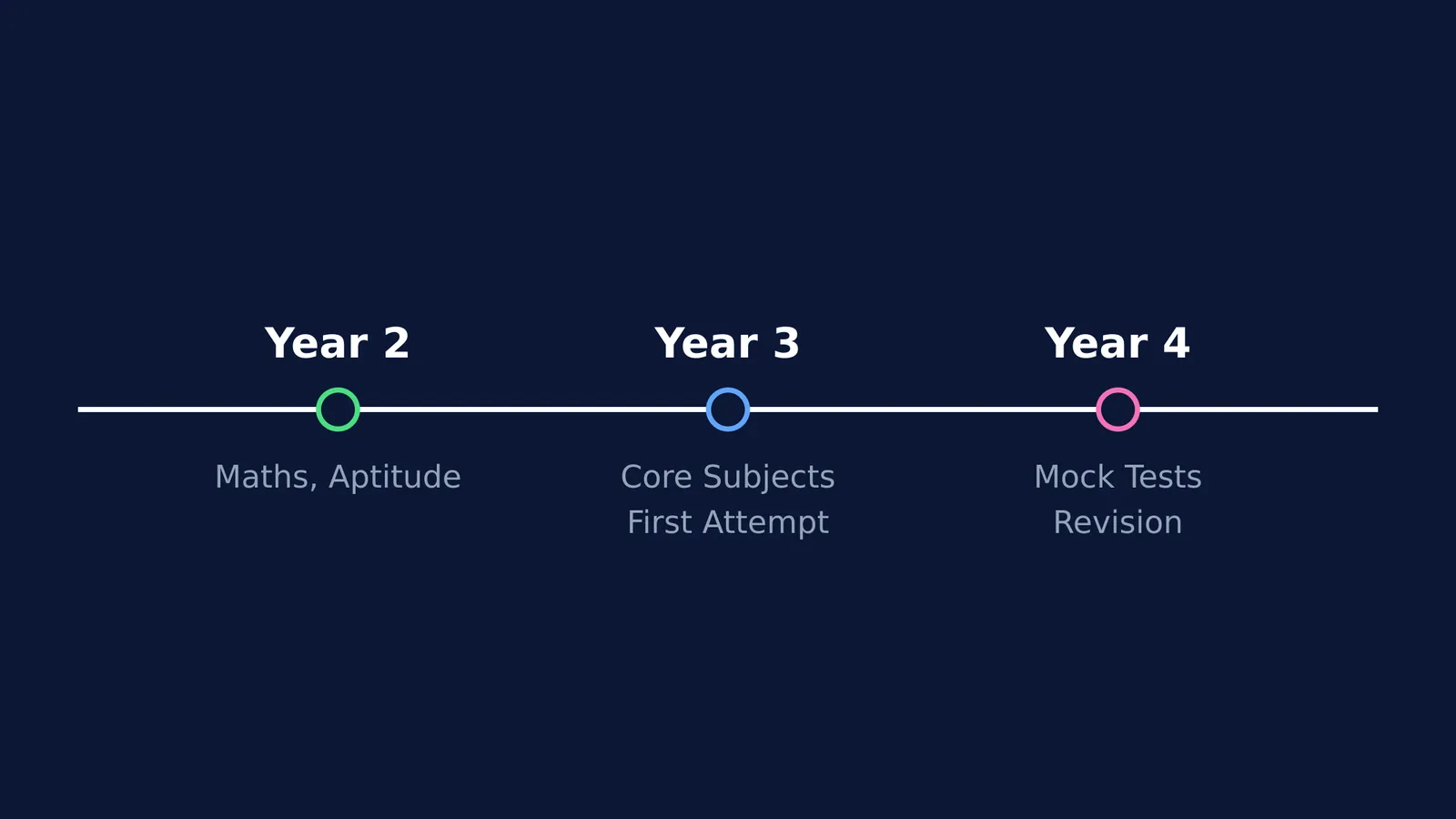
To cover the syllabus without burning out, spread the load across your degree.
Second year (Semesters 3 and 4): Build the foundation
Focus on Engineering Mathematics and General Aptitude.
Identify the core subjects in your current semester that overlap with the GATE syllabus.
Start solving previous years' questions for just those subjects to understand the exam's difficulty level early.
Third year (Semesters 5 and 6): The intensive phase
This is the year to write your first GATE attempt.
Cover the remaining high-weightage subjects.
Shift to taking subject-wise mock tests to spot your weak areas.
Final year (Semesters 7 and 8): Mocks and revision
Treat your final attempt as an exercise in exam temperament.
Stop reading new textbooks. Focus entirely on full-length mock tests.
Review your mistakes the same day you make them.
What to do during university exam weeks?
It is normal for GATE preparation to stop during semester exams. Do not try to maintain your competitive study schedule while writing university papers. Halt your GATE-specific mock tests seven to ten days before your semester exams begin. Once the university exams are over, use the break between semesters to compensate.
By structuring the work over four semesters rather than cramming it into four months, you protect both your university grades and your chances of a top GATE rank. For the next step, see How to build a study routine that lasts longer than a week, or learn How to analyse a mock test: a 60-minute review routine once you start solving papers.


