On this page
Spiro names look strange at first: square brackets, a full stop between two numbers, and rings that seem to need a 3D model. The method has three moves: find the shared atom, count each ring, and number from the smaller ring.
What is a spiro compound?
IUPAC's definition is short: a spiro compound has two (or three) rings that have only one atom in common and are not linked by a bridge, and that common atom is called the spiro atom, according to the IUPAC spiro nomenclature rules (SP-0).
Those rules come from the 1999 IUPAC recommendations by G. P. Moss in Pure and Applied Chemistry, "Extension and revision of the nomenclature for spiro compounds". They build on the von Baeyer bracket method and abandon the alternative naming methods of the older rules A-42 and B-11.
The "one atom in common" part separates spiro from bicyclo, where the rings share two bridgehead atoms. For that family, see our guide to [naming bicyclic compounds with the bicyclo[2.2.1] method](https://news.fermi.ai/academic-success/bicyclo-compounds-iupac-naming).
How do you name spiro[4.5]decane step by step?
Rule SP-1.1 says a monospiro hydrocarbon with two monocyclic rings is named with the prefix spiro, then square brackets holding the number of carbon atoms linked to the spiro atom in each ring, in ascending order and separated by a full stop, then the name of the parent hydrocarbon for the total number of skeletal atoms (IUPAC SP-1.1).
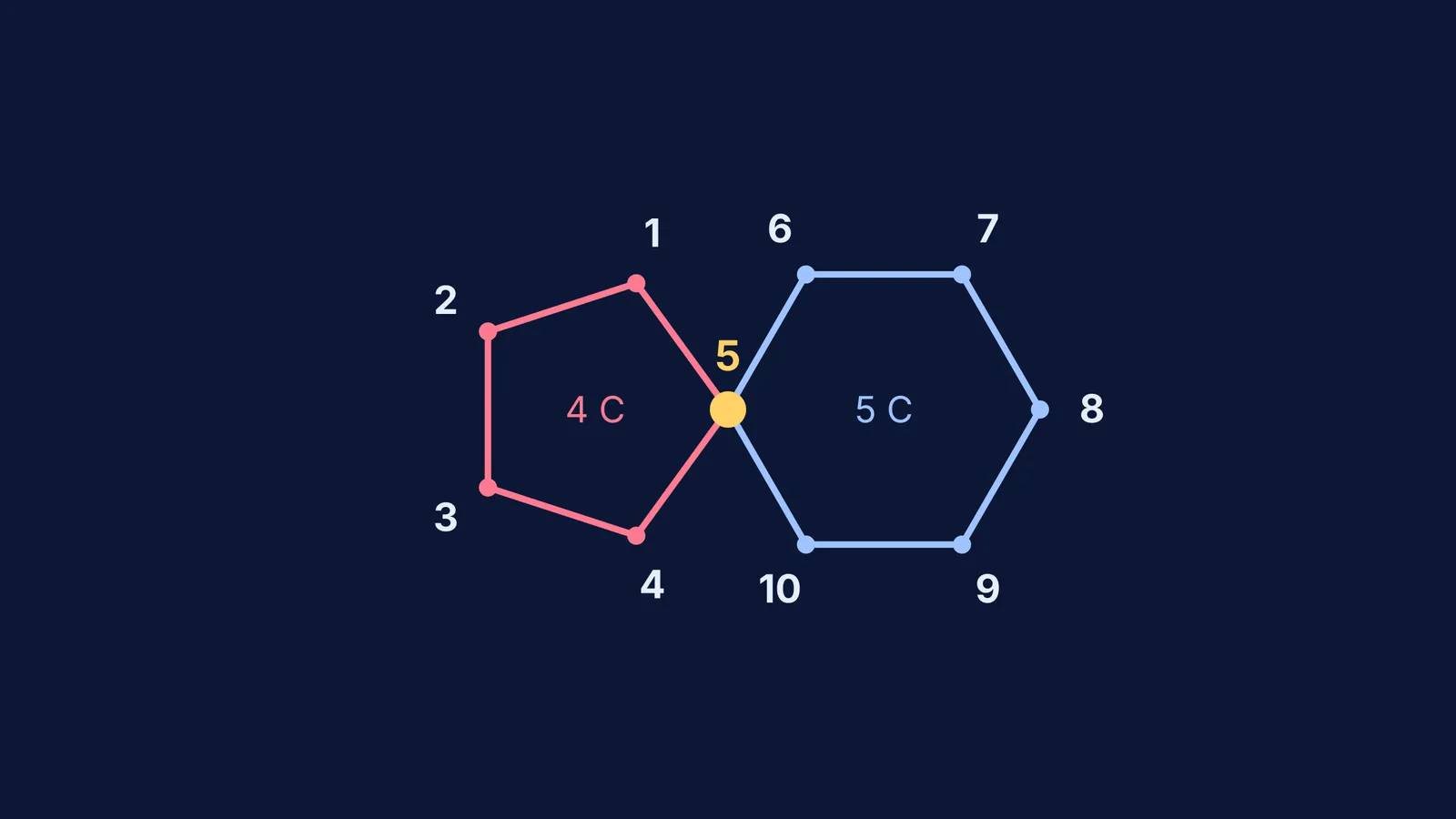
Here is the method on a cyclopentane ring and a cyclohexane ring that share one carbon:
Find the spiro atom: the only carbon that belongs to both rings.
Count each ring's atoms without the spiro atom. The five-membered ring gives 4, the six-membered ring gives 5.
Write the smaller number first: [4.5].
Add both numbers and the spiro atom: 4 + 5 + 1 = 10, so the parent is decane.
Put it together: spiro[4.5]decane.
You can check it against [PubChem's entry for spiro[4.5]decane](https://pubchem.ncbi.nlm.nih.gov/compound/135982), which gives the formula C10H18. Two rings means two degrees of unsaturation, so you have four fewer hydrogens than decane's C10H22.
Try it in reverse. Spiro[3.3]heptane has 3 + 3 + 1 = 7 carbons: two four-membered rings sharing one corner, with formula C7H12 (PubChem).
How are spiro compounds numbered?
Rule SP-1.2 says the atoms are numbered consecutively, starting in the smaller ring at an atom next to the spiro atom, going around the smaller ring back to the spiro atom, and then round the second ring (IUPAC SP-1.2).
In spiro[4.5]decane that gives:
C1 to C4: the four carbons of the five-membered ring
C5: the spiro atom
C6 to C10: the five carbons of the six-membered ring
In a simple spiro[a.b]alkane, the spiro atom is always numbered a + 1: C5 in spiro[4.5]decane, C4 in spiro[3.3]heptane.
That is why IUPAC writes spiro[4.5]decane, not spiro[5.4]decane: brackets and numbering both start from the smaller ring.
How do heteroatoms and double bonds fit in?
Rule SP-1.3 says heteroatoms take replacement prefixes such as oxa and aza, and unsaturation takes the usual endings ene, diene and so on (IUPAC SP-1.3). The brackets don't change, because the nitrogen or oxygen replaces a carbon in the same skeleton.
Worked example: decode 8-azaspiro[4.5]dec-2-ene, one of IUPAC's own examples.
[4.5]decane: a five-membered and a six-membered ring, 10 ring atoms, spiro atom at 5.
Number from C1 in the small ring. C1 to C4 are in the small ring, and C6 to C10 are in the large ring.
8-aza: position 8 is the middle of C6 to C10, the atom directly opposite the spiro atom in the six-membered ring. Put N there.
dec-2-ene: a double bond between C2 and C3, the two small-ring atoms that do not touch the spiro atom.
IUPAC's spiro[4.4]nona-2,7-diene follows the same pattern, with one double bond in each five-membered ring. For practice going from name to structure, see how to draw a structure from its IUPAC name.
What mistakes cost marks in spiro naming?
Run through this checklist before you answer:
Did you leave the spiro atom out of both bracket numbers?
Is the smaller number first, with a full stop and not a comma?
Does the bracket sum plus one match the parent name?
Did C1 start in the smaller ring, next to the spiro atom?
Is the spiro atom numbered a + 1?
Did you write prefixes like aza or methyl before "spiro" and ene after the parent?
The prefix habits from naming substituted cycloalkanes carry over.
If you keep landing on the wrong locants, the Fermi Problem Library has worked problems with a step-by-step solver that explains the reasoning, not just the final name. If the gap is ring nomenclature itself, the Fermi Concept Library gives each chemistry concept its own lesson.