On this page
In second year, BTech stops feeling like Class 12. The common first-year subjects give way to the courses your branch is built on, and your choices about a minor, an internship and a first real project start shaping third year. Here is what matters, in what order, and a plan you can copy.
What should you focus on in second year BTech?
Work through four things, in this order:
The core courses of your branch, which later electives and minors build on.
A clean record: no backlogs and a steady CGPA.
One project you build from start to finish.
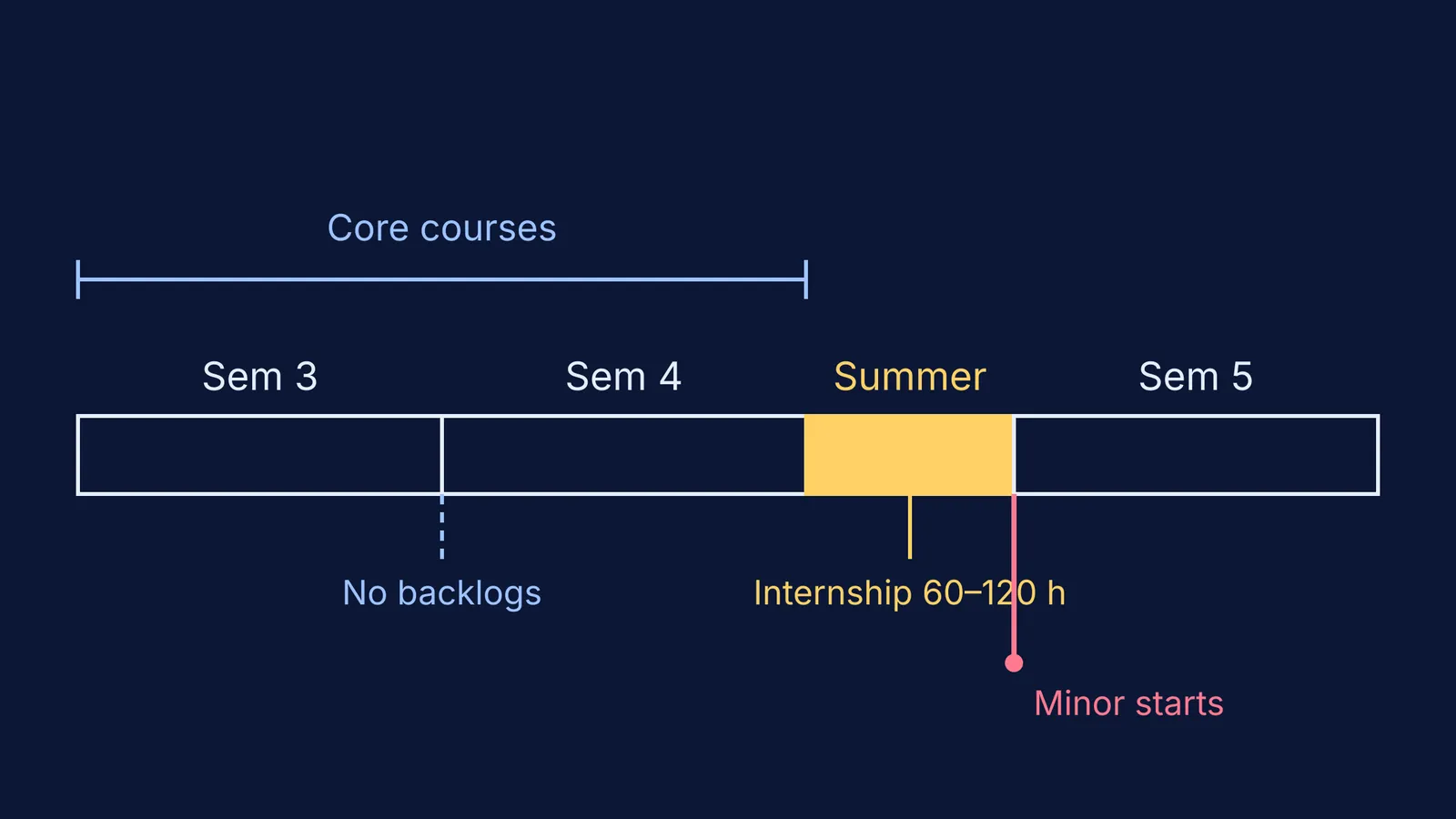
A first internship, usually in the summer after semester 4.
The first two decide which options you get for the other two. If you are weighing marks against skills, read our explainer on whether CGPA or skills matter more for placements.
Which second-year courses matter most?
Open the syllabus for third-year courses and electives. Any second-year course they list as a prerequisite is load-bearing. Mark those two or three and give them the most time each week. For them, a weekly routine beats last-week cramming:
After each lecture, write the main idea in two lines without looking at your notes.
Solve one tutorial problem the same week, before the answer is discussed.
Keep a mistakes page: the problem, what went wrong, the right first step.
Second-year courses often lean on maths you only half understood in first year, such as series or differential equations. To fill those gaps, the Fermi Concept Library has a lesson on every concept in physics, chemistry, biology, mathematics and computing, each shown in its place in the map.
When should you do your first internship in BTech?
The UGC Guidelines for Internship/Research Internship for Under Graduate Students (2023) make an internship of 60 to 120 hours after the 4th semester mandatory for students in UG degree programmes. Engineering colleges also follow AICTE norms and their own university's rules, so hours, credits and timing may differ at your college. Check your regulations, or ask the training and placement cell, in semester 3, not in May.
Where to look:
The AICTE National Internship Portal, which AICTE runs under the Ministry of Education and which is free for students.
Professors in your own department, for a short research project.
Keep the email to a professor short and specific: "I am a second-year ECE student. I read your paper on low-power sensors and tried the filter design from section 3. Could I help with a small part of this work for six weeks this summer?" Our guide to starting an internship search early in BTech covers resumes and where to apply.
What kind of project should you build in second year?
Pick one project that uses a core course. A good one passes three tests:
You can finish it in about eight weeks of evenings.
You can demo it in two minutes to someone outside your branch.
You write a short report: the problem, what you built, what did not work.
For example, a mechanical student could time how fast a flask of hot water cools and compare the result with the heat-transfer model from class.
How do you choose electives and a minor?
Rules differ by university, so read your own. As a worked example, the JNTUH regulations for BTech with Minor require 18 credits on top of the 160 credits of the BTech, earned in third and fourth year. To opt in, a student needs no active backlogs up to semester 3, plus approval from a mentor and the Head of Department before semester 5. Students can take one minor only, not alongside an Honours programme, and at most two minor courses a semester (three with a lab). So your second-year record decides whether you can opt in.
Before choosing, ask:
Does it lead to a job, a degree or a project you actually want?
Can you carry two extra courses a semester without your core grades slipping?
Does it cover something your branch electives do not?
Our explainer on what a minor degree in BTech is covers the rest.
A second-year plan you can copy
Semester 3: mark the load-bearing courses, clear any first-year backlog, read your university's minor and internship rules.
Semester 4: start the project, email three professors or companies, shortlist a minor.
Summer: do the internship, finish the project report, and check when your college opens minor registration.
If you face a heavy semester and don't know where to start, Fermi's AI tutor works out what you already know and builds a plan for the session, so you begin with a clear next step.
IIT Kanpur's counselling page lists Tele MANAS, a free, 24x7 national mental-health helpline, on 14416 and 1800-891-4416.
Begin with the semester 3 syllabus this week.