On this page
You follow the lecture. You can read the textbook. But when the professor asks you a question, or a classmate in the hostel asks where you are from, the words disappear. That gap between understanding English and speaking it is common, especially if you studied in a Hindi-, Tamil- or Marathi-medium school. It closes with practice that is short, daily and low-stakes.
Why does speaking English feel harder than reading it?
In a 1986 paper, Elaine Horwitz, Michael Horwitz and Joann Cope described foreign language classroom anxiety and related it to three performance anxieties: communication apprehension, test anxiety and fear of negative evaluation. They reported that students often felt fairly comfortable responding to a drill or giving a prepared speech but tended to “freeze” in a role-play.
The same paper noted a belief held by a number of students: that nothing should be said until it can be said correctly. If you wait for perfect English, you never get the practice that would make it better.
That anxiety has a cost. A 2019 meta-analysis by Yasser Teimouri, Julia Goetze and Luke Plonsky pooled 105 samples covering 19,933 learners in 23 countries. It found an average correlation of r = −0.36 between second-language anxiety and language achievement. A correlation does not prove that anxiety causes weaker results, but it is a good reason to make practice feel safe.
How can college students improve spoken English every day?
Aim for fluency first: speaking smoothly, at a natural pace, without long pauses. Accuracy can follow as you notice and fix your errors.
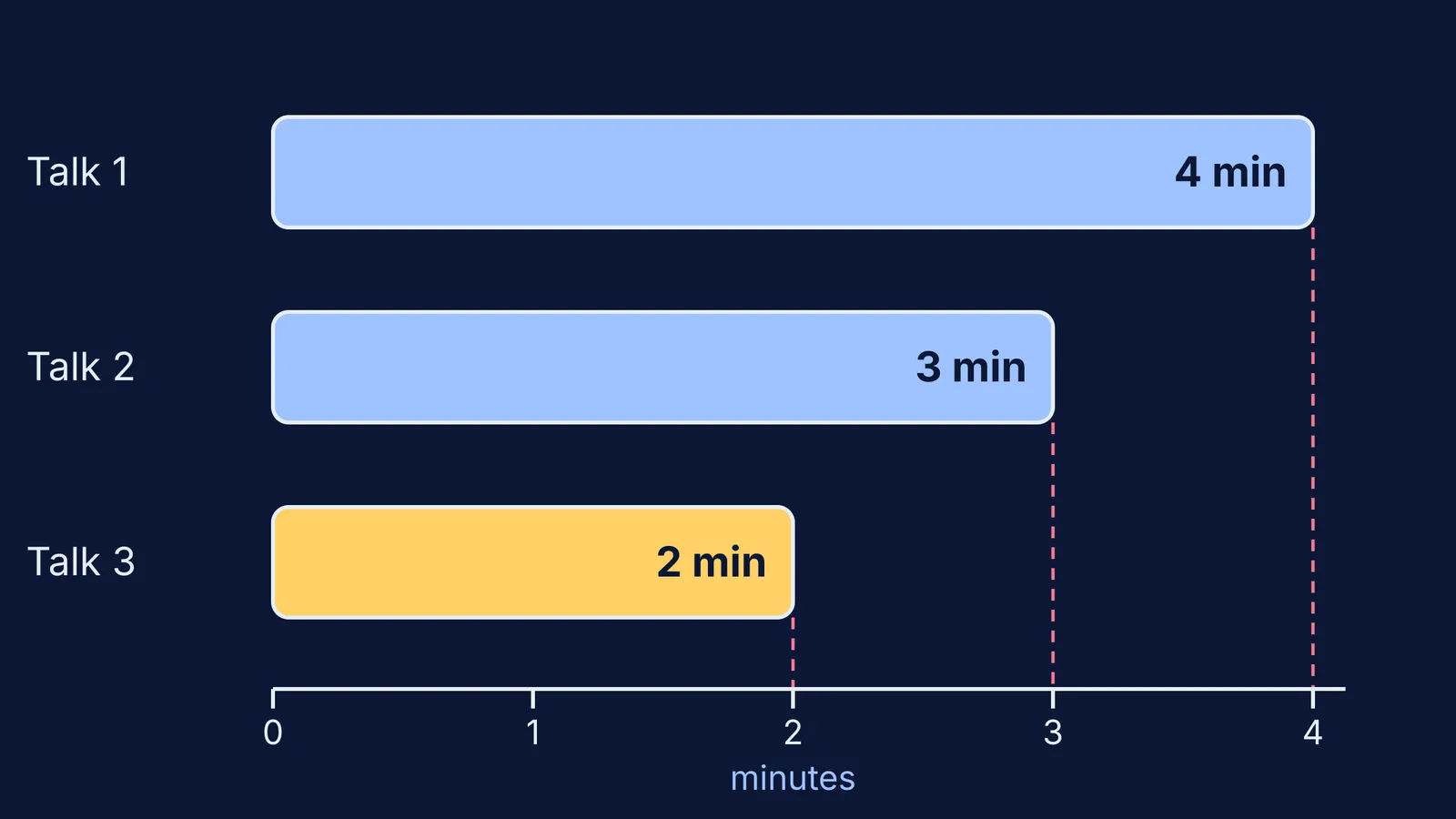
One routine with research behind it is timed retelling. In a study by Supot Arevart and Paul Nation, learners told the same story three times to different listeners, with less time for each retelling. They made substantial gains in speaking speed, hesitated less, and performed above their usual level of fluency. The routine is often called the 4/3/2 activity: four minutes, then three, then two.
You can do a version of it in your room:
Pick a topic you know well: today’s lab, a chapter you studied, the plot of a film.
Talk about it for four minutes into your phone’s voice recorder. Do not stop to fix mistakes.
Tell the same thing in three minutes, then in two.
Play back the last version. Note one word you were searching for and one sentence you would say differently. Use both tomorrow.
The study used real listeners, so when you can, retell to a roommate or friend instead.
What should you listen to, and how?
Listening gives you the phrases you will later say. Make it a short daily habit.
Listen to something in your own subject each day: a recorded lecture, a seminar, an explainer video.
Pick one sentence you liked. Pause, then say it aloud, copying the speaker’s rhythm and stress.
Keep a phrase notebook of useful chunks rather than single words: “What I mean is…”, “Could you say that again?”, “Let me put it another way.”
Where can you practise without fear of mistakes?
Climb a ladder, one rung at a time, and stay on a rung until it feels ordinary:
Alone: retelling, reading aloud, thinking aloud while you solve a problem.
One friendly person: English voice notes with a friend who is also practising.
Short, routine exchanges: the canteen counter, the library desk, your lab partner.
Class: one question a week.
A club, study group or short presentation.
Scripts to borrow:
To start a conversation: “Hi, I’m ___, first year, ___ branch. Which department are you in?”
When a word is missing: “I don’t know the English word, but it’s the thing that…”
To buy time: “Good question. Let me think for a second.”
To invite correction: “Did I say that right? Please tell me if not.”
If the language around campus is also new to you, read our guide to joining a college where you don’t speak the local language.
Our piece on why making mistakes helps you learn explains why.
A four-week plan to build spoken English
Week 1: one recorded 4/3/2 retelling a day, plus one listening sentence copied aloud.
Week 2: keep the retelling; add English voice notes with a friend.
Week 3: one short exchange in English every day, and one question in class.
Week 4: give a short talk in a club, study group or tutorial, using our guide to practising a science presentation with AI feedback.
Explaining a science idea aloud builds English and understanding together. For daily topics, pick a lesson from the Fermi Concept Library, which covers every concept in physics, chemistry, biology, mathematics and computing, and retell it in four, three and two minutes.
If fear of speaking is stopping you from attending class, eating with others or sleeping, talk to your college counsellor. You can also call Tele MANAS, the free 24x7 national mental health helpline launched by the Ministry of Health and Family Welfare, on 14416 or 1800-891-4416.
Start tonight: pick one topic, set a four-minute timer, and talk.