

On this page
Engineering students have long had to choose one path — Mechanical, Civil, or Computer Science — and stick to it. But the modern workplace rarely relies on just one discipline. A civil engineer who understands data science, or a mechanical engineer who knows robotics, often has a wider range of opportunities.
To bridge this gap, the All India Council for Technical Education (AICTE) introduced a flexible framework. You can now earn a minor degree alongside your primary BTech major, proving your competence in an entirely different field.
How many credits make a minor degree?
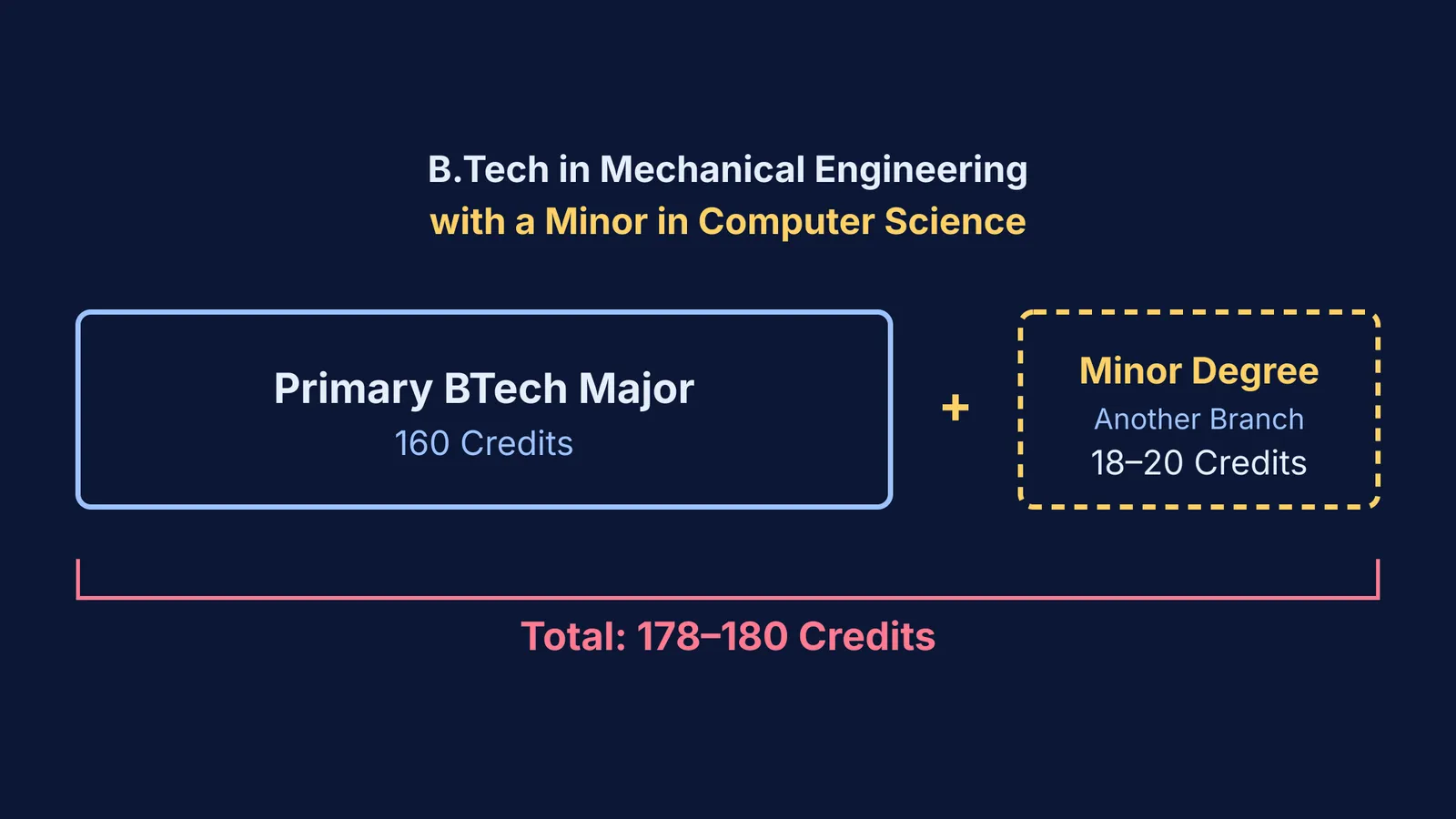
Your standard BTech curriculum demands 160 credits over four years. To graduate with a minor degree, you must earn 18 to 20 additional credits beyond your primary requirements.
This brings your total to 178 or 180 credits. Once completed, your final degree certificate will reflect both specialisations — for example, "B.Tech in Mechanical Engineering with a Minor in Computer Science".
Minor vs Honors: what is the difference?
While both require the same number of extra credits, they serve different purposes.
An Honors degree means you are studying your *own* branch in greater depth. A Computer Science student taking advanced AI courses offered by the CS department earns an Honors degree.
A Minor degree means you are studying subjects from a *different* department. If a Mechanical or Civil Engineering student takes those same AI courses, they earn a Minor degree in Artificial Intelligence.
Which minor specialisations can you choose?
The AICTE has developed model curricula for several emerging areas. Some of the most popular minor degrees include Artificial Intelligence and Machine Learning, Cyber Security, Data Science, Internet of Things (IoT), and Robotics.
You can also find minors in fields like 3D Printing, Blockchain, and Virtual Reality. The goal is to provide skills that the industry needs today. However, your choices will depend on what your specific university or college has been approved to offer. It is always wise to check your college's official academic regulations before deciding.
The workload: how many extra subjects?
Because a minor requires about 18 to 20 credits, you can expect to take several extra subjects.
Universities typically spread this load over the later years of your degree. This means you will study roughly one extra subject each term.
Many universities allow you to earn these credits online. You can complete proctored Massive Open Online Courses (MOOCs) on government platforms like SWAYAM or NPTEL. An eight-week NPTEL course generally translates to two credits, while a 12-week course is worth three.
How can you manage the extra coursework?
Studying for a minor degree often means you have to learn concepts that your main branch does not cover. For instance, a Mechanical Engineering student minoring in Data Science will have to learn advanced statistics and programming from scratch.
If you are struggling with a completely new subject, it helps to build a strong study routine. Start by mastering the basics before moving on to complex topics. Learning a chapter you've never understood requires you to actively read textbooks and test yourself frequently. Do not just reread the material; instead, try to explain it in your own words.
Does a minor degree help your career plans?
A minor degree gives you formal proof of an interdisciplinary skill. If you are applying for a job in a tech company but hold a core engineering degree, a minor in Data Science or Cyber Security signals to recruiters that you have formal training, not just a casual interest. It can also be an advantage when applying for research internships for science undergraduates in India.
However, taking on a minor means managing a heavier workload and studying unfamiliar concepts independently. This is where Fermi's AI tutor helps: when you encounter a new idea outside your core branch, the tutor can work out what you already know and build a plan for the session, so you sit down to a clear next step. You can also explore the Fermi Concept Library to catch up on the foundational mathematics or computing theory your minor subjects assume you know.
Earning a minor degree is an investment of time. If your career plans lie strictly within your core engineering branch, it may be better to focus on a high CGPA right from your first semester at science or engineering college. But if you want the flexibility to pivot across industries, those extra credits are a proven way to stand out.


